
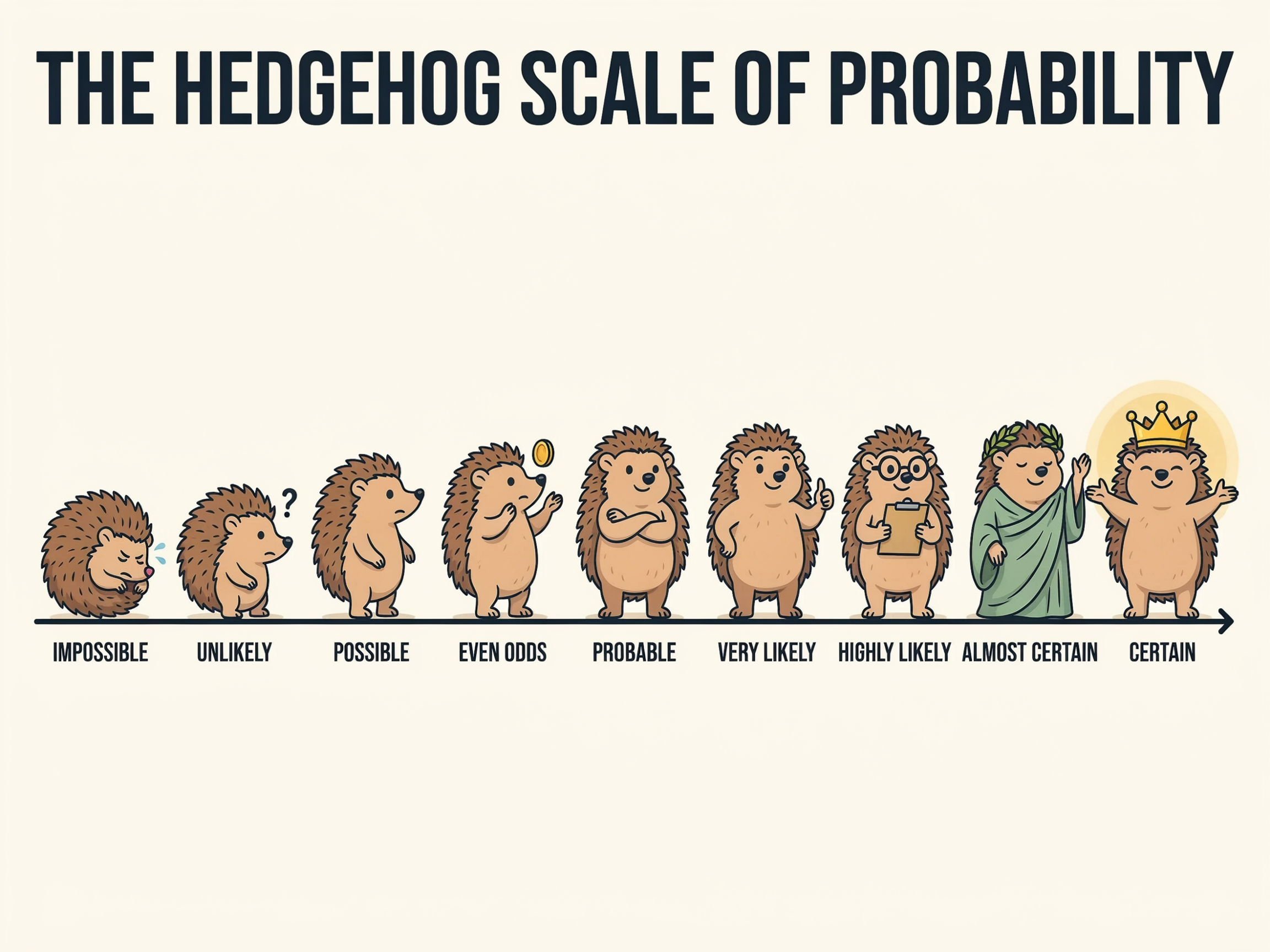
This essay started, as so many unnecessary intellectual adventures do, with yet another Facebook argument. I was discussing probability with someone who seemed perfectly comfortable assigning numerical odds to things for which no probability model existed. Since one of my points was that you can’t simply pull percentages out of thin air and call it analysis, I didn’t want to respond with percentages myself.
That sent me down a small rabbit hole. If I wasn’t going to say “70%” or “95%,” what exactly was the difference between fair, probable, likely, and highly likely? As it turns out, humanity has spent a remarkable amount of time creating verbal substitutes for uncertainty, and an equally remarkable amount of time misunderstanding them. Which brings us to confidence levels, those deceptively simple phrases that often tell us as much about the speaker as they do about the probability being discussed.
Yes indeed, human beings have spent centuries inventing words to avoid saying, “I don’t know.”
Some are elegant. Some are cautious. Some wear lab coats. Others show up at family dinners and start arguments. Yet all occupy the same ecological niche. They are verbal estimates of confidence.
Consider the ladder:
- Impossible: Cannot be true. (0%)
- Almost Certainly False: Extremely unlikely to be true, but not absolutely ruled out. (1% to 5%)
- Unlikely: More evidence against than for. (10% to 30%)
- Possible: Could be true, but evidence is insufficient to judge strongly either way. (20% to 50%)
- Fair Chance: A plausible outcome with roughly balanced prospects. (40% to 60%)
- Even Odds: Exactly as likely as not. (50%)
- Probable: More likely true than false. (55% to 70%)
- Likely: Strongly supported and expected to be true. (70% to 85%)
- Very Likely: Supported by substantial evidence. (85% to 95%)
- Highly Likely: Extremely well supported, with little reasonable doubt. (95% to 99%)
- Almost Certain: So strongly supported that only a remote possibility of error remains. (99%+)
- Certain: Absolute confidence with no possibility of error. (100%)At first glance, it looks scientific. In practice, it often resembles a weather forecast translated by a committee of philosophers.
Or with a useful way to picture the relationship:
Impossible → Unlikely → Possible → Even Odds → Probable → Likely → Very Likely → Highly Likely → Almost Certain → Certain
I have always been amused by the term fair chance. A fair chance of what? Success? Failure? Encountering a bear on a hiking trail? In everyday use it hovers somewhere around 40% to 60%, a probability cloud wearing hiking boots. Ask ten people what “fair chance” means and nine will answer differently while the tenth asks whether we are talking about baseball.
Science developed confidence language precisely because people are terrible at handling uncertainty. Early probability theory emerged from gambling problems in the seventeenth century, where losing money had remarkable power to improve quantitative reasoning (Hacking, The Emergence of Probability, 1975). By the twentieth century, statisticians increasingly preferred numerical probabilities over natural language because words drift. Numbers at least stay put.
Or so everyone hoped.
Then came weather forecasts. Studies repeatedly found that when meteorologists say “likely rain,” different audiences hear different probabilities, often varying by twenty points or more (Murphy et al., Probability Forecasting in Meteorology, 1980). One person’s “likely” is another person’s “maybe.” The sky remains indifferent.
If I had to attach rough probability ranges, they might look something like this:
- Impossible: 0%
- Almost certainly false: 1% to 5%
- Unlikely: 10% to 30%
- Possible: 20% to 50%
- Fair chance: 40% to 60%
- Even odds: 50%
- Probable: 55% to 70%
- Likely: 70% to 85%
- Very likely: 85% to 95%
- Highly likely: 95% to 99%
- Almost certain: 99%+
- Certain: 100%
Notice the overlap. That’s the joke. Language pretends these categories are neatly separated. Reality declines to participate.
Philosophy has wrestled with this problem for centuries. David Hume observed that much of human reasoning operates through probability rather than certainty. Outside mathematics and formal logic, absolute certainty is in surprisingly short supply (Hume, An Enquiry Concerning Human Understanding, 1748). The scientific revolution did not eliminate uncertainty. It professionalized it.
Even “certain” has a checkered history. Lord Kelvin expressed extraordinary confidence that physics was nearly complete shortly before relativity and quantum mechanics detonated that notion (Kuhn, The Structure of Scientific Revolutions, 1962). Nineteenth century physicians were certain diseases came from miasmas. They were wrong. Astronomers were certain the universe was eternal. Then cosmology happened.
I have learned to become suspicious whenever confidence reaches 100%. Nature has a habit of placing banana peels directly in front of certainty.
Of course, not everyone was satisfied with lining confidence up in neat verbal boxes. Some thinkers looked at terms like likely, probable, and almost certain and concluded that reality was far messier than the dictionary suggested. Bayesian reasoning treats confidence less like a fixed label and more like a running score that updates as new evidence arrives. Imagine a hiker in the Cascades hearing rustling in the brush. Initially, “bear” might seem unlikely. Then comes a large footprint. Now it’s probable. Then comes the unmistakable smell and a glimpse of brown fur. Suddenly “highly likely” starts feeling inadequate, and “where are my car keys?” becomes the dominant inference. Bayesian thinking is essentially the art of constantly renegotiating certainty with the universe.
Fuzzy logic took a different route. Rather than asking whether a statement is true or false, it asks how true it is. This is remarkably close to how humans already use confidence words. Consider the statement, “It is raining.” In ordinary logic, either it is or it isn’t. In fuzzy logic, a Pacific Northwesterner standing in a light mist may assign the answer a value somewhere between “technically yes” and “don’t be dramatic.” The entire framework feels less like mathematics and more like a committee meeting between engineers and weather enthusiasts, yet it turns out to be remarkably useful for dealing with vague categories that resist crisp boundaries.
Then there is Dempster-Shafer Theory, a system apparently developed for people who looked at probability and decided it was expressing far too much confidence. Traditional probability often forces you to distribute certainty among competing possibilities. Dempster-Shafer allows you to explicitly reserve belief for “I don’t know.” If Bayesian reasoning is the cautious detective, Dempster-Shafer is the detective staring at the evidence board and refusing to arrest anyone until the coffee arrives. In a world filled with fuzzy confidence terms, it occupies an oddly refreshing position. Sometimes the most honest estimate is not likely or unlikely. Sometimes it is simply an acknowledgment that the evidence has not yet earned a more ambitious adjective.
The legal world developed its own hierarchy. “Preponderance of evidence” effectively means slightly above 50%. “Clear and convincing evidence” means substantially higher. “Beyond a reasonable doubt” sounds like certainty but intentionally stops short of it. Lawyers discovered the same thing scientists did. Human knowledge arrives mostly in shades of gray.
The real trouble begins when people hear confidence terms as declarations instead of estimates. “Likely” becomes “proven.” “Possible” becomes “therefore true.” “Unlikely” becomes “impossible.” Entire public controversies have emerged from these linguistic mutations. The history of risk communication is littered with misunderstandings born from innocent looking words.
A curious feature of confidence language is that every term carries emotional baggage. “Possible” sounds hopeful. “Unlikely” sounds dismissive. “Highly likely” sounds authoritative. Yet none of those reactions come from probability itself. They come from us.
Perhaps that is why confidence scales persist despite their flaws. They occupy a peculiar middle ground between mathematics and conversation. Numbers satisfy precision. Words satisfy people.
And somewhere between “possible” and “almost certain,” between scientific caution and human impatience, sits most of what we actually know.
Not certainty. Not ignorance.
Just educated guessing with better vocabulary.
References
- Hacking, Ian. The Emergence of Probability. 1975.
- Hume, David. An Enquiry Concerning Human Understanding. 1748.
- Kuhn, Thomas S. The Structure of Scientific Revolutions. 1962.
- Murphy, Allan H., et al. Probability Forecasting in Meteorology. 1980.

Leave a Reply