
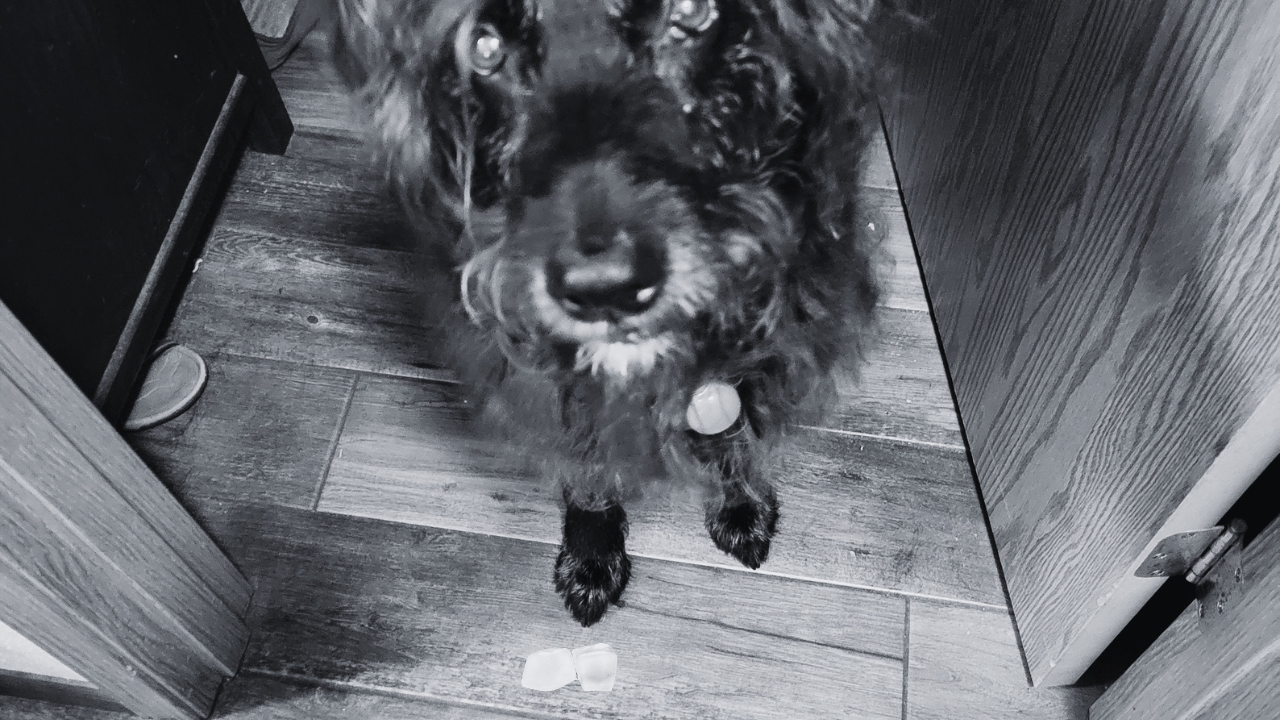
A dog can hear a cheese wrapper open from somewhere beyond the detectable limits of physics. Not hear it, exactly. Experience it. Absorb it. The dog who was asleep three rooms away suddenly materializes beside your leg with the quiet certainty of a monk arriving at evening prayer.
I’ve always found that fascinating.
Humans like to imagine ritual as something elevated. A cathedral, a meditation cushion, a wedding ceremony. Yet watch a dog when the treat jar appears. There is anticipation, formalized behavior, repetition, expectation of reward, and a shared social script. If anthropologists observed a newly discovered tribe standing in a semicircle every evening while an elder distributed sacred biscuits after prescribed gestures, they would immediately begin discussing ritual structure (Durkheim, The Elementary Forms of Religious Life, 1912; Rappaport, Ritual and Religion in the Making of Humanity, 1999).
The dog sits.
The human says “shake.”
The paw rises.
The offering descends.
Meaning floods the event.
An interesting question lurks underneath all of this: can ritual behavior itself evolve? It seems entirely plausible. Dogs are descendants of animals whose survival depended on navigating complex social relationships, anticipating the actions of others, and responding predictably within a group. Behaviors that established trust, reduced conflict, communicated intent, or reinforced social cohesion would have carried obvious advantages. A ritualized greeting, a predictable submissive display, or even the familiar sequence surrounding treats may not have evolved because the ritual had symbolic meaning, but because repetition made social life run more smoothly. The meaning came later, not unlike many human customs whose origins have long since been forgotten while the practices themselves endure.
Looking at dogs, I sometimes wonder whether ritual is less a product of intelligence than of sociality. Humans often assume ritual emerges only after language, theology, or abstract thought arrive on the scene. Yet dogs repeatedly demonstrate that patterned behavior can create expectations, strengthen relationships, and reduce uncertainty without any formal doctrine attached. The dog’s pre-walk dance, the ceremonial inspection of a treat before eating it, the insistence on greeting each household member in a precise order all suggest that ritual may be an evolutionary tool before it becomes a cultural one. Human beings layered stories onto ritual. Dogs may reveal what ritual looked like before the stories arrived.
For the human, the ritual often means training, affection, or good behavior. For the dog, perhaps the meaning is not symbolic but participatory. A dog lives largely in recurring patterns. The walk begins with the leash. Dinner arrives after sounds from the kitchen. Visitors produce a greeting ceremony involving circling, sniffing, and apparent enthusiasm beyond all reasonable limits. Rituals seem less like decorations on canine life and more like part of the architecture.
Human rituals frequently reduce uncertainty and strengthen social bonds (Hobson et al., The Psychology of Rituals, 2018). Dog behavior often appears to do something similar. Many dogs perform familiar sequences when stressed. They carry the same toy, visit the same location, pace a familiar path. Some arrange blankets with almost religious dedication. I once watched a dog spend ten minutes preparing a bed before collapsing sideways onto a hardwood floor instead. The effort clearly mattered more than the outcome.
That feels strangely familiar.
Humans also perform actions whose practical value is secondary to their social and psychological function. Graduation gowns do not improve education. Wedding rings do not create commitment. Standing for a national anthem does not alter the physical world. Yet these actions communicate membership, continuity, and belonging.
Dogs may be doing something analogous, though perhaps not identical.
My own dog has spent years providing counterarguments whenever I get too confident about simple explanations.
Consider the ice cube ritual.
Whenever an extra cube escapes the dispenser and lands on the floor, she approaches with exaggerated caution. The remarkable part is that she waits until nobody appears to be watching. If I look directly at her, she immediately drops the cube and adopts an expression of complete innocence.
The moment attention shifts elsewhere, the cube vanishes.
We initially assumed this was a summer behavior. Cold object, hot dog, problem solved.
Then winter arrived. The ritual continued uninterrupted.
Later we would discover wet circular spots on the carpet, usually near her favorite sleeping locations, each one suspiciously the size of a melted ice cube.
Twelve years of observation have not clarified the meaning of this performance. If anything, the mystery has deepened.
The feeding ritual is even stranger.
When she was about ten weeks old, my spouse put up a hand to stop her from rushing a food bowl. That single gesture became the foundation of a remarkably durable social rule.
Twelve years later she still waits for an invitation before eating.
Not a command. Not a spoken sentence. An invitation.
What fascinates me is that the signal itself appears negotiable while the ritual remains fixed.
When she stayed with a sitter, she refused to begin eating until given permission. The sitter eventually developed a different signal that she accepted without hesitation.
Apparently the exact gesture was never sacred. The structure was.
Something about waiting, receiving acknowledgment, and then beginning the meal mattered enough that she carried the pattern into an entirely different social environment.
Humans do something surprisingly similar. The specific form of a ritual often changes while its function remains intact. Different cultures use different words, gestures, symbols, and ceremonies. Yet the underlying pattern persists. Recognition precedes participation. Permission precedes action. The framework survives even when the symbols change.
The most intriguing moments emerge around human emotional displays. Research suggests dogs are sensitive to human vocal tones, gestures, and emotional cues (Horowitz, Inside of a Dog, 2009; Hare & Woods, The Genius of Dogs, 2013). Many owners have experienced a peculiar scene. Someone becomes angry. The dog lowers posture, approaches cautiously, or inserts itself between people.
What exactly is happening?
The easy answer is conditioning. The more interesting question is whether we stop there because conditioning sounds comfortably mechanical.
Humans have a habit of drawing consciousness boundaries just beyond whatever animals currently demonstrate. Tool use once distinguished humans. Then other species used tools. Self recognition was proposed. Then some animals passed versions of that test. Problem solving, planning, communication. The fence keeps moving.
I sometimes wonder whether anthropocentrism functions as a ritual of its own. We repeatedly gather around the sacred proposition that human minds are categorically different, perform the customary distinctions, and then retreat before inconvenient observations.
Dogs complicate the story.
Consider embarrassment. Dogs occasionally display behaviors that many owners interpret as embarrassment after social mishaps. Scientists debate whether this reflects a human-like internal state or a response to social cues (Horowitz, Domestic Dog Cognition and Behavior, 2014). The debate itself reveals something curious. We readily attribute complex unseen states to human beings. We become remarkably cautious when discussing a dog.
The hesitation may say as much about us as about them.
Questions of spirituality slip in through the side door. Not because dogs possess theology. A Labrador has never written a treatise on metaphysics. Yet spirituality often concerns relationship, presence, repetition, and participation in larger patterns. Dogs excel at those things.
A dog greeting a returning human after ten minutes and after ten months with nearly identical enthusiasm occupies a world that is deeply relational. Meaning appears less located in abstract propositions than in enacted connection.
Perhaps consciousness is not a ladder with humans standing smugly on the highest rung. Perhaps it resembles a landscape with different forms of experience distributed across it.
A dog waiting patiently by a doorway where a favorite person usually appears may not be contemplating existence. Then again, most humans are not contemplating existence while standing in line for coffee. Yet both are participating in systems of expectation, significance, and ritual.
The dog watches the door.
The human watches the phone.
Each waits for something meaningful.
One of them is probably wiser.
References
- Durkheim, Émile. The Elementary Forms of Religious Life. 1912.
- Hare, Brian, & Woods, Vanessa. The Genius of Dogs. 2013.
- Hobson, N. M., et al. The Psychology of Rituals: An Integrative Review and Process-Based Framework. 2018.
- Horowitz, Alexandra. Inside of a Dog. 2009.
- Horowitz, Alexandra (ed.). Domestic Dog Cognition and Behavior. 2014.
- Rappaport, Roy A. Ritual and Religion in the Making of Humanity. 1999.

Leave a Reply