
A few weeks ago, after encountering what felt like the nine-thousandth social media argument about atheism, evolution, science, God, evidence, morality, fossils, consciousness, and occasionally dinosaurs on Noah’s Ark, I started jotting things down.
Not rigorously. This was not peer reviewed. No institutional grant was involved. Mostly it consisted of me staring at comment sections and wondering whether the internet had accidentally become a fallacy breeding program.
After a couple of weeks, certain patterns emerged. The same mistakes showed up again and again. Different people. Different pages. Different topics. Same arguments. It was a bit like discovering that half of online discourse is five raccoons in a trench coat.
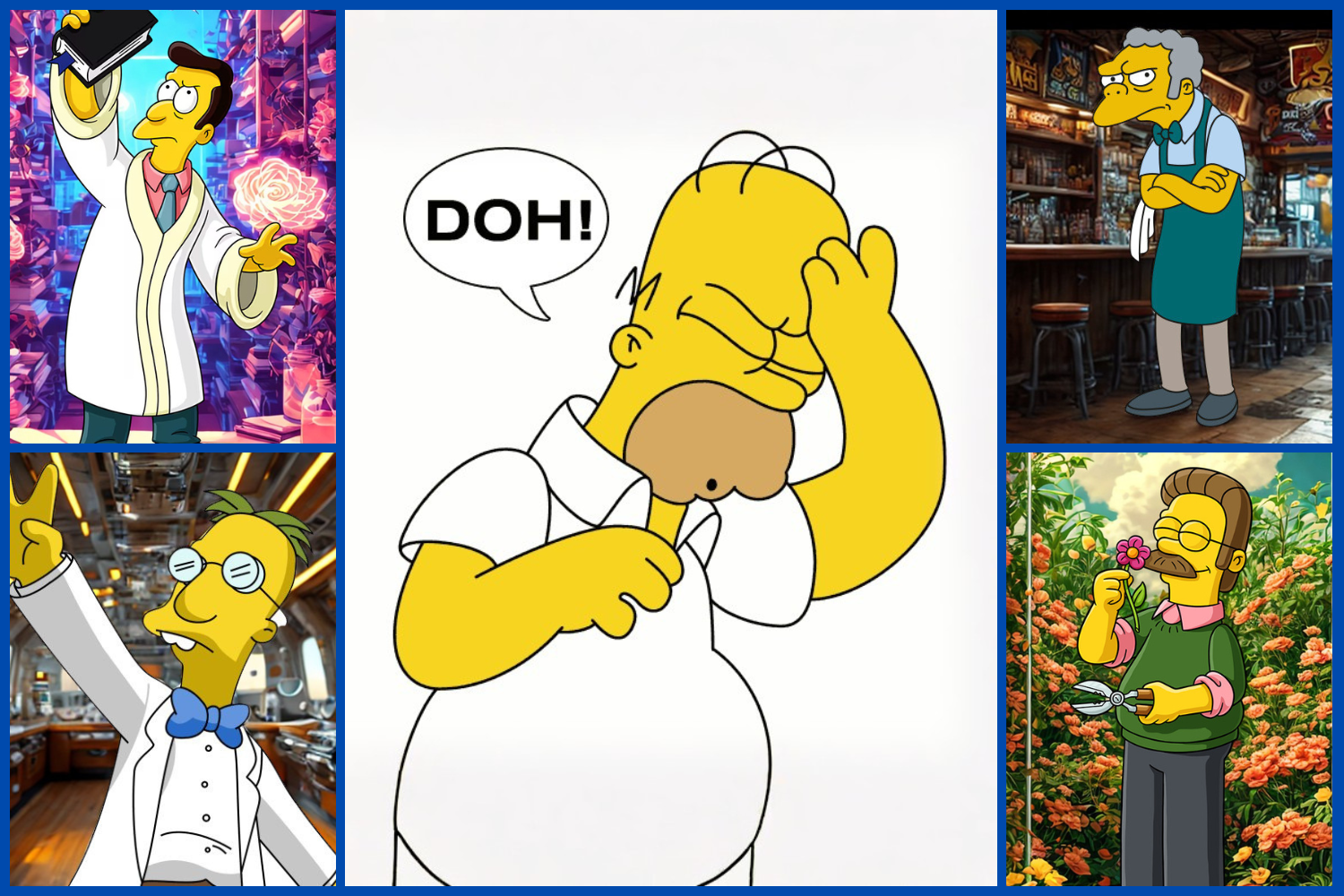
There were plenty of contenders. Straw men. Equivocation. Circular reasoning. Moving the goalposts. Those deserve their own essay someday. For now, these were the five most frequent fallacies I encountered in arguments against atheism or science. Oh, and I added some Simpson’s comparison so those who are more cartoon motivated can follow along.
The Special Pleading Shuffle
Special pleading occurs when someone creates a rule and then exempts their preferred conclusion from the rule without justification (Blackburn, Oxford Dictionary of Philosophy, 2016).
The classic example arrives wearing the theological equivalent of a fake mustache.
“Everything that exists must have a cause.”
“Okay. What caused God?”
“God doesn’t need a cause.”
At that point the rule has survived approximately twelve seconds.
The argument resembles Reverend Lovejoy from The Simpsons. The rules are firm. Universal. Non negotiable. Until they become inconvenient. Then exceptions mysteriously appear like a previously undiscovered book of scripture.
The giveaway is simple. Apply the same standard to every claim. If one proposition receives diplomatic immunity while all others must pass inspection, special pleading has entered the chat.
God of the Gaps and the Expanding Frontier
The God of the Gaps argument takes an unanswered question and inserts God into the empty space (Draper, Stanford Encyclopedia of Philosophy, 2021).
“Science can’t explain consciousness.”
“Therefore God.”
“Science can’t explain the beginning of the universe.”
“Therefore God.”
That conclusion never actually follows.
Moe Szyslak would love this argument. A strange noise comes from the basement. Rather than investigate, Moe immediately declares it supernatural and returns to serving beverages.
The pattern is recognizable because ignorance becomes evidence. A knowledge gap is transformed into proof. Yet unanswered questions only demonstrate that something remains unexplained. They do not identify the explanation.
The counter is straightforward.
Ask how the conclusion was established.
Not imagined. Not preferred. Established.
The Burden of Proof Hot Potato
One of the most common social media maneuvers involves throwing responsibility at someone else.
“You can’t prove God doesn’t exist.”
“You can’t prove invisible dragons don’t exist.”
“You can’t disprove miracles.”
This is burden shifting.
The person making the claim is responsible for supporting it (Flew, The Presumption of Atheism, 1976).
This has strong Homer Simpson energy.
Homer announces he has discovered a magical chair spirit living in the garage.
When asked for evidence, Homer demands that everyone else disprove it.
The easiest way to identify this fallacy is to ask who introduced the claim in the first place. Evidence flows from the claimant outward. It does not flow from every skeptic inward.
The False Dichotomy Factory
Social media loves presenting two options when dozens exist.
“Either evolution is true or God created life.”
“Either morality comes from God or morality doesn’t exist.”
“Either atheism is correct or Christianity is correct.”
This fallacy manufactures a choice where none exists (Copi et al., Introduction to Logic, 2016).
Think of Ned Flanders standing beside a sign that reads:
“Choose wisely!”
The sign points left and right.
Unfortunately there are seventeen other roads hidden behind a shrub.
Even if evolution were disproven tomorrow, that would not establish a particular deity. Even if one religious tradition were false, that would not validate another. Reality is not obligated to conform to a two option multiple choice test.
The Argument from Ignorance
This one may be the internet’s favorite.
“No one has disproven God.”
“Therefore God exists.”
“No one has disproven miracles.”
“Therefore miracles occur.”
“No one has disproven my theory.”
“Therefore it is true.”
The structure never changes.
Professor Frink would immediately spot the problem. Lack of disproof does not produce proof. Absence of evidence is not evidence for whatever idea happens to be waiting nearby (Walton, Informal Logic, 1996).
This fallacy often survives because it feels intuitively persuasive. The unknown creates discomfort. Humans like answers.
Reality, meanwhile, remains stubbornly indifferent.
Why These Five Keep Appearing
The thing that struck me during my informal survey was not merely how often these arguments appeared. It was how frequently they appeared together.
A comment would begin with a God of the Gaps argument, shift the burden of proof, invoke special pleading, present a false dichotomy, and conclude with an argument from ignorance. Like watching Mr. Burns assemble the world’s least reliable logical megazord.
None of these fallacies demonstrate that a conclusion is false.
They demonstrate that the path leading to the conclusion is defective.
Which matters.
Because a good argument should be able to survive without shortcuts, exemptions, rhetorical traps, or appeals to uncertainty.
And judging by the notes I accumulated over those weeks, there is an entire zoo of additional fallacies still roaming freely through comment sections. Those will have to wait for another essay.
References
- Blackburn, Simon. The Oxford Dictionary of Philosophy. 2016.
- Copi, Irving M., Cohen, Carl, & McMahon, Kenneth. Introduction to Logic. 2016.
- Draper, Paul. God, Arguments for the Existence of. Stanford Encyclopedia of Philosophy. 2021.
- Flew, Antony. The Presumption of Atheism. 1976.
- Walton, Douglas. Arguments from Ignorance. Informal Logic. 1996.

Leave a Reply