
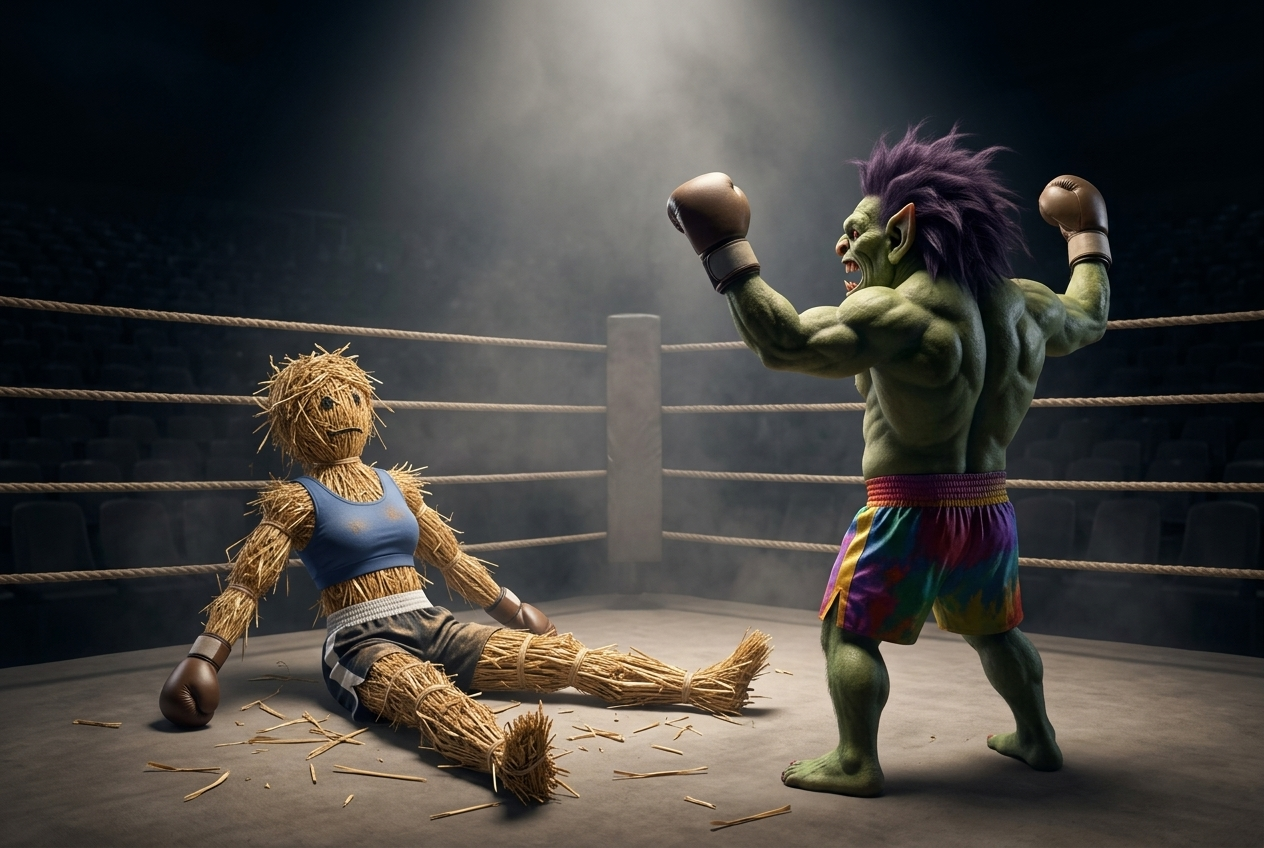
The other day, while wandering through Facebook for reasons I still cannot adequately defend, I stumbled into a discussion between a friend of mine and a local legend. Not a legend in the heroic sense, mind you. More like the sort of legend campers tell around a fire to warn each other what happens when someone mistakes confidence for expertise.
This individual had long appointed himself the sole ambassador of Western Civilization, the unofficial spokesperson for all God-fearing Christians, and apparently the final authority on philosophy. If Plato, Aquinas, and Aristotle were somehow fused together and then given a Facebook account, he seemed convinced the result would still be taking notes from him.
The discussion itself began innocently enough. My friend made a modest claim, the kind of statement that ordinary people would either agree with, disagree with, or scroll past without incident.
Friend: “I think it can be helpful to understand multiple philosophical traditions before deciding which one is correct.”
Strawman User: “So you’re saying truth doesn’t matter and all beliefs are equally valid.”
Friend: “No, I’m saying it helps to understand something before criticizing it.”
Strawman User: “Interesting. So now you’re arguing that nobody should criticize anything.”
Friend: “That isn’t remotely what I said.”
Strawman User: “Typical relativism.”
At this point the discussion continued for several paragraphs, each one containing less connection to the previous statement than the last. Every clarification generated a fresh misunderstanding, and every misunderstanding arrived with the confidence of divine revelation.
Watching this unfold, I realized that many observers might struggle to follow the exchange. So for everyone, I summarized this exchange into a core, no matter how rotten, that people can consume:
The Strawman That Wasn’t: A Completely Reasonable Defense
People often accuse others of using strawman arguments, but I contend that the strawman argument is not actually a strawman argument. In fact, the very suggestion that it is a strawman argument demonstrates a misunderstanding of what a strawman argument is, which proves my point before I have even made it.
Consider a typical debate. Suppose one person says, “I think we should add more benches to public parks.” Immediately, another person may respond, “So you’re saying every square inch of the city should be covered in benches and nobody should ever stand again?” Critics call this a strawman. However, this criticism falls apart under careful examination. The second person is merely discussing the inevitable and logically necessary conclusion of adding benches: infinite benches.
A skeptic may object that the original person never advocated infinite benches. But that objection ignores the fact that I am not discussing what they said. I am discussing what they would have said if they had fully thought through their position, adopted my assumptions, ignored reality, and agreed with me. Therefore my version is clearly more representative than theirs.
Furthermore, if a strawman argument were truly a strawman, it would be made of straw. Yet arguments are made of words. Last time I checked, dictionaries are not harvested from fields. Since no actual straw is present, the term itself is misleading. Consequently, anything called a strawman argument cannot really be a strawman argument.
Some philosophers might point out that this reasoning confuses a metaphor with a literal object. However, those philosophers are obviously claiming that all metaphors are lies and should be outlawed. This extreme position is unreasonable, so their criticism can safely be dismissed.
Another important fact is that strawman arguments are very easy to defeat. If I replace my opponent’s nuanced position with a ridiculous one, I can defeat it in seconds. The ease of victory suggests intellectual efficiency. And because efficient things are usually good, the strawman argument must also be good. Since good things should not be criticized, calling it a strawman argument is unfair criticism. Therefore it is not a strawman argument.
In conclusion, a strawman argument is not a strawman argument because the exaggerated version of your opponent’s claim is obviously their real claim, words are not straw, critics secretly oppose all metaphors, and winning easily is the same thing as being correct. Anyone who disagrees is claiming that scarecrows deserve legal rights, which is a debate for another day.
Having completed this compression process, I feel compelled to discuss the curious honesty of dishonesty.
A normal lie attempts to conceal itself. It hopes to pass unnoticed. The strawman argument, on the other hand, possesses a sort of cheerful transparency. It drags its victim onto the stage, replaces them with a scarecrow wearing a crude name tag, and then triumphantly challenges the audience to observe how easily the scarecrow can be defeated.
There is, in a strange way, something almost admirable about this. Not morally admirable, of course. More mechanically admirable. Like watching a burglar arrive in a van labeled “CRIME DELIVERY SERVICE” and being impressed by the absence of subtlety.
By the end of the Facebook exchange, my friend had exhausted every possible method of clarification. Definitions were provided. Context was explained. Qualifications were added. Yet somehow every statement emerged from the other side transformed into a more absurd version of itself.
The lesson, if there is one, is not merely that strawman arguments are dishonest. It is that they occupy a peculiar category of dishonesty that remains convinced of its own virtue. The practitioner is not satisfied with defeating an opponent. He must first construct an easier opponent and then congratulate himself for the efficiency of the victory.
And thus our philosopher-king of Facebook rode triumphantly into the sunset, having once again defended Western Civilization from opinions nobody actually held. Meanwhile, the rest of us were left marveling at the remarkable feat we had just witnessed: a man winning an argument against an imaginary person while a real person stood nearby waiting for their turn to speak.
In fairness, that imaginary person never stood a chance.
And my challenge to the readers… who was this Strawman User? Are you sure it wasn’t you?
References
Aristotle. On Sophistical Refutations. Translated by E. S. Forster, Harvard University Press, 1955.
Bennett, Bo. Logically Fallacious: The Ultimate Collection of Over 300 Logical Fallacies. eBookIt.com, 2012.
Copi, Irving M., Carl Cohen, and Kenneth McMahon. Introduction to Logic. 14th ed., Pearson, 2011.
Dowden, Bradley. “Straw Man Fallacy.” Internet Encyclopedia of Philosophy, https://iep.utm.edu/fallacy/. Accessed 5 Aug. 2026.
Philosopher-King, Facebook. Collected Victories Over Arguments Nobody Actually Made. Imaginary Press, n.d.
Engel, S. Morris. With Good Reason: An Introduction to Informal Fallacies. 6th ed., Bedford/St. Martin’s, 1994.
Hurley, Patrick J. A Concise Introduction to Logic. 13th ed., Cengage Learning, 2021.
Kahane, Howard, Nancy Cavender, and Thomas M. Johnson. Logic and Contemporary Rhetoric: The Use of Reason in Everyday Life. 13th ed., Cengage Learning, 2014.
Anonymous Commenter. “Source: Trust Me, Bro.” Journal of Internet Certainty, vol. 404, no. 1, pp. 1-1.
Walton, Douglas N. Informal Logic: A Pragmatic Approach. 2nd ed., Cambridge University Press, 2008.
Walton, Douglas N. Methods of Argumentation. Cambridge University Press, 2013.

Leave a Reply