
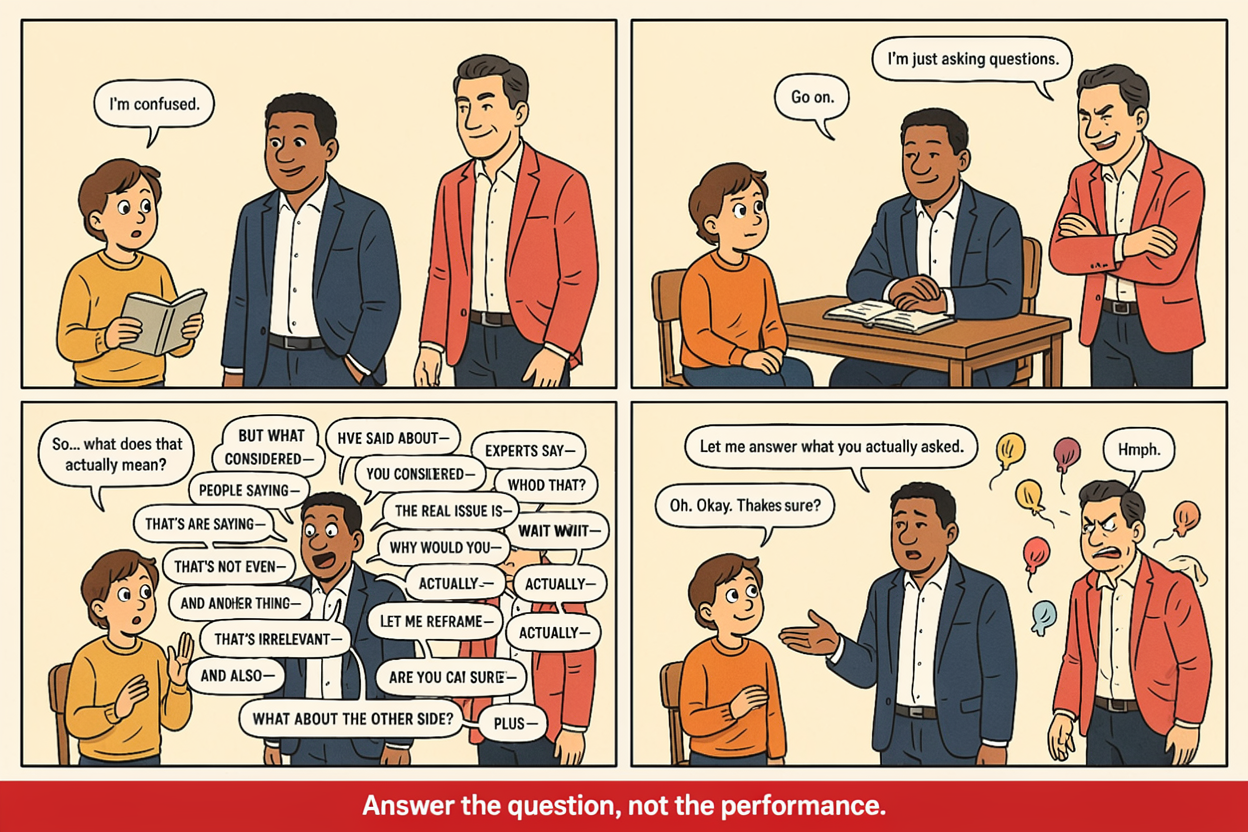
Beating the Illusory Truth Effect and the Refutation Burden of Propaganda
Some lies do not win because they are convincing. They win because they are still standing after everyone else gets tired. That sounds cynical, and maybe it is, but after spending enough time watching pseudoscience ricochet across social media or hearing the same debunked claim repeated on podcasts, radio shows, and neighborhood Facebook groups, it is hard to arrive at a more cheerful conclusion.
The modern information environment runs on two psychological vulnerabilities. The first is the illusory truth effect, our tendency to mistake familiarity for accuracy. The second is what is often called the bullshit asymmetry principle, or Brandolini’s Law, the observation that disproving nonsense requires far more effort than producing it (Brandolini’s Law, 2013). Together they form a remarkably efficient machine for spreading pseudoscience, conspiracy theories, and propaganda.
The disturbing thing is that neither mechanism depends on intelligence. Smart people fall for both. Experts fall for both. I have watched engineers, physicians, and academics share claims they would normally dismantle if they encountered them in a textbook. The problem is not stupidity. The problem is that human cognition evolved for efficiency, not for constant fact-checking.
The illusory truth effect was first demonstrated experimentally by psychologists Lynn Hasher, David Goldstein, and Thomas Toppino in 1977. They found that simply repeating a statement increased participants’ perception that the statement was true, regardless of whether it was actually true or false (Hasher, Goldstein & Toppino, Frequency and the Conference of Referential Validity, 1977). Familiarity created a feeling of correctness. A sentence heard several times seemed more credible than a sentence encountered once.
Think about how strange that is. Nothing about the evidence changes. Nothing about reality changes. Only repetition changes.
Yet repetition alters judgment.
This helps explain why misinformation campaigns rarely rely on elegant arguments. They rely on volume. If someone posts that vaccines cause autism, that climate change is a hoax, or that a miracle supplement cures chronic disease, the statement gains power every time it is encountered. Even when people initially reject the claim, repeated exposure increases processing fluency, making the statement feel easier to understand and recall. Unfortunately, the brain often interprets that ease as truthfulness (Fazio et al., Knowledge Does Not Protect Against Illusory Truth, 2015).
Propagandists discovered this reality long before psychologists measured it. State propaganda in the twentieth century frequently revolved around relentless repetition. The slogan mattered more than the argument. The message appeared on posters, radio broadcasts, newspapers, public speeches, and classroom walls. The goal was not persuasion through evidence. The goal was familiarity.
A claim repeated a thousand times begins to feel like common sense.
That should worry you.
One of the more troubling aspects of the illusory truth effect is how strongly it can shape the thinking of children. Young people are still constructing their understanding of how knowledge works, which means repetition often serves as a shortcut for credibility. A child who hears a claim from classmates, YouTube personalities, and family members may absorb it long before possessing the tools needed to evaluate it. Research on cognitive development suggests that familiar statements are often accepted more readily than unfamiliar ones, even when evidence is absent (Fazio et al., Knowledge Does Not Protect Against Illusory Truth, 2015; Brashier & Marsh, Judging Truth, 2020). The result is not merely mistaken beliefs. It is the formation of habits of thought. If familiarity becomes the standard for truth early in life, separating evidence from popularity becomes increasingly difficult later. Anyone who has tried correcting a deeply rooted misconception in a high school classroom knows the frustration. Students are often not defending evidence. They are defending something that has simply been around for as long as they can remember.
Ask yourself a simple question: how many beliefs do you hold because you investigated them personally, and how many simply feel true because you have encountered them repeatedly?
That question always makes me uncomfortable.
The illusory truth effect becomes particularly dangerous when combined with pseudoscience. Consider the long-running vaccine-autism myth. The claim originated from Andrew Wakefield’s now-retracted 1998 paper and has been repeatedly debunked through large-scale epidemiological studies showing no causal connection (Deer, The Doctor Who Fooled the World, 2020; CDC, Vaccine Safety Research). Yet the myth remains alive because repetition keeps refreshing familiarity. Even people who cannot cite evidence often recognize the claim.
Recognition should never be mistaken for validation.
That distinction sounds obvious until one notices how often society fails to make it.
The second weapon of misinformation is equally potent. Alberto Brandolini articulated what became known as Brandolini’s Law in 2013: the amount of energy needed to refute nonsense is an order of magnitude greater than the amount needed to create it (Brandolini, 2013). The observation seems almost embarrassingly simple, which is probably why it resonates so strongly.
Anyone can invent a conspiracy theory in thirty seconds.
Demonstrating why the conspiracy theory is wrong may require thousands of pages of evidence, multiple expert disciplines, statistical analysis, and weeks of work.
A flat-earth video can be uploaded in an afternoon. Refuting it requires knowledge of astronomy, navigation, physics, mathematics, satellite systems, and centuries of accumulated observation. The asymmetry is brutal.
I have noticed something else. The refuter is usually expected to be patient, precise, sourced, and complete. The propagandist is expected to be entertaining. That is not a fair fight.
The tactic becomes even more effective through what debaters call the Gish Gallop. Instead of making one false claim, the speaker produces dozens. Each individual point may be weak, but collectively they overwhelm the audience. Refuting every claim becomes practically impossible. The audience notices only that one side seems energetic and the other side seems exhausted.
Exhaustion is the point.
So how do we defeat these forces?
First, stop fighting on the terrain chosen by propagandists. Many people assume every false claim deserves a detailed rebuttal. It does not. The most effective response often involves identifying the core falsehood and addressing that central error directly. A hundred weak claims can usually be traced back to one unsupported premise.
A useful example comes from climate change denial. A propagandist might rattle off dozens of talking points in rapid succession: climate has always changed, scientists were supposedly predicting an ice age in the 1970s, volcanoes emit more carbon dioxide than humans, temperature records are manipulated, and renewable energy supposedly cannot work. The temptation is to answer every point individually. That approach almost guarantees exhaustion. A more effective response identifies the common thread connecting the entire barrage: the claim that there is no reliable evidence linking modern warming to human activity. Once that unsupported premise is exposed, the discussion becomes much simpler. The response can focus on the overwhelming and independently verified evidence that atmospheric carbon dioxide has increased dramatically due to human emissions and that this increase is driving current warming. The dozens of peripheral claims suddenly lose much of their relevance.
The contrast is stark.
False claim:
“There are so many unanswered questions and contradictory facts about climate science that we cannot know what is causing current warming.”
Effective response:
“The central question is not whether every detail has been resolved. The central question is whether multiple independent lines of evidence point to human-caused warming. They do.”
By concentrating on the primary unsupported assumption, the rebuttal avoids getting trapped in a marathon of fact-checking. The audience receives a clear framework instead of a tedious list of corrections. Propaganda often succeeds by multiplying arguments. Effective skepticism succeeds by identifying the load-bearing falsehood holding those arguments together.
Second, lead with the truth rather than the myth. Research on misinformation correction consistently suggests that repeating falsehoods can inadvertently reinforce familiarity. Effective correction starts with accurate information, introduces the misinformation only briefly, and then immediately replaces it with evidence-supported explanations (Cook & Lewandowsky, The Debunking Handbook, 2020).
A classic example involves vaccine misinformation. Many people instinctively begin a rebuttal by repeating the myth: “Vaccines do not cause autism.” While well intentioned, that framing repeats the false claim and places it at the center of the discussion. A truth-first correction starts somewhere else entirely. It begins with the evidence: extensive research involving hundreds of thousands of children has found no connection between routine childhood vaccines and autism. Autism develops through complex biological and developmental factors that are not caused by vaccination. Only after establishing those facts does the response briefly acknowledge that some people continue to claim otherwise. The truth becomes the headline. The myth becomes a footnote.
The difference is subtle but powerful.
False claim:
“Vaccines cause autism.”
Less effective response:
“No, vaccines do not cause autism because…”
Effective response:
“Large-scale medical research has consistently found that vaccines are safe and do not affect whether a child develops autism. The autism-vaccine claim originated from a study that was later retracted.”
Notice how the second response gives the audience accurate information to remember rather than a falsehood to mentally revisit. When people leave the conversation hours later, what do you want echoing in their minds: the myth or the evidence? Truth-first rebuttals answer that question from the very first sentence.
Third, build habits that interrupt familiarity. Whenever a claim feels obviously true, pause. Ask where it originated. Ask what evidence supports it. Ask who benefits from its spread. Familiarity creates cognitive comfort. Skepticism should create productive discomfort.
A practical example might begin with a claim that spreads rapidly after a natural disaster:
“The government is using weather-control technology to create hurricanes.”
For many people, especially after seeing the claim repeatedly in videos and posts, the idea can start to feel oddly plausible. The goal is not to immediately memorize a technical rebuttal. The goal is to interrupt familiarity before it hardens into belief. Instead of asking whether the claim matches your existing suspicions, ask different questions. Where did this claim originate? Is every source repeating the same video or article? What evidence would actually demonstrate weather control on that scale? Are qualified meteorologists supporting the claim? Who benefits from promoting it? Has any verifiable evidence been produced, or are people simply pointing to unusual weather and implying causation?
Notice how those questions shift the burden of proof. The response is no longer an exhausting effort to swat down every assertion. Instead, it becomes an investigation into the credibility of the information itself.
Claim:
“The government is creating hurricanes.”
Response:
“What is the original source? What evidence demonstrates this capability? Which independent experts have verified it? Is the claim supported by measurable data, or is it being inferred from coincidence and speculation?”
Propaganda thrives when familiarity short-circuits inquiry. Questions restore the missing step. The moment people begin examining sources, incentives, and evidence rather than simply reacting to claims, the illusory truth effect starts to lose its grip.
Media literacy has become one of the most important defenses against both the illusory truth effect and the refutation burden exploited by propagandists. Unfortunately, media literacy is often misunderstood as little more than learning how to identify fake news stories. The real challenge is learning how information systems shape perception. Students and adults alike need to understand algorithms, engagement incentives, source credibility, selective editing, emotional manipulation, and the economics of attention. Why did this claim appear in your feed? Why does every headline seem designed to provoke anger? Who gains if you believe it? These questions matter because propaganda rarely announces itself. Modern misinformation arrives disguised as entertainment, citizen journalism, health advice, or common sense. Media literacy shifts attention away from the claim itself and toward the machinery delivering the claim. That shift is crucial because familiar messages lose much of their influence once people begin examining how and why they encountered them in the first place (Wineburg & McGrew, Lateral Reading and the Nature of Expertise, 2019).
Educators occupy a unique position in this fight because classrooms can function as laboratories for intellectual self-defense. The most effective instructors do not simply present facts. They expose students to the process by which facts are established, challenged, revised, and verified. When students learn how scientific consensus forms, how peer review functions, and how evidence is weighed against competing explanations, pseudoscientific claims lose much of their appeal. I have always found that students become substantially more skeptical when asked to investigate a claim themselves rather than being told the answer. A teacher who demonstrates how a miracle health product is tested provides a more durable lesson than one who simply declares the product fraudulent. Likewise, requiring students to compare sources, trace citations, and identify unsupported assertions trains habits that can endure long after graduation. The goal is not to produce human fact-checking machines. It is to create citizens who instinctively ask, “How do we know that?” before accepting a claim. In an era saturated with misinformation, that question may be more valuable than any individual fact a classroom could teach.
Fourth, cultivate what I think of as informational patience. Pseudoscience thrives on urgency. Miracle cures require immediate action. Conspiracies demand immediate outrage. Propaganda insists there is no time to think. Truth usually arrives more slowly. Scientific understanding develops through replication, criticism, and correction. If someone insists you must believe something right now, that urgency itself deserves scrutiny.
A useful example involves the endless parade of miracle health products that appear whenever people are anxious, sick, or frightened.
Claim:
“Doctors do not want you to know about this supplement, and you must buy it now before authorities suppress the information.”
The urgency is not accidental. It is the sales pitch. The false dilemma suggests that immediate action is necessary and that hesitation carries a cost. An informationally patient response refuses to accept that timeline. Instead of rushing toward belief or dismissal, it slows the conversation down.
Response:
“If this treatment works, where are the clinical trials? Has the evidence been independently replicated? Are reputable medical organizations discussing it? Will the claim still hold up after a week of investigation?”
Suddenly the countdown clock loses its power. The demand for immediate commitment is replaced with a demand for evidence.
I have found that misinformation often becomes less convincing the moment it is denied an audience’s panic. Scammers, propagandists, and pseudoscientists understand this better than many skeptics. They know their strongest ally is not evidence but urgency. A person who feels pressured to decide immediately is operating under someone else’s timetable. A person who pauses, checks sources, and revisits the claim later is operating under their own. That distinction may sound trivial, but it is often the difference between being manipulated and being informed. When a claim insists that you must believe now, buy now, share now, or panic now, that demand itself is evidence worth examining.
A rainy Pacific Northwest afternoon provides a useful model. When visibility drops, sensible drivers slow down rather than accelerating into the fog. Why should information be any different?
Another useful habit is preparing before the argument begins. One lesson I have taken from watching Neil deGrasse Tyson is not that he always has the perfect answer, but that he rarely sounds surprised by familiar claims. Whether he is talking with someone who is merely confused or someone actively promoting misinformation, he tends to remain calm, identify the central issue, and return to a handful of well-practiced explanations. There is a reason for that. The big questions rarely change. Is evolution “just a theory”? Do vaccines work? Is climate change real? Can astrology predict personality? The claims cycle endlessly because repetition is a feature of pseudoscience, not a bug. Why reinvent your response every time? If you encounter the same misconceptions repeatedly, it makes sense to construct concise answers in advance, refine them over time, and practice explaining them in ordinary language. A prepared response is not a script carved in stone. It is a starting point. It can always be adapted to the situation, and adaptation is far easier than creating a rebuttal from scratch under pressure.
The same principle applies to analytical checklists. I use them constantly when evaluating arguments because most misinformation relies on a relatively small set of recurring tactics. Is the claim attacking a position nobody actually holds? That may be a straw man. Is the speaker advancing a controversial claim and then retreating to a much weaker claim when challenged? That may be a motte-and-bailey maneuver. Is there an impossible demand for absolute certainty, selective use of evidence, or a shifting burden of proof?
Having a written mental framework for these patterns reduces the cognitive load of every encounter. Instead of chasing individual claims across a field of distractions, you begin recognizing the machinery underneath them. Many people repeat these tactics so consistently that they seem unable to argue without them. Once you have practiced identifying the underlying pattern, the conversation becomes less about responding to every new variation and more about addressing the familiar structure driving it. In the long run, that approach saves energy, improves clarity, and makes it far more difficult for propaganda to overwhelm attention through sheer repetition.
Finally, create repetition for reality. The lesson of the illusory truth effect is not merely that repetition is dangerous. It is that repetition works. Accurate information should be repeated clearly, consistently, and often. Scientists, journalists, educators, and ordinary citizens frequently underestimate this point. Facts cannot win a visibility contest by appearing only once.
Truth is not self-executing.
If pseudoscience spreads through repetition and propaganda spreads through exhaustion, then resistance requires disciplined repetition of verified facts and disciplined refusal to chase every distraction. The goal is not to win every argument. The goal is to prevent familiarity from becoming a substitute for evidence and fatigue from becoming a substitute for judgment.
That sounds simple.
It is not.
But neither is preserving a reality-based society.
References
- Brandolini, Alberto. Brandolini’s Law (Bullshit Asymmetry Principle). 2013.
- CDC. Vaccine Safety and Autism Research. Centers for Disease Control and Prevention.
- Cook, John, & Lewandowsky, Stephan. The Debunking Handbook 2020. 2020.
- Deer, Brian. The Doctor Who Fooled the World. 2020.
- Fazio, Lisa K., Brashier, Nadia M., Payne, B. Keith, & Marsh, Elizabeth J. Knowledge Does Not Protect Against Illusory Truth. Journal of Experimental Psychology, 2015.
- Hasher, Lynn, Goldstein, David, & Toppino, Thomas. Frequency and the Conference of Referential Validity. Journal of Verbal Learning and Verbal Behavior, 1977.
- Brashier, Nadia M., & Marsh, Elizabeth J. Judging Truth. Annual Review of Psychology. 2020.
- Wineburg, Sam, & McGrew, Sarah. Lateral Reading and the Nature of Expertise: Reading Less and Learning More When Evaluating Digital Information. Teachers College Record. 2019.

Leave a Reply