
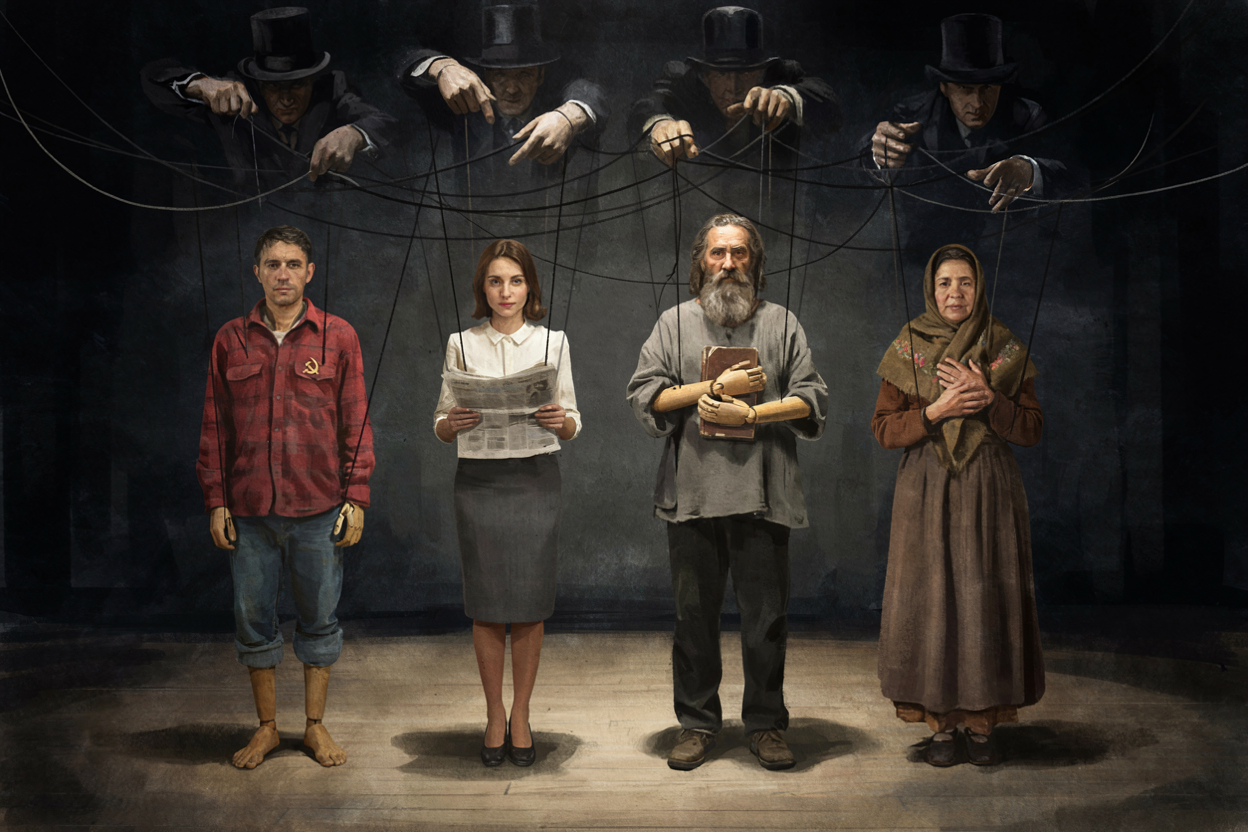
The recurring pattern of oligarchal rule
The prompt that started this was posted as a simple question on Threads,
“When Oligarchs build structures that ultimately belong to the government, could that be called communism?”
It drew me in less because of the label being proposed and more because of how quickly labels get used as substitutes for thought in our intentional social media fog. I find myself watching how easily ideology gets confused with mechanism, as if naming something resolves its structure. It does not. The question reveals a kind of slippage I see often, where people argue over words while the underlying issue, who actually controls the system, is left unexamined. I have had enough experience reading institutional outcomes, not just statements, to feel that disconnect immediately. The framing matters here. If we misread control as ideology, we miss the way power actually organizes itself, quietly, through contracts, funding streams, and administrative layers that feel neutral until they are not. And that is where this essay begins, with that gap between what is said and what is done, between the name on the structure and the hand that decides its use.
The question feels almost casual at first, like something tossed across a thread at midnight, but it pulls on something older and heavier. When oligarchs build structures that later belong to the government, I don’t reach for labels first. I look for who ends up holding the switch. I have seen enough institutional drift in the Pacific Northwest, where public projects grow out of private contracts and then quietly forget the original promises, to know that ownership on paper is not the same as control in practice. That gap is where the argument lives.
I tend to think control is the axis everything turns on. If a system distributes control broadly and the structure serves a collective interest, then the analogy to communism has at least a surface plausibility. But I keep returning to the difference between declared purpose and actual governance. When control consolidates in a narrow class, whether it calls itself party or corporate board, the result is not communism. It is a managed hierarchy that uses public language to legitimize private ends. That is a familiar pattern in fascist systems, where the state becomes an extension of concentrated power rather than its counterweight (Griffin, The Nature of Fascism, 1991).
Italian fascism illustrates the structure clearly. Mussolini’s regime did not abolish private capital. It absorbed it. Industrialists like the Agnelli family navigated the regime by aligning with its projects, while the state directed production toward national goals defined by the leadership rather than any democratic process (De Grand, Italian Fascism, 2000). I think about this as a kind of negotiated capture. The oligarchs did not disappear. They adjusted. The system remained top-down, with labor and public resources oriented toward priorities set by a small political nucleus. In my reading, that is not a shared system. It is a funnel.
Germany followed a similar trajectory, though the language shifted. The Nazi economy kept private ownership intact but subordinated it to state direction through rearmament and autarky policies (Tooze, The Wages of Destruction, 2006). The Krupp and IG Farben executives were not displaced, but their autonomy narrowed as the regime defined production targets. I remember visiting a site in Berlin years ago, standing in a reconstructed industrial space and thinking how ordinary it must have looked to workers at the time. The machines did not announce ideology. The output did. The people, whether managers or laborers, were positioned as instruments of a larger design. That design did not belong to them.
Japan’s wartime system adds another dimension. The state mobilized zaibatsu conglomerates, integrating them into a militarized economy where corporate and state interests merged around expansion and resource extraction (Dower, War Without Mercy, 1986). There is a tendency to see this as national unity. I see it more as alignment under pressure. The oligarchic families remained influential, but their influence converged with a centralized military leadership that determined the direction of society. Again, who held the final authority? The answer was not diffuse. It was concentrated and disciplined.
The Soviet case complicates the picture, though not in the way people often assume. The rhetoric of worker ownership masked a system where the Communist Party itself functioned as a governing class, controlling allocation and production through bureaucratic mechanisms (Fitzpatrick, The Russian Revolution, 1982). Stalin’s consolidation of power produced an architecture that looked ideological from the outside but operated as a hierarchy of access. I have always found the gap between theory and lived experience there striking. Workers in Soviet factories could say, in principle, that the means of production were theirs. In practice, they obeyed directives from party structures that were not accountable to them. That is why I have described it as a form of oligarchical control wearing Marxist language. The form changed. The pattern did not.
China’s revolutionary trajectory shows a related evolution. The early Maoist period emphasized egalitarian transformation, but the Cultural Revolution and subsequent reforms reveal a recurring tension between ideology and centralized authority (MacFarquhar and Schoenhals, Mao’s Last Revolution, 2006). The state retained ultimate control, and the party remained the gatekeeper of economic and social mobility. In both Soviet and Chinese contexts, the claim of collective ownership does not erase the reality of concentration at the top. It merely reframes it.
So when I hear the word communism attached to oligarch-built structures, I pause. I think of Philadelphia neighborhoods built through public-private redevelopment, or Seattle projects where tech wealth intersects with civic infrastructure. The question is not rhetorical to me. It is practical. Who decides how the structure is used when the ceremony ends and the ribbon is cut? Who benefits when the system is under strain?
Modern capitalism is not immune to this drift. In fact, it is increasingly vulnerable to the same pattern of concentrated influence. Corporate lobbying, regulatory capture, and the scale of private capital all push decision-making upward, away from public accountability. I notice how easily “public good” language can be adopted by entities with very specific interests. It reminds me, uncomfortably, of earlier systems that used collective rhetoric to stabilize hierarchical control. The danger is not in the label. It is in the consolidation.
I keep thinking about the present, about the US and UK, where the language is cleaner but the pattern feels familiar. Decisions that shape infrastructure, housing, and financial flows often appear procedural, even technocratic, yet the outcomes tilt steadily toward the same narrow set of interests. I have watched projects justified in the name of efficiency or growth, then quietly re-route benefits upward, as if the direction was never in question. It is not conspiracy thinking to notice repetition. It is pattern recognition. And the pattern is not random. It follows the contours of influence, where money becomes the quiet author of policy and policy becomes the loyal executor of money.
The uncomfortable part, at least for me, is how institutional this has become. It is not just individual actors or isolated scandals. It is the normalization of systems where wealth accumulation and political power reinforce each other across generations, where access itself becomes the currency that shapes outcomes. When I look at it closely, I see something that no longer fits neatly under traditional ideological categories. It is not simply capitalism or something else. It is a convergence, a mode of governance where oligarchal control operates through existing structures rather than outside them. That is what makes it durable, and also harder to name without slipping into the very confusion the original question hints at.
I do not think history repeats itself in neat cycles. It stutters. It rhymes awkwardly. But the underlying dynamic, oligarchs shaping systems that appear collective while remaining controlled from the top, appears again and again. It shows up in fascist regimes, in communist states, and in contemporary market economies. Different flags, similar architecture.
And I am left with a simple, unfinished question, one that does not resolve cleanly: if control concentrates, does it matter what we call the system? Or do we just keep describing the same structure until we finally admit what it is?
References
- De Grand, Alexander. Italian Fascism: Its Origins and Development. University of Nebraska Press, 2000.
- Dower, John W. War Without Mercy: Race and Power in the Pacific War. Pantheon Books, 1986.
- Fitzpatrick, Sheila. The Russian Revolution. Oxford University Press, 1982.
- Griffin, Roger. The Nature of Fascism. Routledge, 1991.
- MacFarquhar, Roderick, and Michael Schoenhals. Mao’s Last Revolution. Harvard University Press, 2006.
- Tooze, Adam. The Wages of Destruction: The Making and Breaking of the Nazi Economy. Viking, 2006.

Leave a Reply