
The Taung Child and the Unpredictability of Fossilization
It started, as so many modern arguments do, with a comment thread.
The claim was blunt: fossils “cannot be formed over millions of years” because, under “NORMAL conditions,” bodies simply decompose or are consumed before they have a chance to preserve.
The word normal did most of the work in that argument… an apparently self-evident boundary for what nature allows.
My response, though, tried to dislodge that assumption. I pointed out that “normal” is not a universal rule, but a context-dependent description: diatoms accumulate into vast chalk deposits like the White Cliffs of Dover; animals are preserved in tar pits, ice, volcanic ash, and, most relevant here, in caves. Each of these settings has its own logic of preservation, its own exceptions to decay. That exchange left me with a lingering question: do people actually understand that fossilization is not governed by a single “normal” pathway at all? The Taung Child, Australopithecus africanus, offers a particularly clear answer, because its preservation was both entirely ordinary within its environment and utterly improbable in the broader sense; an accident of cave deposition that reveals just how many different roads can lead, or fail to lead, into the fossil record.
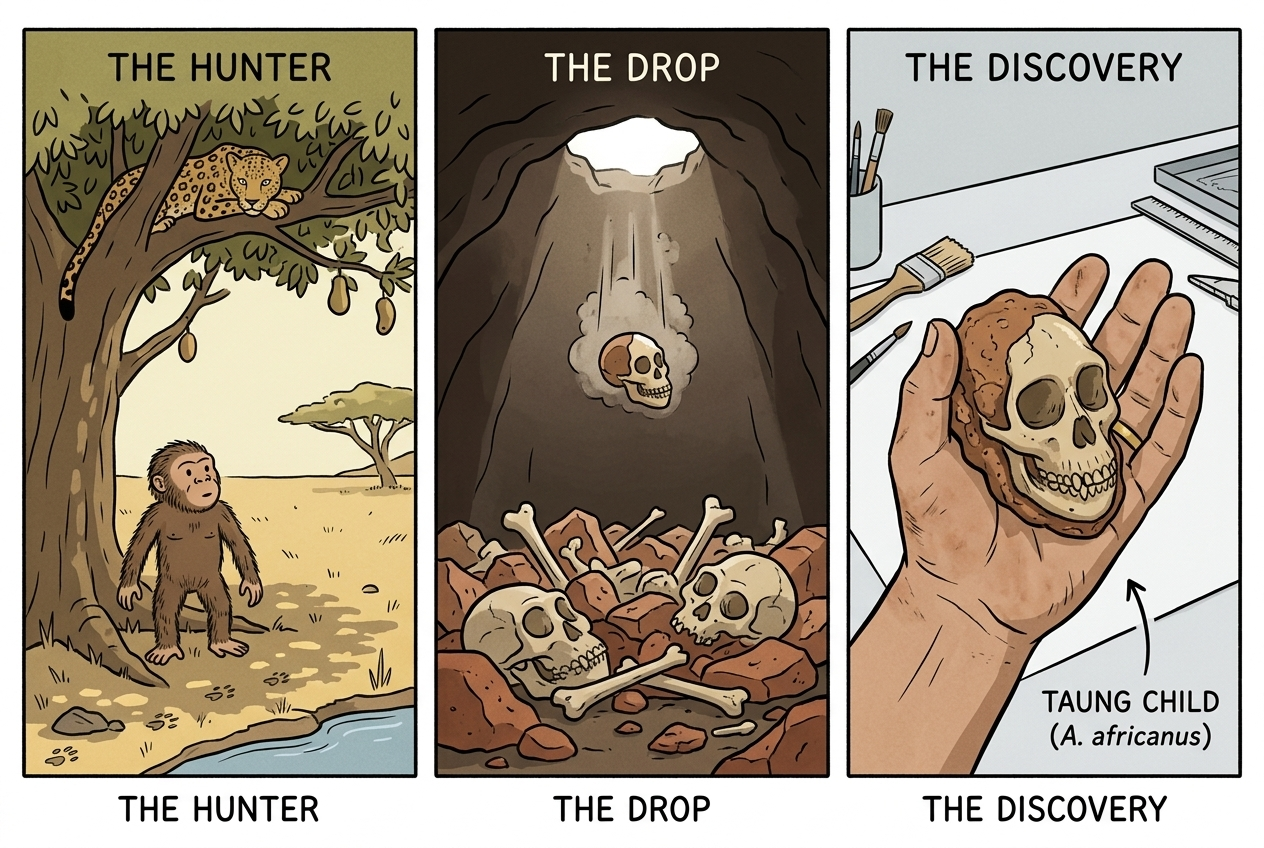
Fossilization is often imagined as a neat, predictable sequence… organisms die, are buried, and slowly turn to stone. Yet the Taung Child (Australopithecus africanus) demonstrates that preservation is anything but standard. Its path into the fossil record began not with gradual burial, but with a sudden fall into a cave, a depositional pathway that shaped both its survival and its scientific importance (Dart, The Taungs Skull, 1925).
Cave environments are frequently thought of as ideal repositories for fossils because they can protect remains from surface erosion and scavengers. However, this protection is conditional. Many cave assemblages form through repeated and messy inputs—animals falling in, carnivores dragging prey inside, or sediment washing in during floods (Brain, The Hunters or the Hunted?, 1981). These processes create highly mixed deposits, where bones are fragmented, reworked, and time-averaged rather than preserved intact. In such cases, the cave is less a conservator than a chaotic accumulator, blending multiple events into a single geological layer (Behrensmeyer, Taphonomy and Ecology, 1978).
The Taung Child’s deposition path is distinct because it likely originated from a single, catastrophic event. The skull was discovered embedded in breccia, cemented cave sediment, suggesting that the individual fell into a limestone cavity and was rapidly incorporated into accumulating debris (Dart, The Taungs Skull, 1925). This kind of direct entrapment is rare. Unlike surface burial, where sedimentation is often gradual and extensive, cave deposition can be highly localized and episodic, depending on the structure of the cave system and the timing of collapse or infilling (Laville et al., Pleistocene Caves of South Africa, 1980).
Once inside the cave, conditions must align precisely for fossilization to proceed. The body of the Taung Child was shielded from scavengers and weathering, but protection alone is insufficient. Bones can still dissolve in acidic groundwater or be destroyed by physical disturbance. The crucial factor was mineral-rich water percolating through the cave sediments, initiating permineralization; a process in which minerals replace organic material within the bone, preserving its microscopic structure (Hedges & Millard, Bones and Groundwater, 1995). This process is highly sensitive to chemical conditions, and even within caves it is far from guaranteed.
This is where the Taung Child highlights the variability of cave fossilization. Some cave fossils are preserved in flowstone, where calcite layers encase remains slowly and continuously, creating a protective seal. Others are found in collapses or debris cones, where bones are compressed, fragmented, or displaced by ongoing geological activity (Brain, The Hunters or the Hunted?, 1981). In contrast, the Taung Child appears to have been preserved in a relatively stable depositional environment, where sediment accumulation proceeded without significant reworking. The difference is significant: rather than being part of a long, mixed deposit, the fossil represents a more singular preservation event, captured before extensive disturbance could occur (Laville et al., Pleistocene Caves of South Africa, 1980).
Even so, the fossilization process remained contingent and incomplete. Cave systems are dynamic; they can shift, collapse, and erode over time. Many potential fossils are lost before mineralization can take hold. The fact that the Taung Child survived at all underscores how rare successful fossilization really is. Most biological remains never enter the fossil record, and among those that do, only a fraction are preserved in recognizable form (Behrensmeyer, Taphonomy and Ecology, 1978).
When Raymond Dart examined the fossil in 1924, he was not simply identifying a new species—he was interpreting the outcome of an unusual preservational pathway. The skull’s survival depended on a precise combination of events: a fall into a cave, rapid burial in sediment, protection from destruction, and chemical conditions favorable to bone mineralization (Dart, The Taungs Skull, 1925). Each step was necessary, and none was inevitable.
This is the deeper lesson the Taung Child offers. Fossilization is not governed by a single “normal” route. There is no standard template that consistently produces fossils. Instead, there are many possible pathways; some involving rivers and floodplains, others involving volcanic ash, tar pits, or caves. Each pathway imposes its own constraints and opportunities, and success depends on a fragile balance of timing, environment, and chance (Hedges & Millard, Bones and Groundwater, 1995).
Cave deposition in particular illustrates this uncertainty. It can preserve remains with remarkable fidelity, yet it can also destroy them completely. The difference between preservation and loss may hinge on subtle variables: the angle of entry, the availability of sediment, the chemistry of groundwater, or even the presence of predators. The Taung Child survived because everything aligned in just the right way… an exception rather than a rule.
In that sense, the fossil is not only evidence of early human evolution, but also a record of geological contingency. Its existence reminds us that preservation is not a default outcome of death. It is a rare convergence of circumstances, where a single moment. falling into a cave. became the gateway into deep time.
The Taung Child therefore stands as a powerful example of how unpredictable fossilization truly is. There are no normal paths, only improbable ones that occasionally succeed. And when they do, they preserve not just bones, but the story of how fragile, and extraordinary, survival through time can be.
References
- Behrensmeyer, A. K. Taphonomy and Ecology. University of Chicago Press, 1978.
- Brain, C. K. The Hunters or the Hunted? An Introduction to African Cave Taphonomy. University of Chicago Press, 1981.
- Dart, R. A. The Taungs Skull: A New Fossil Homine from South Africa. Nature, 1925.
- Hedges, R. E. M., and Millard, A. R. Bones and Groundwater: A Geochemical Perspective on Fossil Preservation. Oxford University Press, 1995.
- Laville, H., Rigaud, J.-P., and Sackett, J. Pleistocene Caves of South Africa. Academic Press, 1980.

Leave a Reply