
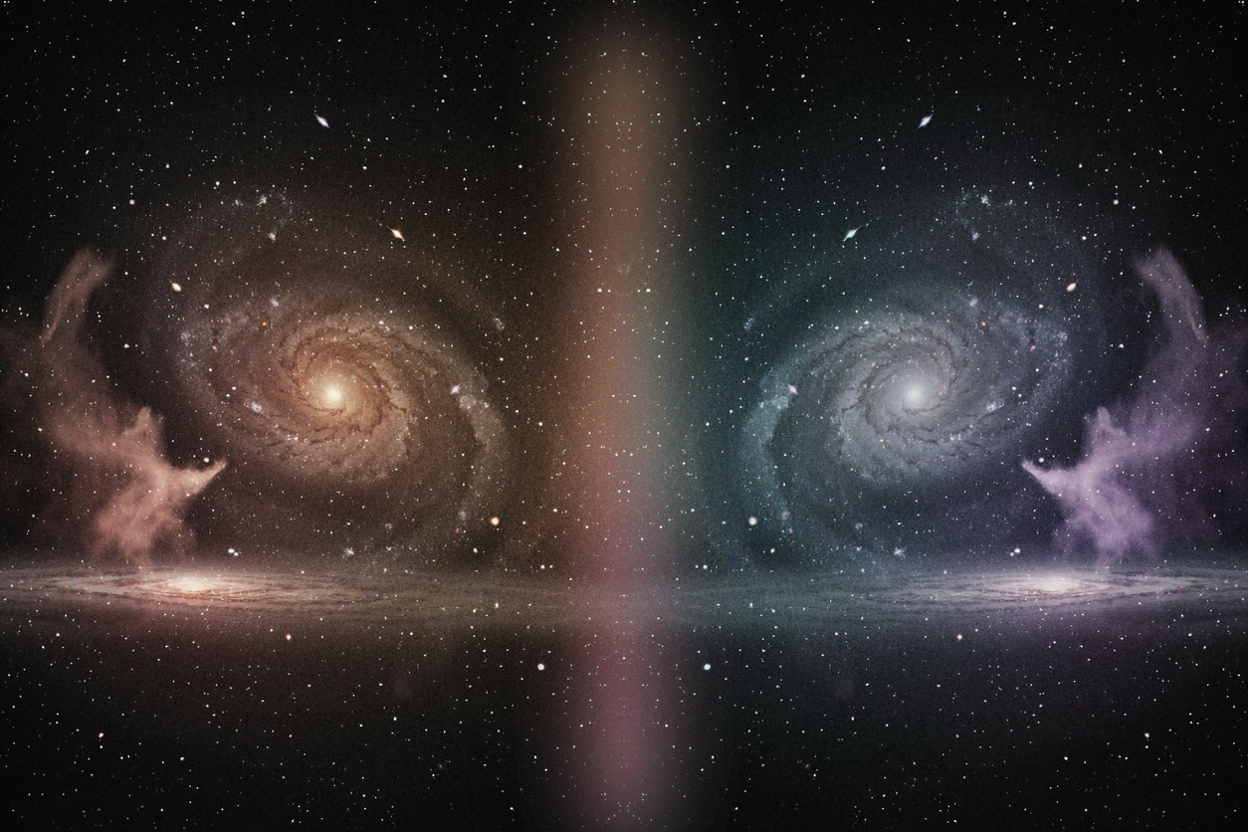
A Threads exchange on beginnings, symmetry, and the limits of perspective
And now something again from Threads. The thread started the way a lot of good ones do, with a question that feels both simple and impossible to finish.
Gintama opens it, almost like tossing a stone into deep water.
“Do you believe our universe is infinitely big? I believe it’s finite. If you believe it’s finite, how big do you think it could be, using our observable universe as a scale?”
It is a Pacific Northwest kind of question, quiet but expansive, the sort that makes you look out past the wet gray sky and wonder what else is folded behind it. I read it and feel that familiar lift. Not certainty. Curiosity. The OU as a ruler, as a unit of imagination. OU times trillions. Or something worse, something so large the math starts to lose its patience.
Then Gintama shifts, and the thread tightens around a second idea.
“I just learned that the matter in our universe is basically a tiny fraction left over from matter-antimatter annihilation. How did the universe have that much (anti)matter in the first place? It’s amazing.”
Amazing is right. It is the kind of amazement that does not settle. It keeps asking for more space.
I reply, and I can almost hear my own tone in the text, a little upbeat, a little careful not to flatten the wonder.
“Also, the universe did not have any matter/antimatter to start with. It had energy and zero volume. When expansion began the addition of volume eventually allowed reduction in energy density, so that quantum vacuum fields could spontaneous produce matter/antimatter.”
And with a little more… something please the spirits of completeness. And to hopefully keep my humble.
“Now, which was favored matter or antimatter, is not important, as those are human labels. After ~20 minutes of simple quarks, then gluons, electrons, photons, nucleosynthesis makes light nuclei (mostly helium-4, some deuterium, lithium). Much later, recombination lets electrons bind, forming neutral hydrogen. Stars take about another 300 million years.
And if there any cosmologists who know this better, please feel free to correct my understanding.”
There is something almost conversational about it, even when the subject is not. I find myself smiling at the absurdity of describing the beginning of everything in a few lines on a social feed. Early-universe cosmology frames this period as a hot, dense state dominated by radiation where particles continually formed and annihilated in equilibrium (Weinberg, The First Three Minutes, 1977). The language is technical, but the picture is almost bodily, like a system breathing itself into existence.
Gintama comes back quickly, pressing the edge of the idea.
“If antimatter had won, could the universe still create stars and everything else, but with antimatter versions?”
That question sits differently. It is not just physics anymore. It is a thought experiment about symmetry, about whether the universe cares which side you are on. I answer him directly.
“Yes, the same structures would still form. The laws are symmetric, so antimatter builds atoms, stars, and galaxies the same way matter does. From the inside, it would look completely normal, just with different particles making up everything.“
That line has a kind of quiet weight to it. What if your entire cosmos is built from a different label, but the experience is identical? That is not just cosmology. It is perspective.
The physics supports this symmetry more than intuition does. Matter and antimatter are expected to obey nearly identical laws under charge-parity transformations, with the small observed asymmetry in nature being central to why matter dominates today (Sakharov, “Violation of CP Invariance, C Asymmetry, and Baryon Asymmetry of the Universe,” 1967). That imbalance is not dramatic. It is microscopic, but it cascades into everything we see. No asymmetry, no galaxies. No galaxies, no thread, no questions about size.
Gintama’s questions have a way of pulling the conversation upward, away from specifics. Finite or infinite. Matter or antimatter. OU as a scale. There is something almost playful in it, and I appreciate that. I do not come to these exchanges as someone trying to close the loop. I come to them because they open it further. I have spent enough time tracking these ideas, not as a specialist but as someone trying to follow the edges, to feel that the most useful questions are the ones that remain slightly unfinished.
What if we take the observable universe as a starting point and just keep multiplying? OU times a trillion is already a kind of joke, because it assumes space behaves like a container that can be scaled indefinitely. But inflationary cosmology suggests the universe may extend far beyond our observable horizon, potentially in ways that are effectively unbounded from our perspective (Guth, Inflationary Universe, 1997). So the question is not wrong. It is just incomplete in a very human way. We are trying to measure something that does not care about our measuring stick.
I find myself enjoying this part of the exchange more than I expected. There is a lightness to it. Not in the subject matter, but in the way the questions are asked without pretense. Gintama is not trying to impress anyone. He is trying to understand. That matters.
From my side, I lay out the sequence. Energy. Expansion. Vacuum fluctuations. Particle production. I point to nucleosynthesis, where light elements formed within minutes after the early universe cooled, and to recombination, when neutral atoms formed and the universe became transparent to light (Alpher, Bethe, and Gamow, “The Origin of Chemical Elements,” 1948). The timeline is precise, almost elegant, and still it leaves a gap where the imagination rushes in faster than the equations.
And then I step back a little and let the thread breathe.
If antimatter had won, would you even notice? If the universe is finite, what does it mean to ask how big it is, when you are already inside it? These are not just physics questions. They are questions about the limits of perspective, about the way we anchor meaning in scale. I think about standing on a ridge in the Cascades, looking out at layers of mountains, each one repeating the same shape at a different distance. You can keep going, mentally, until the pattern stops being about geography and starts being about how we perceive continuity.
The thread does not resolve. It does not need to. Gintama’s questions remain open, and my answers, while technically complete, are not final. They are more like invitations.
And I like that.
Because in a feed full of certainty, there is something refreshing about a space where the questions are allowed to stretch, where someone can ask about the size of everything and someone else can answer without pretending to hold the whole picture. It feels, in a small way, like the right kind of conversation. Not definitive. Just honest.
So, what would you ask if you assumed the universe was listening, but not obligated to answer?
References
- Alpher, Ralph A., Hans Bethe, and George Gamow. The Origin of Chemical Elements. Physical Review, 1948.
- Guth, Alan H. The Inflationary Universe. Addison-Wesley, 1997.
- Sakharov, Andrei D. “Violation of CP Invariance, C Asymmetry, and Baryon Asymmetry of the Universe.” JETP Letters, 1967.
- Weinberg, Steven. The First Three Minutes. Basic Books, 1977.

Leave a Reply