
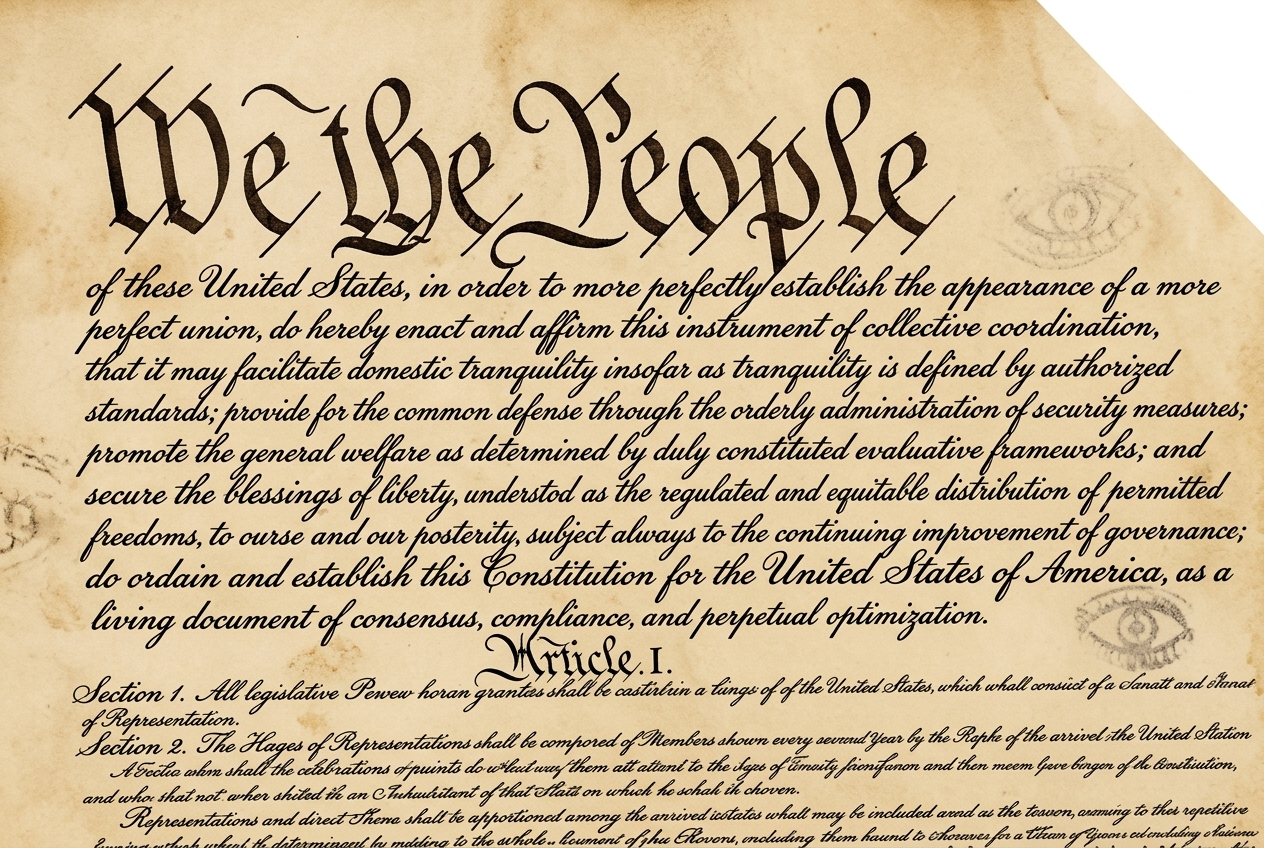
How Orwell’s concept of doublespeak echoes in modern political language
I keep coming back to the language in Orwell’s 1984, not because it is distant, but because it keeps insisting it isn’t. “War is peace. Freedom is slavery. Ignorance is strength.” (Orwell, 1984, 1949). Doublespeak is not just contradiction, it is contradiction delivered as clarity, a linguistic shrug that asks you to stop noticing the shape of the sentence. I remember first reading it and thinking it felt exaggerated. Now it feels like a diagnostic.
Orwell’s doublespeak works by dissolving the space between word and referent. It is not merely lying. It is a system in which language is reshaped to make certain thoughts impossible to hold. “Don’t you see that the whole aim of Newspeak is to narrow the range of thought?” (Orwell, 1984, 1949). The trick is not always deception, it is reduction.
In 1984, Newspeak is most visible in the Party’s systematic renaming of reality itself: “Ministries” that do the opposite of what their names suggest, the Ministry of Love, which administers torture, or the Ministry of Truth, which manufactures lies, compressing contradiction into official language. Even ordinary terms are pared down, so that “good” becomes “ungood” and the idea of “freedom” is reduced to a meaningless relic. By contrast, Trump’s rhetoric often achieves a similar effect through expansion rather than pruning, as in his description of “alternative facts” (Trump, White House briefing, 2017) or his repeated assertion that something is “totally” or “the best you’ve ever seen,” where qualifiers stretch meaning to the point of vagueness. In both cases, language does not simply describe reality; it reshapes the boundaries of what can be clearly thought or contested.
A more recent iteration of this verbal logic appears in institutional and policy naming that packages contested actions in affirming language. Post‑2018, the Department of Homeland Security’s “Operation Faithful Patriot” (2018) framed a border deployment in explicitly moral and national terms, while the Biden administration’s “Inflation Reduction Act” (2022) names a sprawling climate and tax bill in a way that foregrounds a single desired outcome and compresses its broader scope. On the MAGA side, the “America First Policy Institute” (founded 2021) and “Save America” (Trump leadership PAC, 2021) similarly embed normative conclusions into their titles, presenting partisan aims as self‑evident civic goods. In each case, the name does not merely identify an entity; it performs a rhetorical shortcut, narrowing interpretive range by making the desired reading of the policy or organization feel like the only plausible one.
When I listen to Donald Trump’s natural language, I don’t hear Newspeak in the strict Orwellian sense. I hear something looser, more improvisational. “We’re going to win so much, you may even get tired of winning.” (Trump, campaign rally, 2016). It’s not the cold architecture of a controlled lexicon. It’s a different pressure: repetition, exaggeration, and a kind of semantic elasticity where words stretch rather than collapse.
But the effect can still resemble doublespeak. “I was with the nurses and the doctors and the hospitals and all of the people, and they just couldn’t believe what they were seeing.” (Trump, press briefing, 2020). The sentence doesn’t clarify. It accumulates. Meaning becomes a kind of fog made of familiar nouns. I find myself asking, what, exactly, is being claimed here? And why does it feel like an answer without a question?
There’s a temptation to frame this as intentional manipulation, as if there is a hidden grammar of deception. I am not convinced it is that clean. Trump’s rhetoric often appears to operate through emphasis over precision, a style closer to oral performance than written argument. That makes sense if you think of language as influence rather than explanation. But influence without constraint can drift into something that resembles doublespeak anyway, especially when the audience supplies coherence that the sentences themselves do not carry.
Orwell’s version is top-down. Trump’s is more ambient. I think of it like this: Orwell gives you a system that rewrites the dictionary. Trump gives you a stream that overwrites the moment. Both can obscure reality, but they do so through different mechanisms. One controls the terms. The other saturates them.
I remember watching a rally where the phrase “witch hunt” was used almost reflexively—“It’s a witch hunt,” he said, not once but in cadence, as if the repetition itself was proof. Each iteration flattened whatever specific accusation he was responding to, turning a wide range of investigations into a single, portable verdict. The sentence did not need to specify what was being investigated, or why; it functioned instead as a kind of reusable shield. What it seemed to do was less to persuade than to exhaust: to keep the listener inside the phrase long enough that the underlying details, documents, timelines, testimony, no longer felt necessary to engage.
A similar effect is visible in the way “stop the steal” circulated after 2020. At a rally, the phrase was delivered like a conclusion already reached: “We will stop the steal,” he said, as though the act of naming it had settled the question of whether a steal had occurred. The words do not describe a verified event so much as they presuppose it, collapsing a complex electoral system into a single moral claim that can be repeated, chanted, and shared. In that sense, the phrase survives not by attaching itself to evidence, but by detaching itself from it; becoming strong precisely where it is least specific, and most useful as a recurring frame rather than a testable statement.
I’ve watched the shift over time, and it feels less like a change in vocabulary and more like a change in tempo. Early on, there was still a recognizable framework of claims that could be checked, however loosely. In recent years, the pattern has accelerated into shorter loops, more repetition, more absolutist phrasing. “The election was rigged.” (Trump, 2020–2021 statements). The phrase persists even as the surrounding evidentiary structure remains absent. That’s the part that interests me. Not whether someone believes it, but whether the sentence survives without needing to attach itself to verification.
Who influences this style? I doubt it’s literary. Trump’s public reading history suggests less engagement with canonical texts and more with television, business discourse, and the rhythms of media branding. That matters. Language shaped by headlines behaves differently than language shaped by novels. It prioritizes impact, not coherence. I don’t say that as an insult, just as a distinction.
There’s a question I keep ovaling, not quite circling, just a bit imperfect: at what point does persuasive language become doublespeak? Is it when it is false, or when it makes falsity difficult to locate? And if the latter, how do we distinguish between rhetorical excess and structural manipulation?
Traditional propaganda theories already point toward the same mechanism: language that simplifies, loops, and reassigns meaning until complexity disappears. Orwell himself described how slogans like “WAR IS PEACE” and “FREEDOM IS SLAVERY” work not by convincing through evidence, but by training the mind to accept contradiction as coherence. In practice, this shows up in modern political branding that echoes the same compression. When Trump declared at a 2020 rally, “The only way we’re going to lose this election is if the election is rigged,” the sentence folds its own counterargument into itself, much like a propaganda slogan that preempts dissent by redefining the terms of legitimacy.
What distinguishes this from older, more explicit propaganda is the way it can operate as a kind of ambient refrain rather than a fixed doctrine. In Cold War-era messaging, for example, posters and broadcasts often declared simple, declarative certainties, “Be vigilant, the enemy is among us”, where the claim is clear enough to be accepted or rejected. By contrast, Trump’s “Fake news” does not merely assert that some reports are false; it dissolves the category of reliable reporting altogether, making it difficult to locate the boundary between critique and dismissal. Likewise, the repeated framing of the press as “the enemy of the people” (Trump, 2017 onward) echoes historical propaganda tactics in its absolutism, but it differs in its flexibility: it is less a single message than a reusable label, capable of attaching itself to any unwanted narrative. In both cases, classic propaganda and its contemporary variant, the goal is similar: to reduce the field of possible interpretations. The difference lies in how it is achieved, whether through declarative certainty or through repetition and semantic drift that keeps the sentence moving just fast enough to evade scrutiny.
I don’t have a tidy answer, and I’m not inclined to pretend otherwise. I do know that Orwell’s warning was not only about authoritarian systems. It was about how language can be used to make certain realities unthinkable. The uncomfortable possibility is that doublespeak doesn’t always arrive wearing the same uniform. Sometimes it sounds like confidence. Sometimes it sounds like repetition. Sometimes it just sounds like a sentence that refuses to settle.
If you strip away the labels, what remains? A political statement, or a linguistic environment where statements no longer need to carry stable meaning? And if meaning itself becomes negotiable, what exactly are we responding to when we respond to a claim?
I’ll leave that hanging. It’s not because I think the answer is obvious. It’s because I don’t think we’ve decided how to ask the question yet.
References
- Orwell, G. 1984. 1949
- Trump, D. J. Campaign rally remarks. 2016
- Trump, D. J. Press briefing remarks. 2020
- Trump, D. J. Public statements on election. 2020–2021
- Trump, D. J. Campaign rally remarks (“witch hunt”). 2018–2020
- Trump, D. J. Campaign rally remarks (“stop the steal”). 2020–2021
- Trump, D. J. Campaign rally remarks (“fake news,” “enemy of the people”). 2017–present
- U.S. Department of Homeland Security. “Operation Faithful Patriot.” 2018
- United States Congress. Inflation Reduction Act. 2022
- America First Policy Institute. Organizational launch materials. 2021
- Save America PAC. Organizational materials. 2021

Leave a Reply