
Diversity, homology, and the slow architecture of bacterial flagella
I didn’t set out to write a counter-argument in the abstract. I started with a thread, the kind that spirals when you drop a stack of papers into it and let the claims circulate. In that Facebook discussion, I had listed several works that, taken together, undercut the idea that bacterial flagella are irreducibly complex. My friend’s suggestion cut through the noise in a way that made sense: pick one paper, stay with it, and let it do the work. I’ve learned over time that synthesis without grounding can feel persuasive but land nowhere. So I chose a paper that doesn’t rely on a single dramatic finding, but instead builds its case through breadth. That mattered to me.
What do you do with this list? I left it in an appendix at the end, so you can see the choices.
I picked Renault et al. (2017) because it sits at a useful intersection. Some of the other papers in the list lean heavily on mechanism, like Macnab’s detailed account of assembly or Kojima and Blair’s focus on motor structure. Others, like Abby and Rocha or Brenner et al., push the evolutionary narrative forward by tracing transitions and relationships. Renault et al. does something different. It integrates diversity, phylogeny, and comparative biology into a single frame, and that combination makes it harder to dismiss as a narrow technical claim. I wanted a paper that would speak to someone who is still on the fence, someone who might accept individual pieces of evidence but hasn’t yet seen how they connect. This is that kind of paper. It doesn’t argue loudly. It accumulates.
I’ve spent enough time around arguments about bacterial flagella that I can recognize the rhythm before it fully lands. Someone points to a machine-like structure, declares it irreducibly complex, and treats that as the end of the conversation. The paper by Renault and colleagues doesn’t play that game. It does something quieter, and honestly more unsettling for that claim: it shows you the parts, the variations, and the plausible history without needing to announce that it has refuted anything. You just notice the implications if you’re willing to sit with them (Renault, Bacterial flagella: diversity and evolution, 2017).
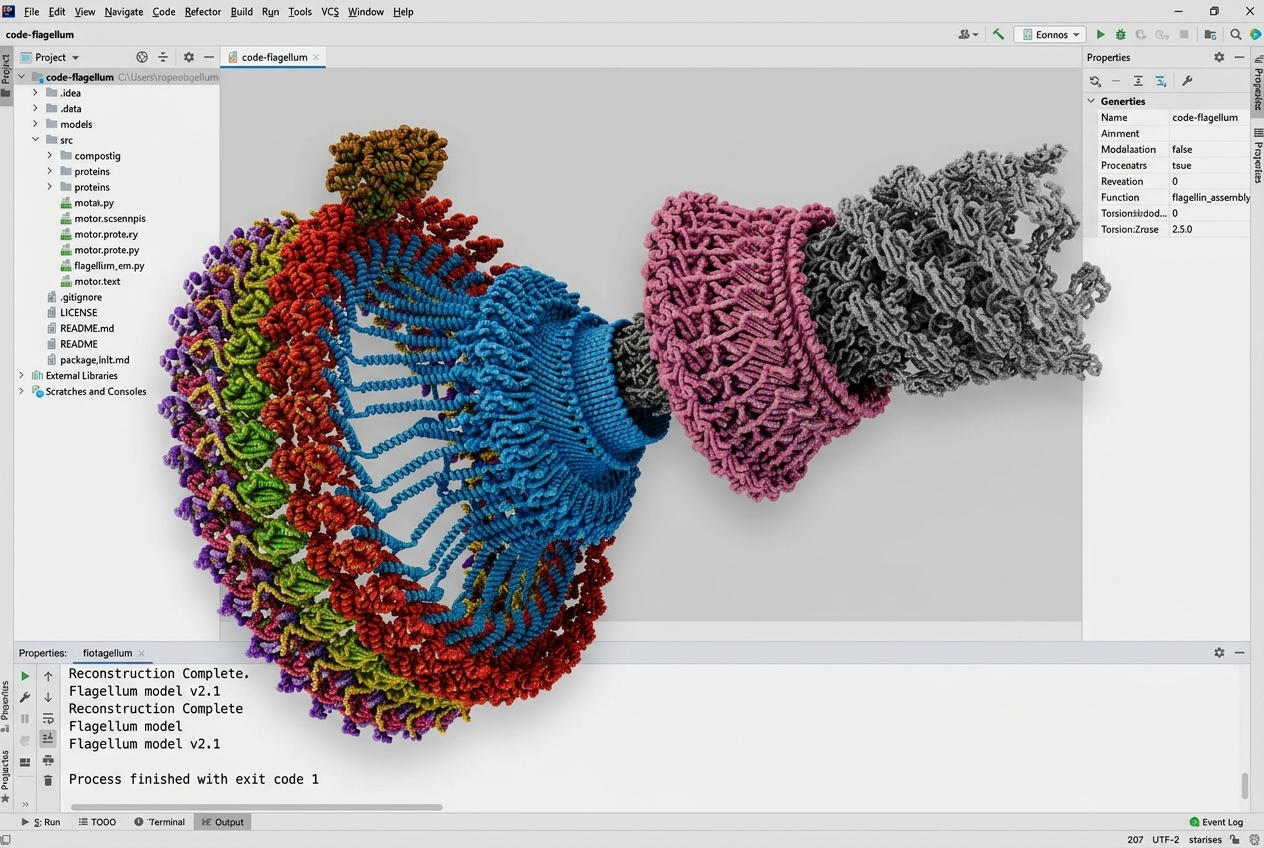
Here’s what struck me first. The flagellum is not one thing. It is a family of systems, distributed across bacterial lineages, with differences that matter. The paper lays out a spectrum of architectures, protein compositions, and regulatory arrangements. Some flagella are simple by comparison, some are elaborate, but none of them appear as pristine, irreducible units. I found myself thinking: if irreducible complexity demands that removing a part collapses function entirely, why do we see so many functional variations that already lack what others have? That question doesn’t need rhetorical flourish. It just hangs there.
The evolution argument doesn’t begin with a fully formed rotary motor. It begins with homology, and that’s where the story gets interesting. Renault et al. trace flagellar components back to systems that are not flagella at all. The Type III secretion system, for instance, shares core structural and functional proteins with the flagellum. You can look at those overlaps and either say “coincidence” or you can ask a more uncomfortable question: what if the flagellum is an elaboration of something simpler that already worked? The paper leans on the second option, and the evidence doesn’t feel forced. It feels layered (Renault et al., 2017).
I’ve always thought there’s a subtle mistake in how irreducible complexity is framed. It treats the flagellum like a static object, something that must appear all at once or not at all. But the evolutionary path described in this paper is not a single leap. It is incremental, with intermediate forms that have independent utility. Think about secretion systems first. Then imagine those systems acquiring extracellular structures. Then imagine those structures becoming more specialized, more mechanically integrated, until motion emerges not as a stroke of invention but as a byproduct of accumulated alignments. Does that sound inefficient? Maybe. Does inefficiency matter if the system still works at every step? That’s the real question.
Let’s turn to something that feels almost too familiar if you’ve ever built systems under changing constraints. The way irreducible complexity frames the flagellum reminds me of how software used to be designed, or how people thought it should be designed. You start with a full specification, lock it down, then implement to match. Clean lines, complete foresight, everything in place before you run the first test. It looks elegant on paper, and it fails in practice because the world doesn’t sit still long enough to respect your initial assumptions.
That shift away from static design is where things start to look more interesting. You don’t begin with a finished system. You start with a minimal function, something that works well enough to test, and then you extend it. Reuse becomes the norm. You lean on existing modules, existing libraries, and you let the system accumulate capability over iterations. Not because that’s the ideal aesthetic, but because it’s the only approach that survives contact with reality. And once you’ve worked that way for long enough, the idea that complexity must arrive fully formed starts to feel unfamiliar, even artificial.
There’s a reason Agile methodology took hold. It wasn’t just about speed or efficiency. It was about recognizing that requirements shift, often in ways you can’t predict. You build, you observe, you adjust. Versions succeed or fail, and the failures don’t vanish so much as get shelved, iterated on, sometimes repurposed. I find it hard not to see a parallel here. Humans learned design from observing biological systems, Agile adapting the approach to design. Biological systems aren’t responding to written requirements, but they are responding to environments that change, pressures that vary, and constraints that don’t stay constant. And if you’ve ever watched a piece of software evolve across generations, you already know what that looks like in a different medium.
The uncomfortable part, at least if you’re invested in irreducible complexity, is that this kind of incremental, opportunistic development doesn’t produce the kind of neat architectural boundaries the argument depends on. It produces overlap. It produces reuse. It produces systems that look a little messy if you expect them to be designed from scratch, but entirely coherent if you expect them to have grown from what was already working. The flagellum, viewed through that lens, stops being an exception and starts looking like a familiar pattern, just in a different substrate.
The diversity data matters more than it might seem at first glance. If a structure is truly irreducible, you would not expect to see so many viable configurations. Yet bacteria exhibit variation in their flagella that affects number, placement, rotation, and assembly pathways. Some species have polar flagella, others lateral, some multiple systems operating under different conditions. The point is not just variation for its own sake. It is that nature does not appear constrained to a single architectural solution. I find it hard to reconcile that flexibility with the idea of a tightly bound, non-reducible system.
A detail that often gets overlooked is modularity. The flagellum is built from discrete protein complexes, each with its own evolutionary history. Renault et al. describe how these modules can be gained, lost, or modified across lineages. That modularity is not decorative. It’s functional redundancy and evolutionary scaffolding. If you remove one module, you don’t necessarily lose all function. You shift it. You adapt it. That is not irreducible complexity. That is the opposite: a system designed by accumulation rather than assembly.
I keep returning to a simple image. Imagine walking along a coastline where the tide has rearranged the rocks. You can point to a single arrangement and say “this looks intentional.” But then you walk further and see dozens of similar arrangements, each slightly different, none identical. At what point do you stop calling it intentional design and start recognizing process? The flagellum sits in that same space. The more you examine the variations, the harder it becomes to maintain the idea that there is a single, necessary configuration.
And here’s where I want to challenge the reader directly. If you were shown a functional secretion system and told that it shares components with the flagellum, would you treat that as irrelevant? Or would you entertain the possibility that complexity can evolve from simplicity when the parts are already doing something useful? If you’re willing to accept that proteins can be repurposed, then the leap to a motor becomes less mysterious. Still complex, yes. Still elegant. But not irreducible in the strict sense that claim requires.
I’ll admit something. I don’t find this conversation satisfying if it stays abstract. What makes the Renault paper persuasive is not rhetoric but accumulation of small, unglamorous facts. Protein homologies. Variations in gene clusters. Functional overlaps. None of it is dramatic on its own. Together, they produce a pattern that is hard to ignore. The pattern suggests continuity rather than discontinuity, and continuity does not align with irreducible complexity in any meaningful way (Renault et al., 2017).
There’s a tendency to treat evolutionary explanations as speculative unless they can reconstruct every intermediate step in detail. That standard is uneven. We don’t require that level of reconstruction to accept other historical processes. What matters here is whether the available evidence is consistent with gradual modification. The flagellum, as presented in this work, doesn’t just allow for that interpretation. It leans into it.
So I keep coming back to the same place. If a system has multiple functional analogues across bacteria, if its components are homologous to simpler systems, and if its structure is modular enough to tolerate variation, what exactly remains of the irreducible complexity argument? Not much, once you strip away the assumption that complexity must arise fully formed.
Maybe the more honest question is this: what would it take to convince you that a machine-like structure can evolve without a designer? Because the data here already points in that direction. The rest is interpretation, and interpretation is where the real disagreement lives.
References
Renault, T. T., Abraham, A.-O., Bergy, A., Berne, A., Caillier, M., Couté, Y., … & Nudleman, E. (2017). Bacterial flagella: diversity and evolution. mBio, 8(3), e00250-17. https://doi.org/10.1128/mBio.00250-17
Appendix
The List:
- Aldridge, P., & Hughes, K. T. (2002). Regulation of flagellar assembly. Molecular Microbiology, 23(2), 185–190.
- Abby, S. S., & Rocha, E. P. C. (2012). The non-flagellar type III secretion system evolved from the bacterial flagellum and diversified into host-cell adapted systems. PLoS Genetics, 8(3), e1002983.
- Brenner, M. P., et al. (2014). Evolutionary transitions of bacterial flagellar systems. Proceedings of the National Academy of Sciences, 111(11), 4448–4453.
- Diepold, A., & Wagner, S. (2014). Assembly of the bacterial type III secretion machinery. Trends in Microbiology, 22(7), 384–392.
- Erhardt, M., Mertens, M. E., & Hughes, K. T. (2010). The type III secretion system: the bacterial flagellum as a model. Journal of Molecular Biology, 427(19), 3860–3870.
- Kojima, S., & Blair, D. F. (2004). The bacterial flagellar motor: structure and function of a complex molecular machine. International Review of Cytology, 233, 93–134.
- Macnab, R. M. (2003). How bacteria assemble flagella. Annual Review of Microbiology, 57, 77–100.
- Nguyen, L. T., Schmidt, H. A., von Haeseler, A., & Minh, B. Q. (2016). IQ-TREE: A fast and effective stochastic algorithm for estimating maximum-likelihood phylogenies. PLoS Biology, 14(1), e1002276.
- Pallen, M. J., & Matzke, N. J. (2006). From The Origin of Species to the origin of bacterial flagella. Nature Reviews Microbiology, 4(10), 784–790.
- Parker, J., et al. (2014). Simplified flagellar systems in bacteria. Nature Communications, 5, 1–9.
- Renault, T. T., et al. (2017). Bacterial flagella: diversity and evolution. mBio, 8(3), e00250-17.

Leave a Reply