
A cross-continental look at a label that sprawls more than it explains
The Bronze Age outside the Middle East does not feel like a single chapter. It feels like a set of overlapping weather systems, each arriving on its own schedule, each leaving different stains on the ground. I keep thinking about that when I line up the evidence, and I find myself asking, why do we insist on calling it one “age” at all?
The earliest start among the lands you asked for sits in the Indus and adjacent regions of India, where bronze working appears by around 3300 BCE and intensifies into the Harappan urban phase (Possehl, The Indus Civilization, 2002). I imagine a potter in Harappa holding a bronze chisel that feels oddly smooth against his palm, as if it has been handled by too many hands already. He is not celebrating a “new age.” He is trying to get his brick to behave, to line up with the grid of streets that no one seems to own but everyone maintains. The Bronze Age here is not a rupture. It is a tool in a city already half convinced it knows what it is doing.
In the Siam region, bronze technology emerges at Ban Chiang around the second millennium BCE, roughly 1500 BCE, with a trajectory that overlaps with but does not mirror the high urbanism of the Indus (White, Ban Chiang: Discovery of a Lost Bronze Age, 1982). I picture a woman named Ploy-Fon kneeling beside a burial jar, and I do not picture her as a symbol. She is too specific for that. Her fingers are stained with clay, her nails cut unevenly, the way they are when work and care do not keep separate schedules.
She did not buy the bracelet. That would be too clean. I think she traded for it, not with coin but with favors that took weeks to accumulate. A day of helping her neighbor mend a water pot. A bracelet of rice she carried for a traveling trader who stopped in the village long enough to drink and complain about the heat. A small piece of copper she salvaged from an older object, already worn thin by someone else’s life. The bracelet, when it finally came to her, was not new. It had already lived a little. That matters more than we usually admit.
What does it represent for her? Not wealth, not yet. She is not thinking in those terms. She holds it up once, catches the light, and it flashes in a way that feels almost rude, as if the metal is announcing itself without permission. She laughs, briefly, the kind of laugh that does not last long in a place where the work is never finished.
Later, when the child dies, the bracelet shifts meaning without asking anyone’s consent. Ploy-Fon keeps it in her hand longer than she means to. The burial jar sits open, patient, and she presses the bronze around the small wrist because she has nothing else that feels like a proper answer. The metal is cool, almost indifferent. She wonders, in a sideways way, whether she has misunderstood it. Is it a marker of status, or is it a way of making sure something is remembered when the body is not? The question does not settle. It just drifts.
She places it anyway. Not as a declaration, but as a gesture that says, this mattered. In her world, objects do not speak loudly. They accumulate tone over time, like river stones. The bracelet will sit there with the child, and someone else, maybe years later, will find it and try to decide what it meant. They will not get a straight answer. They never do.
The culture around her does not chase empire, not in the way later stories want to frame things. It moves sideways, through kinship and exchange, through the slow agreement that certain materials can carry more than utility. Bronze, here, is not a proclamation. It is a medium for continuity, for the kind of memory that does not require writing but still insists on being kept. Ploy-Fon understands this without naming it. She is not building a civilization in the abstract. She is trying, imperfectly, to hold on to what leaves too soon.
And I find myself wondering, standing at a distance I cannot close, whether she would recognize the term “Bronze Age” at all. Or whether she would find it as oddly formal as the rest of us do, when we try to compress a life like hers into something that sounds finished.
Korea’s Bronze Age, beginning around 1500 BCE and extending into the early first millennium BCE, is often tied to the rise of dolmen culture and elite markers that concentrate power in visible ways (Nelson, The Archaeology of Korea, 1993). I keep imagining the San clan sitting in a low-lit wooden house, the air smelling faintly of smoke and stored grain, while Baek-San turns a bronze dagger over in his hands. It is not heavy in the way stone is heavy. It feels deliberate, almost staged, like it arrived already knowing how it would be seen.
Bit-Hwa watches him more than the blade. She has seen him hold farming tools, fishing hooks, even a broken pot rim he refused to throw away because waste feels like a kind of disrespect. This dagger is different. It has edges that seem less about cutting and more about being noticed. He does not say much, which is his way when something matters. The two little girls press close to their mother’s side, curious in the way children are curious about things adults are pretending are not important. The child on the way shifts under Bit-Hwa’s hand, a small reminder that the future is already negotiating its place in the room.
The dagger came through a chain of exchanges that no one in the family fully tracks. Baek-San says it was given, though given is a generous word for what may have been a trade of labor, grain, and a debt that will be repaid later in some form no one can yet name. The San clan has a habit of accepting things that carry weight beyond their immediate use. That is how influence moves in their world, not all at once, but through objects that accumulate attention the way water accumulates in a basin.
Baek-San lays the dagger beside a flat stone slab, where other families might have laid offerings, or simply nothing at all. He does not use it. He holds it up briefly, letting the light skim the surface. The girls watch as if he is performing a small ritual, though no one has taught them to call it that. Bit-Hwa thinks, privately, that the dagger is less a tool than a way of saying the world can be arranged, that order can be made visible. She is not entirely convinced. The world resists that kind of neatness.
Outside, the dolmens stand in scattered fields, their stone tops resting on supports that look, to me, like they are holding up a question rather than a roof. Baek-San has walked past them many times. He does not treat them as sacred in the way later people might assume. He treats them as markers of decisions made by other hands, other families, other claims to presence. Still, he knows they matter. They are not simply graves. They are statements that linger.
In the San household, the dagger becomes part of that same language. It sits in reach, never far, as if its presence alone can steady something unstable. The two girls sometimes touch it when no one is watching, and Bit-Hwa lets them, because she understands that objects like this do not belong to any one person for long. They belong to the way people imagine themselves being seen.
I find myself pausing on that thought. The Bronze Age here does not feel like a single, unified experience. It feels like a negotiation between the ground and the people who insist on building meaning above it. Baek-San’s family is not trying to dominate the landscape. They are trying to locate themselves within it, and the dagger, with its careful shape and quiet authority, is one way of doing that.
Not everyone agrees with this method. Some families prefer other signals, or none at all. Bit-Hwa, for her part, does not fully trust any object that asks to be looked at for too long. She has seen how attention can harden into expectation. Still, when she places her hand on her belly and feels the small movement of the child on the way, she does not reach for certainty. She reaches for continuity.
And that, I think, is where the Bronze Age in this place quietly rests. Not in the dagger itself, and not even in the dolmens, but in the ongoing, uneven agreement that visibility can carry power, and that power, however it is displayed, will always be up for interpretation.
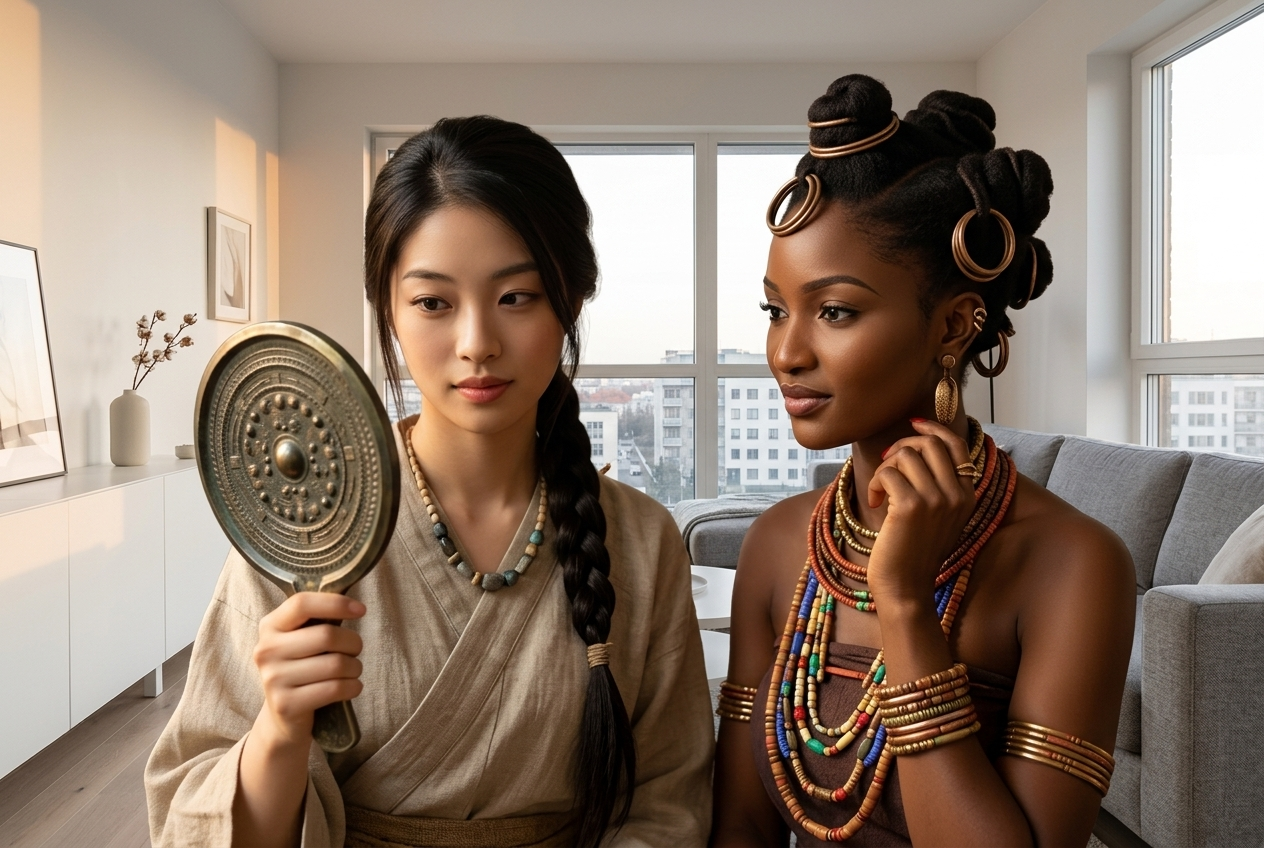
Japan’s Bronze Age arrives late, around 1000 BCE, tied to the Yayoi period and the influx of wet rice agriculture and bronze ritual objects (Barnes, The Archaeology of Japan, 2015). I think of Sora-hime, a figure I always return to when I need to feel the period instead of just charting it. She is handed a bronze mirror. It is new to her, not new to the world, and she studies her reflection with a kind of suspicious delight. Does she see herself or the person she is expected to become? The mirror is not just metal. It is a way of asking whether identity can be made as carefully as a blade. The Japanese Bronze Age, if we call it that, feels like a moment when imported materials start to reshape local narratives. I do not feel it as conquest. I feel it as reinterpretation.
In Scandinavia, the Bronze Age begins around 1700 BCE and ends near 500 BCE, a long, slow burn marked by monumental rock carvings, sun symbolism, and richly decorated metalwork (Kristiansen & Larsson, The Rise of Bronze Age Society, 2005). I imagine a ship carved into stone on a cliff face, its crew frozen mid-voyage, and someone standing there asking whether the sea is a boundary or a road. Bronze here is tied to distance. The material does not come from local soil. It comes from trade networks that stretch far enough to make geography feel negotiable. The people are not just making things. They are maintaining relationships that require constant recalibration. The Bronze Age ends here not with collapse but with oversaturation, as iron begins to offer a different kind of practicality.
Nok in Nigeria complicates the whole idea of bronze. The Nok culture, flourishing around 1000 BCE to 300 CE, is known more for its terracotta than for bronze itself, though evidence of early metallurgical experimentation exists in the wider West African context (Fagg, Nok Terracottas, 1969; de Maret, “Early Metallurgy in Africa,” 1999). I picture Ife-Ase, a sculptor with clay under her fingernails and a habit of squinting at faces as if she is trying to remember them from somewhere else. The figure she shapes is not idealized. It looks tired in a way that feels earned, like it has carried too many unspoken things. She rotates the head slightly, pauses, then presses a thumb into the cheek, not to perfect it but to make it breathe.
There is no clear “Bronze Age” here in the way later regions would define it, and that absence feels almost intentional. Ife-Ase hears travelers talk about metal, about its sheen and its stubbornness, but in her hands clay remains the more honest material. Still, she has seen small metal fragments, not abundant, not central, just present enough to suggest another path the world could have taken. The Nok figures she leaves behind stare outward from their resting places, and I find myself wondering whether they are meant to remember or to warn. Ife-Ase would not ask that question. She would simply set the figure down, wipe her hands, and move on to the next face, as if the act of making is already its own answer.
And then North America, where the Bronze Age never really takes hold. Not because people lacked sophistication, but because the conditions for sustained bronze metallurgy, particularly tin availability and the same dense interregional exchange networks, did not align in the same way (Cobb, Native American Metalworking, 2000). I think about that absence differently now, as if the question is misplaced. Why should every region pass through the same material sequence? The continent had its own relationships with copper, especially in the Great Lakes, where metal was shaped and used without the same alloyed dependence that defines bronze elsewhere. The “age” simply does not arrive, and perhaps it was never invited.
What holds these regions together is not similarity. It is timing and divergence. India’s early urban bronze use, Siam’s domestic integration, Korea’s hierarchical display, Japan’s reflective reinterpretation, Scandinavia’s long-distance networks, and Nok’s parallel experimentation do not converge into a single pattern. They scatter. Even the end points differ. Some transition into iron quickly. Some linger. Some never define themselves by bronze at all.
I find myself less interested in the label and more in the quiet moments inside it. A mirror lifted in Japan. A bracelet placed in Siam. A dagger held in Korea. A ship carved in Scandinavia. A brick set in India. A face formed in Nok. These are not stages of progress. They are ways people tested what the world could hold.
And if you ask me whether the Bronze Age is a real thing outside the Middle East, I would probably answer with another question instead. Real for whom, and in what sense, and why does it need to be the same everywhere?
There is something uneven about the whole story, and I like it that way.
References
- Barnes, Gina L. The Archaeology of Japan: From the Earliest Rice Farming Villages to the Rise of the State. Routledge, 2015.
- Cobb, Charles R. Native American Metalworking. University Press of Florida, 2000.
- de Maret, Pierre. “Early Metallurgy in Africa.” In The Coming of the Age of Iron, edited by T. Shaw et al., 1999.
- Fagg, William. Nok Terracottas. The British Museum, 1969.
- Kristiansen, Kristian, and Thomas B. Larsson. The Rise of Bronze Age Society. Cambridge University Press, 2005.
- Nelson, Sarah M. The Archaeology of Korea. Cambridge University Press, 1993.
- Possehl, Gregory L. The Indus Civilization: A Contemporary Perspective. AltaMira Press, 2002.
- White, Joyce C. Ban Chiang: Discovery of a Lost Bronze Age. University of Pennsylvania Museum, 1982.

Leave a Reply