
Doing the math for another pseudoscience claim
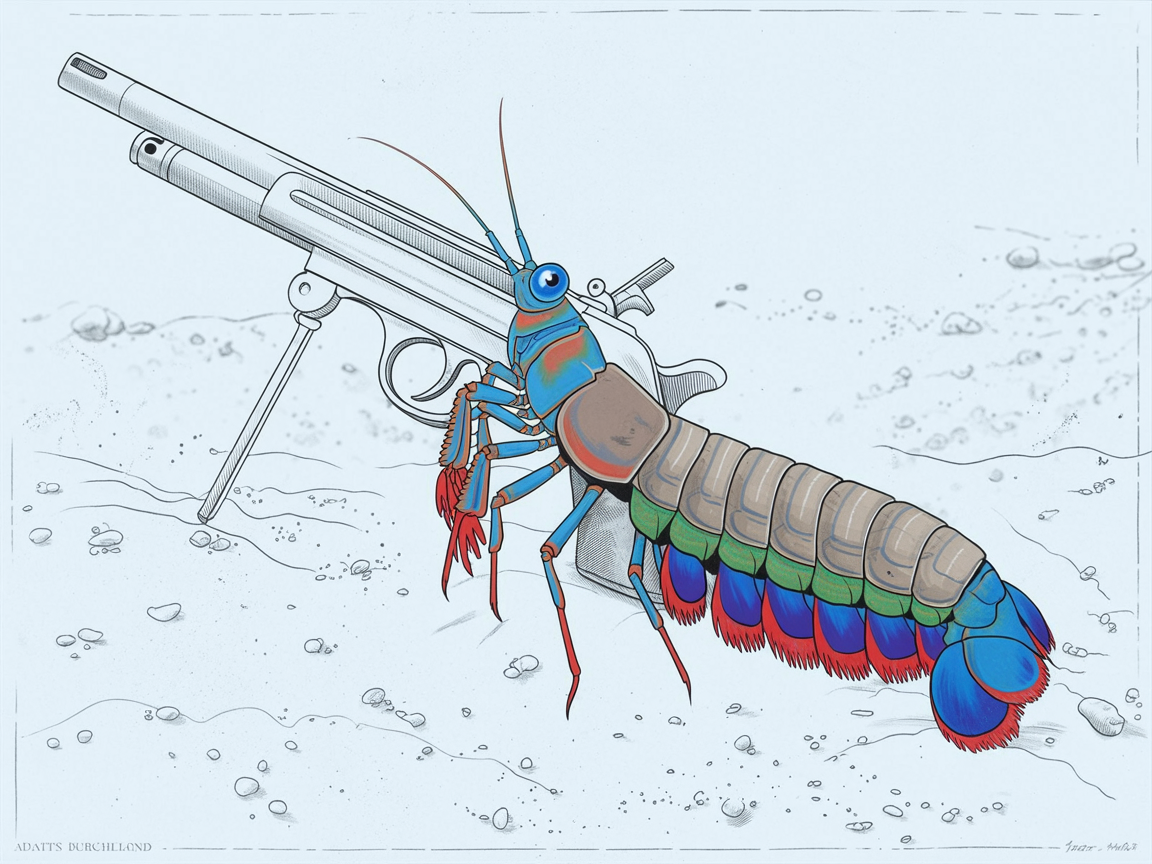
I live in a region where people check tide charts as often as traffic apps, so I tend to do the math before letting a good story carry me away. One piece of Intelligent Design quasi-misinformation (that is information made to look impressive and drive incredulity or as a hook to draw readers to actual misinformation) I’ve been seeing again is about the Mantis Shrimp.
The mantis shrimp’s strike is extraordinary, accelerating a mineralized dactyl club to roughly 21–23 m/s in water, but the popular comparison to a bullet doesn’t survive basic physics (Patek et al., Deadly strike mechanism, 2004; Patek & Caldwell, Extreme impact forces, 2005).
To see why, we can calculate the kinetic energy of a striking mantis shrimp club using the standard equation E = ½ m v². The scientific literature reports strike speed clearly but not the isolated mass of the club, so I show the realistic mass range of 1–5 g and a mid‑case value of 3 g, which is consistent with morphological estimates from dactyl‑club structural analyses (Weaver et al., Stomatopod Dactyl Club, 2012).
Using v = 22 m/s and m = 0.003 kg, we get:
E = ½ × 0.003 kg × (22 m/s)² = 0.726 J.
Sensitivity checks:
• At m = 0.001 kg → 0.242 J
• At m = 0.005 kg → 1.21 J
For comparison, a typical .22 Short round carries ~79 J of muzzle energy, based on ballistic tables listing ~58 ft‑lb for standard 29‑grain loads (Ruger .22 Rimfire Ballistics Tables, 2026).
Percentage comparison (mid‑case):
0.726 J ÷ 79 J ≈ 0.92%.
Across the full mass range, the mantis shrimp’s impact energy equals roughly 0.3–1.5% of a .22 Short. Even at the upper end, that is nowhere near firearm territory. The animal’s effectiveness comes not from bullet‑like kinetic energy but from its latch‑spring power amplification and the secondary shock of collapsing cavitation bubbles—an entirely different physical pathway (Patek et al., Deadly strike mechanism, 2004).
Out here, where we prefer claims that hold up in real weather and real math, the better story is the true one: the mantis shrimp is a masterpiece of biological engineering, but not a tiny underwater marksman.
References
- Patek, S. N., et al. ‘Deadly strike mechanism of a mantis shrimp.’ Nature, 2004.
- Patek, S. N., & Caldwell, R. L. ‘Extreme impact and cavitation forces.’ Journal of Experimental Biology, 2005.
- Weaver, J. C., et al. ‘The Stomatopod Dactyl Club: A Formidable Damage‑Tolerant Biological Hammer.’ Science, 2012.
- Ruger 10/22 Ballistics Table. ‘.22 Rimfire Ballistics Tables,’ 2026.

Leave a Reply