
I’ve been contemplating more over my moring americano, as I watch the destructive results of our past political decisions, and careless placement of someone who could be a clininical narcissists in the highest postion of power.
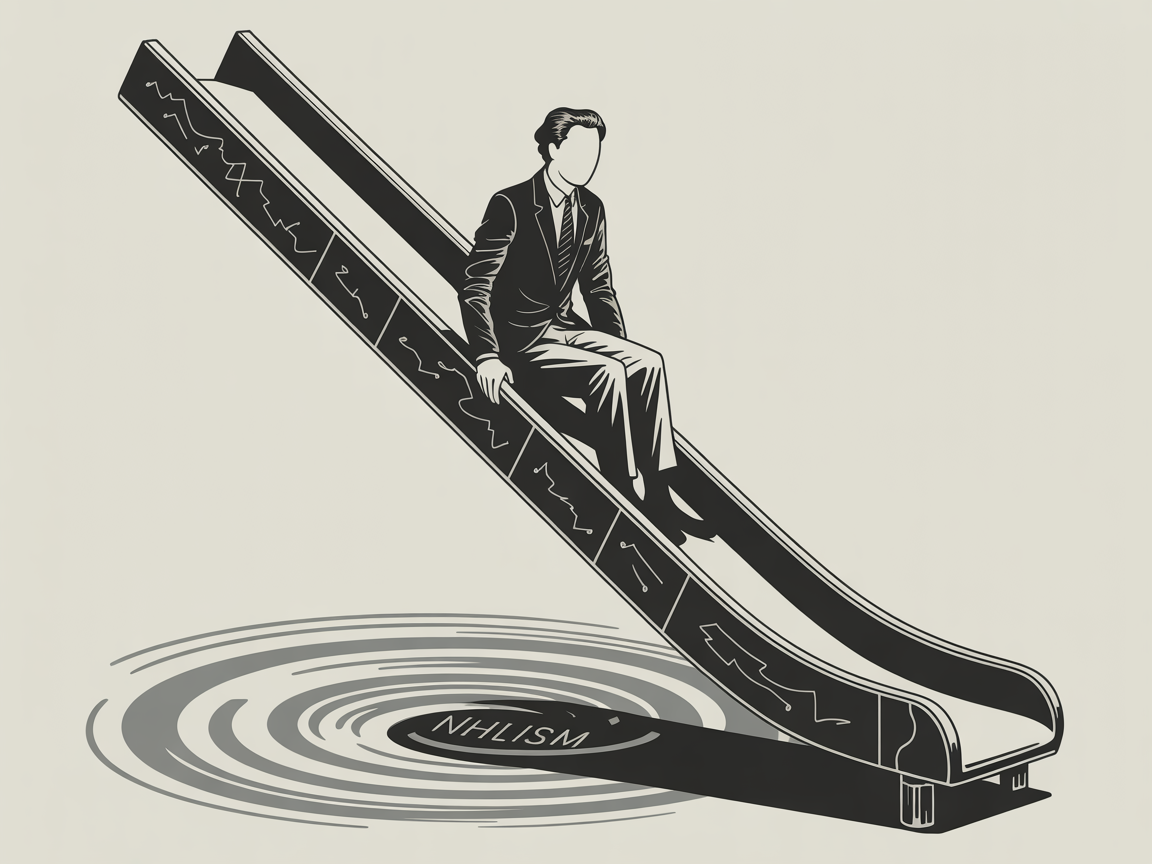
There is a point where narcissism stops looking like confidence and starts behaving like a solvent. I have watched it play out in public life more times than I expected in the last decade, and the pattern feels unnervingly neurological. When a person’s internal world contracts to a single gravitational center, everything outside that center loses weight. What else would you call it when incentives, institutions, and even shared facts flatten into props. At some level the brain rewires around a single priority: protect the self at all costs, even if the cost is meaning.
Psychologists have warned us that pathological narcissism often arises from a loop of reward seeking and threat reactivity. It amplifies self‑referential processing in ways that reduce empathy and blunt long‑term reasoning. When combined with power, that loop becomes more visible. You can see it in the way certain public figures treat political office like a theater of personal grievance rather than a platform for coherent policy. One month the crisis is immigration, the next it is election procedure, the next it is internal party loyalty. The themes shift, but the throughline is constant: whatever affirms the self is true, whatever challenges it is corrupt. In cognitive terms that is the brain pruning everything that does not serve its primary narrative (Campbell & Miller, The Handbook of Narcissism and Narcissistic Personality Disorder, 2011).
When I watch rallies or hearings or viral clips that center on this kind of self‑inflation, I sometimes wonder whether the speaker realizes how close they are to a kind of practiced nihilism. A worldview that cannot tolerate external reference points eventually stops believing in them. If every critic is an enemy and every institution is rigged, what meaning remains outside personal victory. Once the self becomes the only stable benchmark, the rest of the moral landscape collapses into background noise. Recent political cycles have made this obvious, with candidates describing unfavorable polls as fake, watchdog agencies as traitorous, and constitutional limits as mere “opinions.” Those statements may look strategic on the surface, but the psychological structure beneath them is strikingly consistent with narcissistic cognition overwriting shared reality (Twenge & Campbell, The Narcissism Epidemic, 2018).
From a neuroscience perspective, there is a grim logic to this. Studies show that extreme narcissism dampens activity in regions linked to empathy and horizon‑tracking, and increases sensitivity to perceived humiliation. That combination tilts a person toward impulsive negation whenever their self‑story is threatened. You can almost watch the pattern in real time during political conflicts where leaders pivot from policy to personal attack, or from public duty to claims of persecution. If nothing outside the self can be trusted, then why should any value or institution endure. That is where narcissism breeding nihilism stops being a metaphor and starts looking like a predictable cognitive failure mode (Sherman et al., NeuroImage, 2021).
If I sound a little personal, it is because I keep seeing echoes of this, and similiar behavior like Major Character Disorder, Dark Triad, and Villain Era, in community meetings, online forums, and local debates here in the Northwest. The weathered patience of this region makes nihilism stand out sharply. People here still expect meaning to be shared, not owned. So when a public figure torches their own credibility just to avoid admitting a mistake, it feels less like political theater and more like a brain caught in a loop. And it leaves me asking the same question every time: what happens to a society when too many of its loudest voices forget that the self is not the whole terrain.
References
Campbell, W. K., & Miller, J. D. The Handbook of Narcissism and Narcissistic Personality Disorder. Wiley, 2011.
Twenge, J., & Campbell, W. K. The Narcissism Epidemic: Living in the Age of Entitlement. Atria, 2018.
Sherman, E. D., et al. “Neural correlates of narcissistic traits and self‑processing.” NeuroImage, 2021.

Leave a Reply