
On Proptaku’s “Darwin Fish” shirt, evolutionary iconography, and why a Devonian tank is better than a punctuation mark
A few months before the shirt existed, Proptaku and I were discussing the Darwin fish.
Not this Darwin fish.
The other one.
The familiar version that has appeared on car bumpers, laptop lids, and internet forums for decades. The design keeps the outline of the Christian ichthys almost completely intact, then alters it just enough to make a point. Sometimes it gains legs. Sometimes it gains feet. The word “Jesus” becomes “Darwin.” The message is clear, but the fish itself remains stubbornly generic, as though evolution’s entire four-billion-year portfolio had been reduced to a clip-art sardine.
I said this seemed like a missed opportunity.
If the goal is to reference evolutionary history, why use a fish that could be any fish?
Proptaku considered this.
“What would you use instead?”
“Dunkleosteus.”
There was a pause.
“The giant armored murder fish?”
“The giant armored murder fish.”
That distinction felt important.
The traditional Darwin fish works because it mirrors the Christian symbol closely enough for viewers to understand the comparison immediately. It is visual shorthand. The design relies on cultural familiarity rather than biological specificity. But evolution is not really about shorthand. Evolution is a story filled with bizarre experiments, extinct lineages, unexpected adaptations, and creatures that look as though nature occasionally lost a bet with itself (Benton, Vertebrate Paleontology, 2015).
Dunkleosteus belongs firmly in that category.
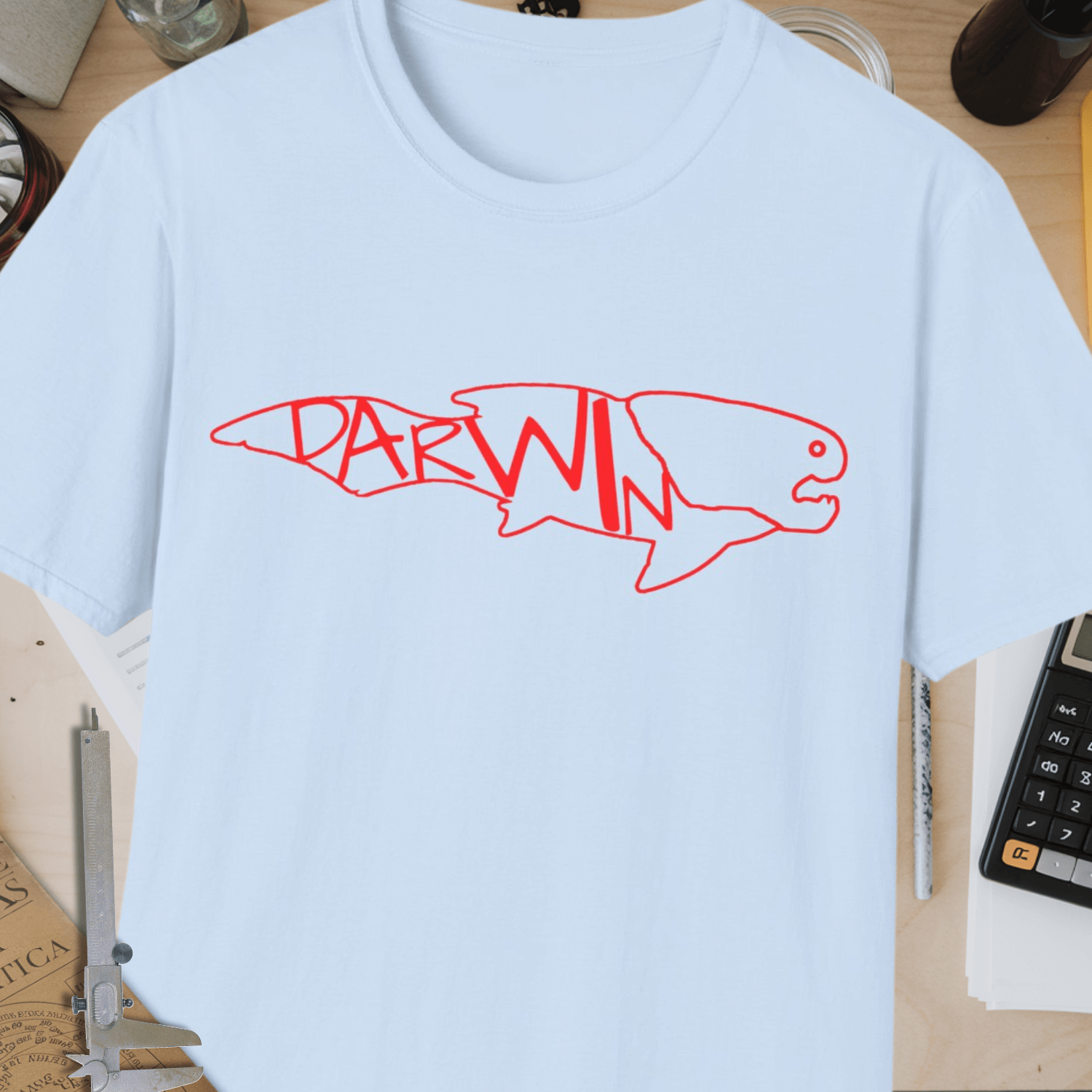
When the finished shirt finally appeared, glowing in red against black fabric, the difference was immediately obvious. The word “DARWIN” was not merely placed inside a fish. It had become part of a recognizable Devonian predator. The broad armored head, the distinctive jaw profile, and the blunt aggression of its silhouette transformed the symbol from a commentary into a biological reference.
I looked at the design and laughed.
The old Darwin fish suggests evolution.
This one looked prepared to enforce it.
The modern Christian fish, often called the ichthys, has a long history as a religious symbol, dating to early Christianity where the Greek word for fish functioned as an acronym associated with Jesus Christ (Ferguson, Backgrounds of Early Christianity, 2003). In contemporary American culture, however, it has become something slightly different. It is no longer just a religious emblem. It is also a cultural marker. A logo. A public signal of identity.
Like all widely recognized symbols, it eventually became available for parody.
The Darwin fish emerged as perhaps the most famous alternative. Instead of a traditional fish bearing the name Jesus, the Darwin version frequently adds legs or references evolutionary theory, transforming a declaration of faith into a commentary on science, skepticism, or secularism (Numbers, The Creationists, 2006). By the early internet era, these variations had become commonplace enough to function as a recognizable genre of visual humor.
And once a symbol becomes a genre, things inevitably become strange.
There are parody fish supporting science. Parody fish supporting atheism. Parody fish supporting rival sports teams. I have seen examples online replacing the text with political slogans, internet memes, science-fiction references, and at least one version devoted entirely to coffee. Social media accelerated this process because symbols that can be redrawn in five seconds tend to mutate rapidly (Shifman, Memes in Digital Culture, 2014).
The ichthys became less of an image and more of a template.
Which is why Proptaku’s shirt succeeds.
It does not merely swap one word for another.
It replaces the fish entirely.
That matters because the standard Darwin fish often uses the same generic outline as the original symbol. The fish remains an abstraction. Evolution is represented through language rather than biology.
Dunkleosteus changes the conversation.
For those unfamiliar with Devonian celebrities, Dunkleosteus terrelli lived roughly 358 to 382 million years ago and belonged to a group called placoderms, armored fishes that dominated ancient marine ecosystems (Carr & Hlavin, “Two New Species of Dunkleosteus,” 2010; Britannica, “Dunkleosteus”). It possessed bony armor plating across its head and a powerful jaw mechanism capable of generating immense bite forces (Anderson & Westneat, “Feeding Mechanics of Dunkleosteus,” 2007).
More importantly, it looks spectacular.
Evolutionary symbols often suffer from being overly conceptual. The common Darwin fish occasionally falls into this trap. The design communicates an idea, but not necessarily a creature. One could argue that a conventional Darwin fish is less a fish than a punctuation mark that wandered into a biology lecture.
Dunkleosteus refuses abstraction.
It arrives wearing armor.
I admit I am biased. The Pacific Northwest has a deep appreciation for large predatory things that appear capable of defeating modern infrastructure. Orcas. Salmon. Mountains. Occasionally weather systems. Dunkleosteus feels spiritually compatible with this regional aesthetic.
The shirt captures that energy perfectly.
The tail of the fish forms the beginning of “DARWIN,” while the letters become structural elements within the body itself. The word does not merely sit inside the animal. The word becomes the animal. By the time the viewer reaches the head, they are staring at the unmistakable profile of a prehistoric predator. The design performs a neat visual trick. Language evolves into anatomy.
That is an unusually elegant way to discuss evolution.
The more I studied the shirt, the less convinced I became that the traditional Darwin fish should remain the default evolutionary symbol. If the goal is to celebrate biological history, why settle for a generic outline when nearly four billion years of evolutionary experimentation are available?
Consider the alternatives.
An infinity symbol, ∞, occasionally appears in discussions of evolution because it suggests continuity. The problem is that infinity is mathematics. Evolution is history.
History has teeth.
History leaves fossils.
History occasionally develops an armored fish capable of biting through ecological assumptions.
Dunkleosteus communicates deep time in a way abstractions cannot. Looking at it immediately raises questions. What is that? When did it live? Why does its face resemble industrial equipment? Good scientific symbols encourage curiosity. Dunkleosteus practically demands it.
I mentioned this to Proptaku.
“The infinity symbol has simplicity on its side,” I said.
“So does a circle,” they replied.
“That’s not a recommendation.”
“Exactly.”
A useful symbol should carry information. Dunkleosteus carries information by accident. Its very existence reminds viewers that life on Earth has undergone astonishing transformations across geological timescales (Benton, Vertebrate Paleontology, 2015). Human beings are not standing apart from that story. Human beings are one recent chapter within it.
The shirt does not make this argument explicitly.
It does not need to.
Like many successful designs, it trusts viewers to complete the thought themselves.
As we left the museum, I found myself thinking less about evolution and more about symbols. Every symbol begins as a shortcut. Over time, however, shortcuts accumulate meanings, controversies, communities, and counter-communities. The Jesus fish became a religious identifier. The Darwin fish became a response. Internet culture transformed both into adaptable visual templates.
Yet Dunkleosteus somehow escapes most of that baggage.
It is difficult to become ideologically rigid when represented by what appears to be a living battering ram from the Devonian.
Perhaps that is why the design works so well.
It remembers that evolution is not merely a concept. It is a succession of organisms, each stranger than the last. The history of life is not a neat line. It is a vast collection of experiments, failures, adaptations, extinctions, and occasional triumphs.
And if you are going to reduce that story to a fish-shaped logo on a T-shirt, it makes sense to choose the fish that looks most capable of winning an argument without speaking.
Dunkleosteus may not be the most important organism in evolutionary history.
But it is unquestionably the one most likely to improve the logo.
References
- Anderson, Philip S. L., and Mark W. Westneat. “Feeding Mechanics and Bite Force Modeling of the Devonian Placoderm Dunkleosteus terrelli.” Biology Letters, 2007.
- Benton, Michael J. Vertebrate Paleontology. Wiley-Blackwell, 2015.
- Carr, Robert K., and William J. Hlavin. “Two New Species of Dunkleosteus from the Devonian of North America.” Acta Geologica Polonica, 2010.
- Encyclopaedia Britannica. “Dunkleosteus.” Encyclopaedia Britannica.
- Ferguson, Everett. Backgrounds of Early Christianity. Eerdmans, 2003.
- Numbers, Ronald L. The Creationists: From Scientific Creationism to Intelligent Design. Harvard University Press, 2006.
- Proptaku. “Darwin Fish Unisex Softstyle T-Shirt.” Proptaku.
- Shifman, Limor. Memes in Digital Culture. MIT Press, 2014.
For those interested

Leave a Reply