
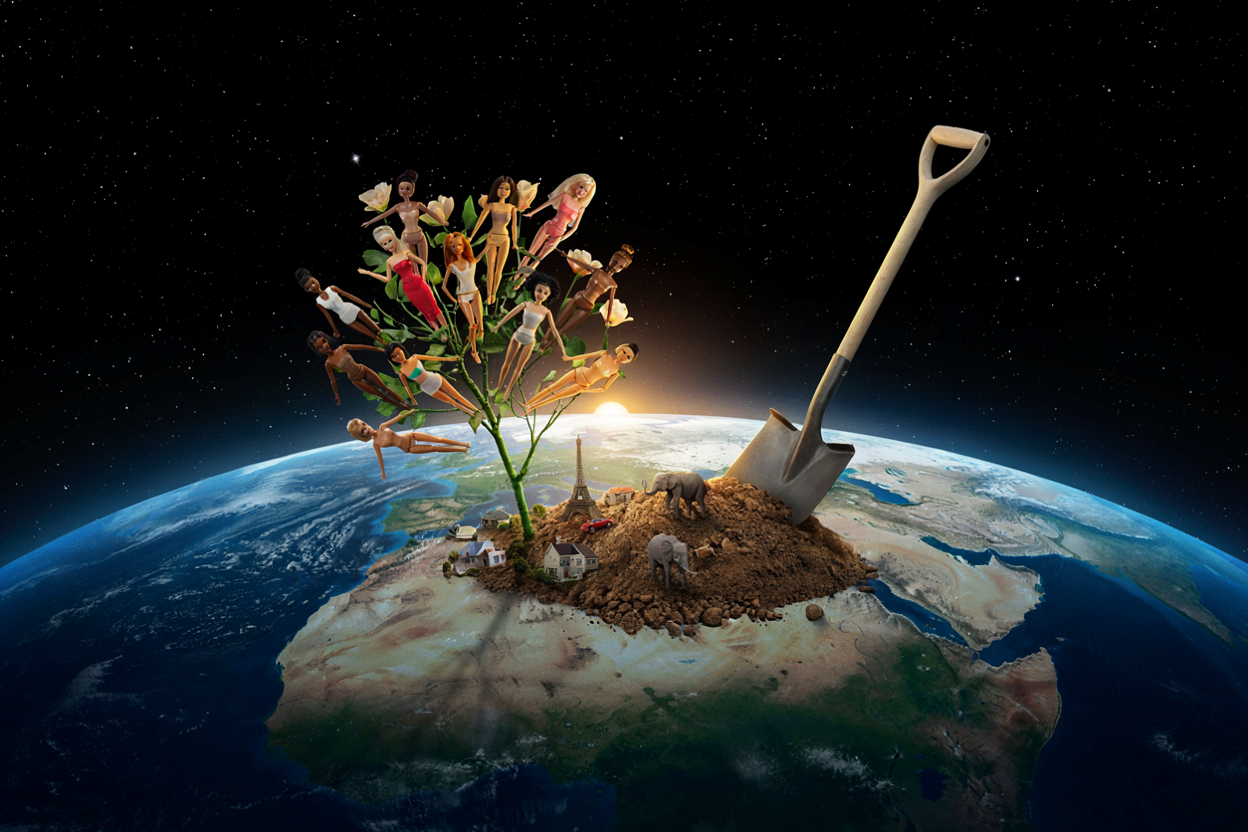
How Language Keeps Calling Things What They Are, Against Better Judgment
I keep tripping over the fact that we name things with words that are just… descriptions, as if we ran out of imagination and decided that the thing itself would suffice. It’s like calling a dog “Dog,” then insisting this is poetic. And yet we do it constantly, with a kind of quiet confidence that borders on absurd.
Take Earth. Not the planet in its blue marbled grandeur, but the word itself. Old English eorþe… dirt, ground, the stuff you scrape off your boots (Harper, Online Etymology Dictionary, n.d.). We’re living on “dirt” and we’ve agreed not to make a big deal out of that. I find that oddly comforting and vaguely insulting. If you’ve ever stood on a wet trail in the Pacific Northwest, mud suctioning your shoes like it has opinions about you, you understand the literalness of it. We named the whole planet after that.
Then there’s Adam, from Hebrew ’ādām, meaning man, or more precisely, humankind, and also tied to ’āḏāmāh, soil (Klein, A Comprehensive Etymological Dictionary, 1966). Man from dirt. Dirt from man. There’s a recursive joke here that no one bothered to punch up. I imagine a committee of ancient speakers, shrugging: “Call him Adam. He’s… human.” No branding department, no layers of metaphor. Just on-the-nose ontology. Which raises a question: do we name things what they are because we trust reality, or because we lack the patience to decorate it?
Eve, Ḥavvah, “life” (Harper, Online Etymology Dictionary, n.d.), is the counterweight. If Adam is soil, Eve is animation. You can almost hear the conceptual imbalance being corrected: fine, one of you is dirt, the other is the principle of being alive. It’s not subtle. It’s not trying to be. I respect that. I also suspect it’s cheating.
If Eve is “life,” then I have to pause and ask: what, exactly, does that make Adam? Not-life? A preliminary draft of existence? I catch myself wondering if that puts him in some awkward category… linguistically, theologically, and possibly biologically. Is Adam a kind of pre-life, like a sketch that hasn’t been shaded in yet? I’d hesitate to call him a zombie, though the temptation is there, especially if we’re playing fast and loose with definitions. Two zombies in scripture feels excessive. One per Testament seems like a generous allocation. Maybe Adam is something closer to a golem; formed, animated, but not quite alive in the way Eve is framed. And then Jesus enters the conversation and, well, suddenly the taxonomy gets messy. Think about it… Jesus… zombie… eating his flesh… oooh, creepy. Resurrection is not the same thing as reanimation, but try explaining that distinction to a word that already means “life.” I’m not sure the vocabulary survives the encounter.
Sahara is another case, from Arabic ṣaḥrāʾ, meaning desert or wilderness (Room, Placenames of the World, 2006). A desert called “desert.” That’s it. No embellishment. It’s as if the land refused metaphor and settled for a flat statement. I’ve driven through stretches of eastern Washington that feel like this—dry, sparse, a little haunted by their own clarity. Naming it “wilderness” is less a poetic act than a shrug in linguistic form.
I can’t say “Sahara” without picturing two competing filmic deserts in my head, which is probably my own problem, but here we are. In one version, it’s Bogart—stoic, sun-blasted, the desert as a place of quiet desperation and efficient dialogue, where even the sand seems to have a sense of timing. In the other, it’s Belushi—louder, messier, the desert as something you’d stumble through with sand in your shoes and a half-eaten sandwich, laughing at the absurdity of being anywhere that dry. Same word, same “desert,” two entirely different climates of meaning. And then Amazon arrives like a different category entirely, as if the language itself decided to change genres mid-sentence.
Amazon, though, complicates everything. The name comes from the Greek Amazōn, often interpreted as “without breast” (a- “without” + mazos “breast”), a mythological projection of otherness onto women warriors (Liddell & Scott, Greek-English Lexicon, 1940). The absurdity is layered here. A river named after a misunderstood body-part rumor. A term that encodes not description but misdescription. It’s a reminder that not all “on-the-nose” names are accurate. Some are just confident guesses that survived the centuries like bad advice.
And I can’t help but think of the modern Amazon, the corporate one, where the river’s name got repurposed into a global logistics mindset; everything flowing, everything delivered, everything mapped. Somewhere in there Jeff Bezos looks at a word that once meant a myth about warriors and decides it should mean fast shipping and cloud infrastructure, which feels like its own kind of etymological violence. And then there’s the aesthetic layer: branding that leans into the idea of scale and terrain while the actual operation is more warehouse than wilderness. I’m not sure the Amazon river would recognize its namesake, but I suspect it would have opinions about the Prime membership. Meanwhile, the whole thing sits in contrast with a cultural image of Bezos himself, now often photographed in a kind of curated, high-confidence leisure with his current, conspicuously curvaceous wife, definitely the opposite of the original meaning. It’s an image that reads less like “river of warriors” and more like “guy who won the naming game and is still trying to optimize the result.”
Stone, from Old English stān, meaning rock (Harper, Online Etymology Dictionary, n.d.), is almost aggressively literal. It’s the kind of word you’d expect a child to invent when asked to label a pile of rocks. And yet it endures, quietly indifferent to nuance. I sometimes think about how many geological arguments have been conducted using words that are basically the same word. Stone. Rock. Pebble. We pretend classification is precise, but the vocabulary is stubbornly minimal.
There’s a kind of linguistic shrug in “stone” versus “rock,” as if English looked at the same object twice and decided, yes, we’ll just name it again, differently, for no particularly pressing reason. The distinction is so thin it feels almost performative, like we’re maintaining a two-word system just to keep poets employed. I find myself wondering if these words endure less because they’re precise and more because they’re useful for sound—stone, bone, throne, alone… an echo chamber for rhyme and cadence. Are we, in some quiet way, the vocabulary victims of vicarious poets, inheriting terms that survived not because they were accurate, but because they were easy to sing? And if that’s true, what does that make the rest of our naming system; functional, or just rhythmically convenient?
England, from Old English Engla land, “land of the Angles,” itself derived from iegland in some early forms, meaning island-land (Room, Placenames of the World, 2006), is a different kind of descriptive naming: not what it is physically, but what it is socially. Land of a people. And still, “island-land” is brutally redundant in a way that makes me grin. As if the land needed to explain itself twice. Ever been in a place so geographically obvious it feels over-labeled? The Pacific Northwest does that too. “Forest.” “Coast.” “Rain.” We are not subtle people either.
Sterno, the product, from Greek sternō meaning to burn or flame (Harper, Online Etymology Dictionary, n.d.), is perhaps the most honest commercial name I can think of. It promises heat. It delivers heat. No metaphor required. It’s a tiny linguistic contract: you will burn, therefore you are called burn. There’s a strange integrity there, like labeling a knife “cut.” I’d almost trust it more than a brand name that tries to evoke something aspirational. Why not just say what you are?
So why do we do this? Etymologists often point to early human naming practices as fundamentally descriptive, grounded in immediate perception and utility rather than abstraction or branding (Crystal, A Little Book of Language, 2010). If you point at dirt and say “dirt,” you haven’t failed at language… you’ve achieved it in its most basic form. The name is the thing, or at least a usable proxy for it. Still, I can’t shake the sense that this is also a kind of linguistic laziness dressed up as clarity.
Here’s the part I keep circling back to: what if naming is not about distinction but about containment? If you call a thing “Earth,” you’ve locked it into its most basic material. If you call a river “Amazon,” you’ve smuggled in myth and error. If you call a man “Adam,” you’ve reduced an entire lineage to soil. I’m not sure whether this is precision or reductionism wearing a clean shirt.
I think about standing on a mossy trail, damp air pressing in, and asking myself whether the word “forest” is doing any real work. Or is it just a label we’ve agreed not to interrogate too closely? And if I start questioning that, do I end up questioning everything, including my own name, which is almost certainly doing less than I think it is?
Maybe the real strangeness is not that we name things so directly, but that we accept those names without demanding more from them. Or maybe we shouldn’t. After all, how much truth can a word hold before it starts to feel like a lie?
References
- Crystal, David. A Little Book of Language. Yale University Press, 2010.
- Harper, Douglas. Online Etymology Dictionary. https://www.etymonline.com (accessed 2026).
- Klein, Ernest. A Comprehensive Etymological Dictionary of the Hebrew Language. Macmillan, 1966.
- Liddell, Henry George, and Robert Scott. A Greek-English Lexicon. Oxford University Press, 1940.
- Room, Adrian. Placenames of the World. McFarland, 2006.

Leave a Reply