
On Proptaku’s “Food Groups” shirt, hedgehogs, and the limits of nutritional order
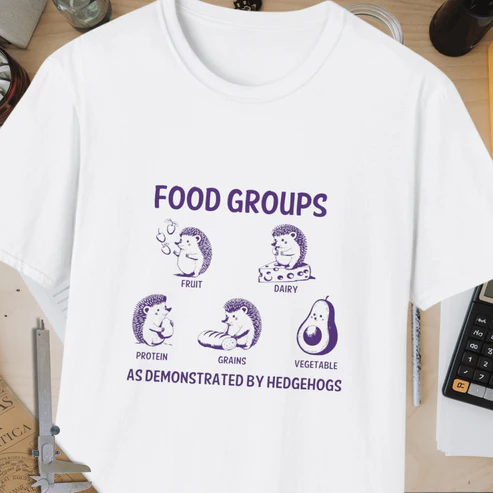
We were at a public garden in the early part of summer, the kind of place that tries to organize nature into something legible without fully succeeding. Gravel paths, labeled beds, and a faintly bureaucratic sense of abundance. Proptaku stood near a small herb plot, their “Food Groups” shirt catching the light in a way that made the hedgehogs look unusually intentional. Five of them, each assigned to a category, each doing something that felt both accurate and slightly disrespectful to nutrition science.
I noticed the fruit hedgehog first, juggling… fruit. Not in a metaphorical sense. It was mid-action, as though fruit itself had decided coordination was a worthwhile pursuit. The dairy hedgehog stood on a cheese wedge with the expression of someone who has accepted their situation but would like to speak to a manager. The protein hedgehog was eating a grub, which is probably the most direct way to make a point about amino acids without losing your audience. And the image is vague… you have to know hedgehog diets. The grains hedgehog cut a French loaf with the careful pride of someone who knows it is being watched. The vegetable hedgehog, meanwhile, wore an avocado costume and seemed determined to behave in a way that defied categorization entirely.
I said, “This is not how food groups work.”
Proptaku replied, “It is how people think they work.”
That distinction matters more than it should.
Food groups, as a system, are an attempt to translate complexity into a set of manageable categories. Proteins, grains, dairy, fruits, vegetables. The structure is meant to guide dietary behavior, not to describe food in its full biochemical reality. It is a pedagogical framework, not a perfect taxonomy (U.S. Department of Agriculture, MyPlate Dietary Guidelines, 2011). The shirt, however, treats the system as something that can be embodied, which immediately introduces friction between the abstract and the absurd.
The fruit hedgehog, for example, is performing. Fruit is often framed as a category of natural sweetness, quick energy, and convenient nutrients. But the juggling suggests instability, as though the category itself cannot remain still. I have to admit, I have been this hedgehog at a farmer’s market, trying to decide between apples and whatever counts as a responsible snack, as if the decision carries the weight of long-term health rather than immediate preference. The shirt turns that indecision into motion. And I settle on pears, if the have them.
The dairy hedgehog is the most emotionally legible. Standing on a cheese wedge, it conveys the kind of quiet uncertainty that comes with being part of a category that is constantly debated. Dairy is both a source of calcium and a subject of ongoing nutritional reassessment, depending on who is talking and what decade they are speaking from (Huth et al., Milk and Health: A Review, 2012). Its placement may have more to do with supporting an industry than actual balance. The hedgehog’s posture suggests awareness of this tension. It is not resisting its placement, but it is not entirely comfortable with it either. I find this relatable, though I would prefer not to.
The protein hedgehog is perhaps the least ambiguous. It is eating a grub, which is an efficient way to demonstrate that protein is not inherently about aesthetics. It is about function. The body requires it for structure, repair, and ongoing maintenance. The shirt does not sanitize this. It keeps the detail grounded in something slightly uncomfortable, which is appropriate. Protein is often treated as abstract necessity, but here it is rendered as an act that is very specific and somewhat unglamorous. I have been known to overthink my own protein intake in ways that feel vaguely like watching this hedgehog and wondering if I am doing enough.
The grains hedgehog, with its French loaf, introduces a cultural layer that the other categories do not fully match. Grains are foundational in many diets, but they are also deeply tied to tradition, economy, and geography. The loaf is not just carbohydrate. It is context. The hedgehog’s careful grip suggests an awareness of that weight. I will confess that I have stood in bakery lines in the Pacific Northwest, quietly attributing moral value to bread choices, as though selecting sourdough over something else constitutes a meaningful decision. The shirt is quietly mocking that tendency, though not unkindly.
Then there is the vegetable hedgehog, which is arguably the most honest of the five. The avocado costume is doing a lot of conceptual work. Vegetables are often treated as the corrective category, the one that offsets excess elsewhere. But the hedgehog’s deliberate weirdness complicates that narrative. It refuses to be purely functional or purely symbolic. It exists in a state of playful resistance, which is, in my experience, how vegetables behave when you are not paying attention to them. Proptaku studied this hedgehog for a moment and said, “It is not trying to be a vegetable. It is just in proximity to one.”
That sentence stayed with me longer than expected.
The humor of the shirt comes from this mismatch between systemized categories and the messy reality they are meant to contain. Nutrition science is structured, evidence-based, and constantly evolving as new research refines older assumptions (Institute of Medicine, Dietary Reference Intakes, 2005). But the way people relate to food is rarely structured in the same way. The hedgehogs expose that gap by behaving like participants in a system that is clearly not built for them.
I found myself thinking about how often I rely on categories to simplify decisions that are not actually simple. Food groups are useful, but they are not exhaustive. They do not account for context, culture, or the minor psychological negotiations that occur every time I decide what to eat. The shirt makes that visible by turning abstraction into character.
Proptaku adjusted their stance, leaning slightly toward the vegetable hedgehog. “The system is fine,” they said. “It just assumes the categories are stable.”
“Are they?” I asked.
They shrugged. “Only until you introduce hedgehogs.”
I am not sure that is a formal position in nutritional science, but it feels close enough to be useful.
As we walked along the path, the garden’s organization began to feel less like clarity and more like a series of decisions someone had to make about what belongs where. The hedgehogs, in their own way, reflect that process. They are not just illustrations. They are interpretations. And like most interpretations, they reveal as much about the system as they do about the subject.
I keep returning to the fruit hedgehog. Not because it is the most accurate, but because it is the most active. It is the category that refuses to sit still. Which might be the real lesson here. Food groups are not fixed realities. They are frameworks intended to guide understanding, not to replace it.
And if you are going to illustrate that with hedgehogs, it makes sense that at least one of them would be juggling.
References
• Huth, Peter J., et al. “Milk and Health: A Review of Recent Human Research.” Journal of the American College of Nutrition, 2012.
• Institute of Medicine. Dietary Reference Intakes. National Academies Press, 2005.
• Proptaku. “Food Groups as Demonstrated by Hedgehogs Unisex Softstyle T-Shirt.” https://proptaku.com/products/the-food-groups-unisex-softstyle-t-shirt
• U.S. Department of Agriculture. MyPlate Dietary Guidelines. 2011.

Leave a Reply