
On Proptaku’s shirt, thermodynamics, and the quiet comedy of phase transitions
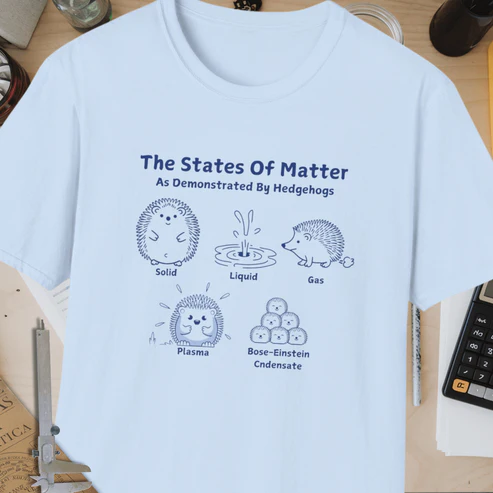
Proptaku’s shirt is not subtle. It reads like someone decided that the periodic table needed more quills. “The States of Matter as demonstrated by hedgehogs” sits across the chest with the kind of calm certainty usually reserved for field guides and warning labels. The design treats physics as something you can wear, which is already a mildly absurd proposition, and then escalates the absurdity by assigning each state of matter a hedgehog. Solid, liquid, gas, plasma, and Bose–Einstein condensate, each represented with a level of sincerity that borders on academic mischief.
I noticed it first in a coffee shop in Seattle, where the air is always slightly damp and the conversations tend to drift toward systems thinking whether you want them to or not. There was a new t-shirt on the table top. Proptaku was sitting across from me, rotating a paper cup like it had a hidden phase diagram printed on the inside. I said, “That shirt is doing a lot of work,” and they replied, “It’s actually doing less work than the hedgehogs. They’re the ones in charge.”
That is the tone of this entire situation. A little earnest, a little playful, and quietly precise about something that most people only half remember from high school.
The shirt is, in a sense, a compact lesson in thermodynamics. Matter is not static. It is conditional. Temperature and pressure dictate how it behaves, whether it holds its shape or spreads out or turns into something that looks like a bad decision made visible (Callen, Thermodynamics and an Introduction to Thermostatistics, 1985). The hedgehogs, of course, are not part of the official curriculum. But they make the concept harder to forget, which is a form of pedagogy that should probably have its own grant category.
I should admit something here. I have been using the hedgehog framework in my head more than I am comfortable with. It started as a joke, then became a tool, and now I occasionally catch myself wondering what state of matter a particularly anxious email is in, which is not a skill anyone asked for.
The story goes that the “solid hedgehog” was the first to be observed, though not in a laboratory. According to the shirt’s internal mythology, a physics teacher somewhere in the Pacific Northwest noticed that a hedgehog curled into a ball behaves like a textbook example of rigidity under stress. Its structure resists external forces, maintaining a defined shape. This is, in fact, what solids do. Their atoms are arranged in fixed positions, vibrating in place rather than flowing freely (Kittel, Introduction to Solid State Physics, 2004). The hedgehog version simply makes this visible, which is useful if you are the kind of person who learns better from spiky animals than from lattice diagrams.
I once saw a hedgehog curl up at a veterinary clinic while waiting for what I assumed was a routine checkup. It looked, briefly, like something you could set on a shelf without it changing. That is the illusion solids provide. They appear stable, but the stability is conditional. Remove enough energy, and you get something that looks fixed. Add heat, and the story changes.
The “liquid hedgehog” is where things get more complicated. The shirt depicts it as slightly expanded, quills relaxed, moving through dihydrogen oxide without taking its shape too seriously. I’m sorry, you can’t see that, it’s under the water. Liquids, unlike solids, maintain volume but not form. They flow. They adapt. Their molecules are still close, but no longer locked into place (Atkins and de Paula, Physical Chemistry, 2014). The hedgehog analogy suggests something that has decided, for the moment, to stop pretending it can hold a rigid identity.
I think about this version more than I should. There are days when I feel like the liquid hedgehog, moving through commitments and conversations, taking the shape of whatever context I am in. Proptaku once said, “Liquid is just solid that stopped resisting.” They did not elaborate, which is typical. I have learned to treat their comments as compressed data rather than finished statements.
The “gas hedgehog” is perhaps the most traditionally comedic. The quills are splayed, the body still intact, but the posture reads less as loss of form and more as active production, as though the organism has become a small, self-contained vent. In the shirt’s interpretation, this is not dispersion but emission: the hedgehog is functioning as a source of gas, a detail that turns a familiar phase into something oddly mechanical and unglamorous. Gas molecules are characterized by high kinetic energy and large distances between them. They do not maintain fixed relationships. They expand to fill available space (Maxwell, Theory of Heat, 1871). Here, however, the hedgehog is not the gas itself but the boundary condition that keeps releasing it, a kind of living apparatus for demonstrating that even “solid” forms can participate in processes that undermine their own apparent stability.
I have a memory of Proptaku pointing at a faint mist rising from a lake in the early morning and saying, “That’s basically a hedgehog that forgot where it was going.” I did not argue with the logic, because it was early, and because it felt true in the way that metaphors often do when you are not fully awake.
Plasma is where the shirt stops being merely funny and starts being slightly unhinged in a way that physicists would probably appreciate. The plasma hedgehog is energetic, glowing, and visibly excited about its own existence. Plasma is what you get when gas is energized to the point that electrons are stripped away, creating an ionized state that behaves differently from the other phases (Chen, Introduction to Plasma Physics and Controlled Fusion, 2016). It is common in stars, lightning, and fluorescent lighting, which means the shirt is, in its own way, depicting a hedgehog that has become astrophysical.
I asked Proptaku if they thought the plasma hedgehog was overdoing it. They said, “It is just responding to input. That is all any of them are doing.” There was a pause. Then they added, “Also, it is probably having the time of its life.”
The final state, Bose–Einstein condensate, is where the shirt becomes genuinely educational and slightly surreal. In this state, particles cooled to near absolute zero occupy the same quantum state, effectively behaving as a single entity (Bose, Plancks Gesetz und Lichtquantenhypothese, 1924; Einstein, Quantentheorie des einatomigen idealen Gases, 1924). The shirt renders this as a pile of tightly packed hedgehogs, their individual forms still visible but pressed into such close proximity that distinction becomes functionally irrelevant. It is not a loss of structure so much as a collapse of individuality into shared behavior, which is both scientifically accurate in spirit and deeply strange in execution.
There is a kind of quiet humor in imagining a hedgehog so cold that it stops being individually distinguishable. Proptaku once said, “If you get all the hedgehogs into the same state, you do not have hedgehogs anymore. You just have hedgehog.” They said it with the same tone someone might use to describe a weather system.
I will admit that I am drawn to this interpretation. It suggests that identity, like matter, is not fixed. It depends on conditions. On energy. On context.
The shirt, in its way, holds all of this together with a kind of practical confidence. It is ethically produced, structurally sound, and built to withstand phase transitions, which is a phrase that should probably be used more often in everyday life. Proptaku wore it during a small conference I attended last spring (OK, it was Emerald City Comic Con). I remember watching them explain plasma hedgehogs to a group of serious physicists (OK, cosplayers in lab coats), who laughed, then nodded, then went quiet in the way people do when a joke turns out to be structurally correct.
I have been thinking about that moment ever since. Not because it was dramatic, but because it was precise. The shirt made a complex subject accessible without flattening it, which is harder than it looks.
Maybe that is the real lesson here. Matter does not simplify for us. It changes state. It adapts to conditions. And if you are paying attention, you start to notice that people do the same thing. Proptaku, for example, does not stay in one phase for long. They move between solid, liquid, gas, and something that looks suspiciously like plasma, depending on the situation. The hedgehogs just make it easier to see.
I am still not entirely sure what to make of the Bose–Einstein hedgehog. But I keep coming back to it anyway. There is something appealing about the idea that, under the right conditions, everything becomes connected, even if only briefly.
And if that is the case, then the shirt is not just a joke or an educational tool. It is a reminder that the boundaries we see are often temporary. That matter, like people, is always in transition.
References
• Atkins, Peter, and Julio de Paula. Physical Chemistry. Oxford University Press, 2014.
• Bose, Satyendra Nath. “Plancks Gesetz und Lichtquantenhypothese.” Zeitschrift für Physik, 1924.
• Callen, Herbert B. Thermodynamics and an Introduction to Thermostatistics. Wiley, 1985.
• Chen, Francis F. Introduction to Plasma Physics and Controlled Fusion. Springer, 2016.
• Einstein, Albert. “Quantentheorie des einatomigen idealen Gases.” Sitzungsberichte der Preussischen Akademie der Wissenschaften, 1924.
• Kittel, Charles. Introduction to Solid State Physics. Wiley, 2004.
• Maxwell, James Clerk. Theory of Heat. 1871.
• Proptaku. “The States of Matter as Demonstrated by Hedgehogs Unisex Softstyle T-Shirt.” https://proptaku.com/products/the-states-of-matter-unisex-softstyle-t-shirt

Leave a Reply