
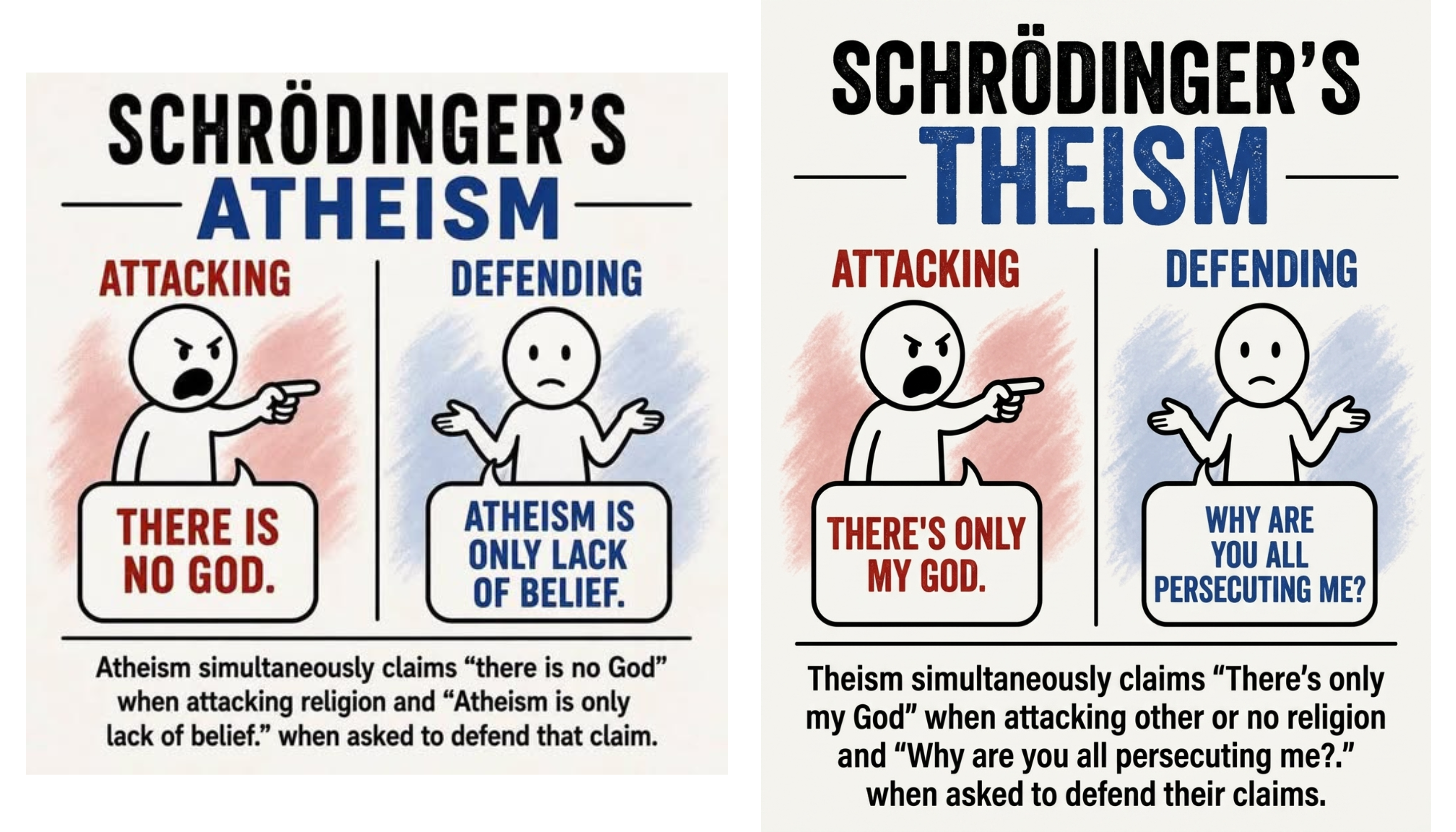
One thing I notice, especially with so much exposure to social media, is that far too many people with strange agendas and very little imagination have turned to meme based propaganda as the primary vehicle for pushing a message. The format is attractive because it compresses an argument into a single image, strips away context, and replaces analysis with recognition. The goal is rarely to persuade through evidence. The goal is to create the feeling that a conclusion is already obvious. If the audience nods before thinking, the meme has done its job.
What makes this style of propaganda so interesting is how little work it actually does. The first image, the “Schrödinger’s Atheism” meme, is a good example. It presents two statements, assigns them to an entire category of people, and then declares a contradiction. The mechanism is almost embarrassingly simple. No data. No survey. No argument connecting the claim to actual atheist positions. No demonstration that the same individuals are making both statements. Just a generic stick figure, a generic accusation, and an implied dilemma. The visual design does most of the labor while the reasoning remains conspicuously absent.

I find that revealing. The meme depends on the audience already agreeing with its conclusion. If someone stops and asks a few annoying questions, the structure starts wobbling. Which atheists? How many? Under what circumstances? Where is the contradiction? The image never bothers to say. It cannot, because answering those questions would require abandoning the meme format and doing the harder work of constructing an argument.
The second image is useful precisely because it demonstrates how easily the template can be inverted. Nothing substantial changes. The same stick figures remain. The same visual framing remains. The same accusation remains. Only the labels are swapped. Suddenly the target is theism rather than atheism. The remarkable thing is not that the second meme is persuasive. It is that it works almost exactly as well as the first. That should make people uneasy.

When a message can be reversed without changing the underlying structure, it reveals that the structure was never carrying meaningful evidence in the first place. The template functions like a stencil. Slide one group out. Slide another group in. The rhetorical effect survives because the image was never dependent on facts. It was dependent on audience loyalty.
This is one reason meme based propaganda tends to be intellectually lazy. It bypasses the burden of demonstrating a claim and instead manufactures the appearance of demonstration. The image creates a shortcut around the evidentiary process. What should be a conclusion becomes a premise. What should be supported becomes assumed. The audience is invited to laugh, share, and move on before noticing that almost nothing has actually been established.
Personally, I think the inversion is the most educational part. The moment a meme can be turned against its creator with a few edited words, it exposes itself. A sturdy argument usually survives inversion. A propaganda template rarely does. The fact that both versions feel superficially plausible tells us less about atheism or theism than it does about the weakness of the format itself. It is a cardboard cutout pretending to be an argument.
References
Kahneman, Daniel. Thinking, Fast and Slow (2011).
McIntyre, Lee. Post-Truth (2018).
Mercier, Hugo & Sperber, Dan. The Enigma of Reason (2017).
Tufte, Edward. The Visual Display of Quantitative Information (2001).

Leave a Reply