
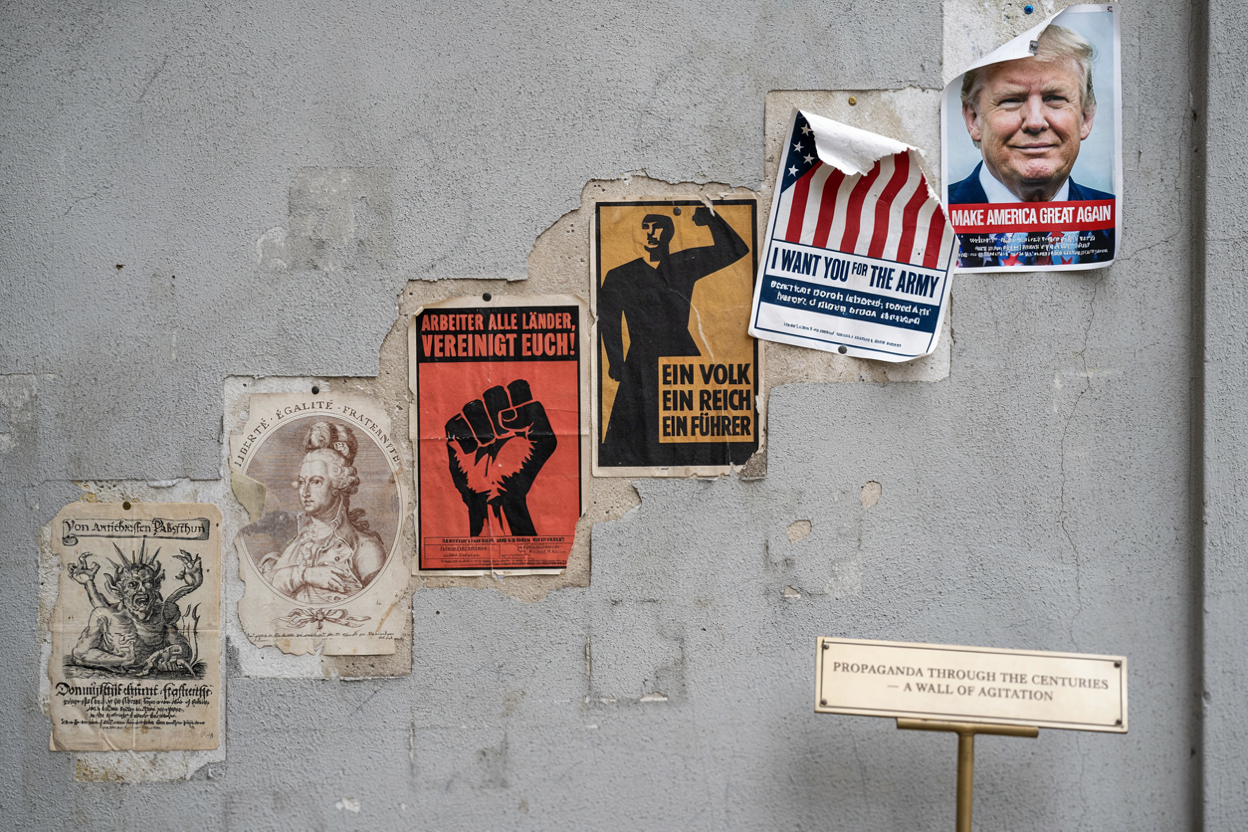
The morning of July 5th sits with that Pacific Northwest flat light, the kind that makes everything feel slightly overexposed and also oddly exact. I am starting this essay from that place, after months of not circling back to propaganda as a topic. There is a sense of exhaustion in the return, but also a kind of focus, like I have run out of excuses to leave the structure unexamined.
It matters that this is the day after July 4th, not just as a calendar fact but as a kind of afterimage. The Fourth is a concentrated exercise in narrative: repetition made visible, emotion made public, and identity made performative. Flags function as transfer, carrying the weight of legitimacy without argument. Glittering generalities do their usual work, words like freedom and liberty hovering above any precise definition, easy to repeat, harder to interrogate. The entire day leans on social proof, the expectation that participation signals correctness, that the crowd itself is evidence. Even the structure of the holiday maps cleanly onto the “rules of influence” behind propaganda tactics and goals: Tactics = what you do, Goals = what you want, Principles = why it works. The Fourth is not accidental. It is arranged.
On July 5th, that arrangement loosens, and what remains is the mechanism. The same principles still operate, but without the same saturation. Repetition has already done its work, so the message no longer needs to be loud. The goals are still there, shaping perception, normalizing identity, reinforcing reputation, but they are easier to see as constructed rather than inherent. And this is where the exhaustion settles in for me, because the structure does not disappear when the performance ends. It just becomes quieter, which makes it more difficult to ignore. I find myself asking what it means to recognize a system like this and still participate in it, even critically. At what point does awareness become another form of repetition, another layer of the same framework?
What I see from research and time in discussions is not any single tactic, but the way the three layers stack. The “rules of influence” behind propaganda tactics and goals are simple enough to state and hard enough to escape:
- Tactics = What you do (name calling, bandwagon, etc.)
- Goals = What you want (control, mobilize, persuade)
- Principles = Why it works (psychology and behavior)
That triad is not abstract. It is operational. It explains how a message moves from construction to effect. It is also the hidden architecture behind the kind of debates I wrote about earlier, where “you and your opponent are not playing the same game”. That line still feels right, but what I missed then is that propaganda is often the game itself, not just a disruption of it.
The tactics are recognizable at the surface level.
1. Name Calling – Attaching a negative label to a person or idea so the audience rejects it without examining evidence.
2. Glittering Generalities – Using vague, emotionally positive words (like “freedom,” “truth,” “justice”) without clear, testable meaning.
3. Transfer = Borrowing authority or prestige from something respected (a symbol, institution, or figure) to make a claim seem legitimate.
4. Testimonial – Quoting a person (often famous or authoritative) to endorse a claim, whether or not they are qualified on that topic.
5. Plain Folks – Presenting a message as if it comes from an “ordinary person” to create familiarity and trust.
6. Card Stacking – Selective presentation of facts, emphasizing favorable details while omitting or downplaying contradictory evidence.
7. Bandwagon – Suggesting that something is correct or desirable because “everyone” supports it or is doing it.
8. Fear (often called “Fear Appeal”) – Invoking anxiety or threat to push the audience toward a particular conclusion or action.
9. Logical Fallacies – Using reasoning that appears structured but is actually flawed, such as false dilemmas, straw man arguments, or non sequiturs.
They look like rhetorical moves, but they are really delivery mechanisms. Each one is a way to route a message toward a goal without requiring the audience to stop and think too long. Name calling compresses a reputation into a label. Bandwagon compresses judgment into perceived consensus. Fear compresses complexity into urgency. The tactic is the shortcut.
The goals are more stable. They show up across contexts, even when the tactics change.
1. Shape Perception – Influence how people interpret events, issues, or groups. The goal: Control the “lens” through which reality is viewed.
2. Build or Destroy Reputation – Elevate a person, idea, or organization… or discredit it. The goal: Create trust or distrust.
3. Mobilize Action – Get people to take a specific step (vote, donate, protest, buy). The goal: Turn belief into behavior.
4. Maintain Power or Control – Reinforce authority structures and discourage opposition. The goal: Preserve the status quo or ruling influence.
5. Create Loyalty or Identity – Strengthen group belonging (nation, ideology, brand, movement). The goal: Foster “us vs. them” thinking and commitment.
6. Demonize or Dehumanize Opposition – Portray opponents as dangerous, immoral, or less than human. The goal: Justify hostility or reduce empathy toward them.
7. Normalize an Idea or Behavior – Make something seem common, acceptable, or inevitable. The goal: Reduce resistance through familiarity.
8. Sow Confusion or Doubt – Undermine confidence in facts, institutions, or alternatives. The goal: Create uncertainty so people disengage or comply.
9. Justify Policies or Actions – Provide a narrative that makes decisions seem necessary or righteous. The goal: Gain acceptance for controversial actions.
These are not subtle aims. They are directional forces. When a message is aiming at “create loyalty or identity,” it will lean toward “us vs. them” framing. When it is aiming at “sow confusion or doubt,” it will often rely on card stacking or logical fallacies. The goal determines which tactic feels natural.
The principles are where the system becomes less visible and more mechanical.
- Repeat Messages Frequently – Repetition increases familiarity, and familiarity increases perceived truth (“illusory truth effect”).
Rule: People are more likely to accept something they’ve heard many times, even without evidence.
- Use Big, Simple Claims (The “Big Lie”) – Large, dramatic assertions are more memorable and harder for people to fully verify.
Rule: If a claim is bold enough, people assume it wouldn’t be said unless it were true.
- Appeal to Emotion Over Logic – Fear, pride, anger, and hope override analytical thinking.
Rule: Emotional reactions reduce critical evaluation.
- Exploit Cognitive Shortcuts (Heuristics) – People rely on mental shortcuts like authority, popularity, or vividness.
Rule: If something feels credible, it’s often accepted without scrutiny.
- Target Trust in People and Institutions – Undermine credibility of journalists, scientists, governments, or opposing groups.
Rule: When trust is weakened, audiences become more susceptible to alternative narratives.
- Simplify Complex Issues – Reduce nuanced topics into clear binaries or slogans.
Rule: Simplicity is easier to process than complexity, so it spreads faster.
- Create an “Us vs. Them” Frame – Divide audiences into in-groups and out-groups.
Rule: Group identity influences perception more than facts.
- Control the Information Environment – Flood spaces with selective narratives, distractions, or competing claims.
Rule: When overwhelmed, people disengage or default to the most familiar message.
- Leverage Social Proof and Perceived Consensus – Signal that “everyone believes this” or “most people agree.”
Rule: People tend to align with what they perceive as the majority view.
What ties these layers together is interdependence. A tactic without a goal is just noise. A goal without a principle is just intent. A principle without a tactic is just psychology in isolation. The structure only works when all three align, when a message is designed to move through behavior, aim, and cognition simultaneously.
I find myself thinking about this in the context of how people argue, including how I have argued. In my own guide I wrote that the real issue is that “facts don’t land as information. They land as threats”. That observation sits uncomfortably close to propaganda principles, especially the ones involving emotion and identity. If a fact can be reframed as a threat, then it can be neutralized. If it can be neutralized, then it no longer functions as a constraint on belief.
There is a temptation, once you understand this, to use it in return. To mirror the structure. To respond to card stacking with your own selective framing. To answer fear appeal with intensified urgency. To counter “us vs. them” with a sharper version of the same division. That is the trap I keep seeing, and it is not hypothetical. It shows up in real exchange patterns, where the goal shifts from understanding to dominance. The system becomes self-reinforcing. Propaganda against propaganda does not cancel out the structure. It doubles it.
The harder question is where resistance fits. If tactics are what you do, and they are already embedded in the system, then avoidance is not enough. If goals are what you want, then the question becomes whether your own aims are clean from the influence of the same framework. If principles are why it works, then the act of recognizing them becomes part of the mechanism itself. Awareness does not sit outside the system. It runs through it.
Take the principle of repetition. It is easy to identify in political messaging, in advertising, in the way certain phrases circulate until they feel inevitable. But repetition also shows up in critical spaces, where the same counterclaims are repeated until they become their own kind of slogan. The difference is not always in content. It is in whether repetition is being used to clarify or to condition.
Or take the principle of targeting trust. My earlier writing emphasizes holding the burden of proof and refusing to accept framing. That is a form of protecting trust, but it can easily slide into its own version of distrust if it becomes too automatic. At what point does skepticism of institutions become indistinguishable from the very undermining of authority that propaganda relies on? That question does not resolve cleanly. It lingers.
And this brings me back to the idea that propaganda is less about deception and more about structure. It arranges perception, reputation, and action into a predictable flow. It uses tactics to reach goals, and it relies on principles to make those tactics effective. Once you see that, you start noticing how often arguments are not really about evidence at all. They are about whether the structure of the argument is intact.
This is where the structure stops being just an abstract model and starts to look historically familiar. Eco’s Ur-Fascism is useful here not because it defines a single ideology, but because it lays out a repeatable pattern, a kind of political grammar that can reassemble itself in different conditions. When he describes a “cult of tradition,” or the way dissent is reframed as betrayal, or the impulse toward “selective populism,” he is mapping something closer to a system than a doctrine. It is not the content that matters so much as the arrangement: the way identity, authority, and threat are wired together so that disagreement is no longer an exchange of ideas, but a test of belonging. That is not far from the propaganda triad. Tactics become the visible instruments, goals become the direction of that wiring, and principles become the psychological conditions that make the whole thing stable.
What I notice in Eco’s framing is how easily those features can be expressed through the same mechanisms already familiar from propaganda: repetition that hardens slogans into common sense, emotional appeals that collapse complexity into urgency, and the gradual erosion of trust that shifts authority away from evidence and toward narrative. “Newspeak,” as Eco calls it, is not just simplified language; it is language that has been stripped down to a set of repeatable cues, which is exactly what happens when glittering generalities and bandwagon logic take over discourse. The overlap is not theoretical. It is practical. It is the same movement from structure to effect, only now the structure is ideological and the effect is behavioral. And once that pattern is visible, it becomes difficult not to see how close the boundary is between describing these systems and participating in them, especially when the tools used to analyze them are themselves part of the same cognitive terrain.
George Orwell’s 1984 sits almost uncomfortably close to this conversation, not because it is a prediction, but because it is a demonstration of how the structure can be stabilized and made total. The mechanisms are familiar: repetition that hardens into doctrine, language that narrows until it can only carry approved meanings, and the deliberate strangling of trust so that reality must be mediated through authority. What Orwell dramatizes is not just propaganda as persuasion, but propaganda as environment, where the “rules of influence” are no longer optional techniques but the conditions of thought itself. In that sense, the novel is not distant from Eco’s framework or from the list of tactics and principles. It is a compressed version of the same interdependence, pushed to its extreme, where tactics, goals, and principles stop appearing as separate layers and instead fuse into a single system that defines what can even be said.
This dynamic is not merely theoretical; it is mirrored in well-documented patterns of high-control environments, like cults and religions, where influence is exercised less through overt argument than through the shaping of perception and meaning-making itself. Commonly observed tactics include thought reform through controlled repetition of key narratives, language restriction that limits conceptual range and dissent, emotional framing that ties belonging to acceptance of the system, information control that isolates individuals from independent verification, and identity redefinition that aligns personal worth with adherence to the group’s worldview.
So, I ask, directly, without trying to soften it. If a message can shape perception without changing facts, what exactly are we responding to when we argue back? If a goal can be achieved without persuasion, just through normalization or confusion, what does winning even mean? And if the principles of influence are always operating, even in resistance, then what does it look like to engage without replicating the same patterns?
I do not have a clean answer. What I have is a sense that the most dangerous part of propaganda is not its content. It is its portability. The same framework moves easily between persuasion and critique, between authority and opposition, between belief and doubt. It is easy to imagine yourself outside it. It is harder to see when you are just running a different version of the same system.
That is where I am leaving this, not as closure, but as a working tension. The lists are not neutral. They are active. And the question is not whether they exist, but how quietly they organize the way we think.
References
- CeleryKills. A Practical Guide to Debating Creationists (Without Getting Trapped), 2026
- Institute for Propaganda Analysis. Propaganda Analysis, 1937
- Adolf Hitler. Mein Kampf, 1925
- Edward Bernays. Propaganda, 1928
- Daniel Kahneman. Thinking, Fast and Slow, 2011
- Umberto Eco. “Ur-Fascism” (also published as “Eternal Fascism”), 1995
- George Orwell. 1984, 1949

Leave a Reply