
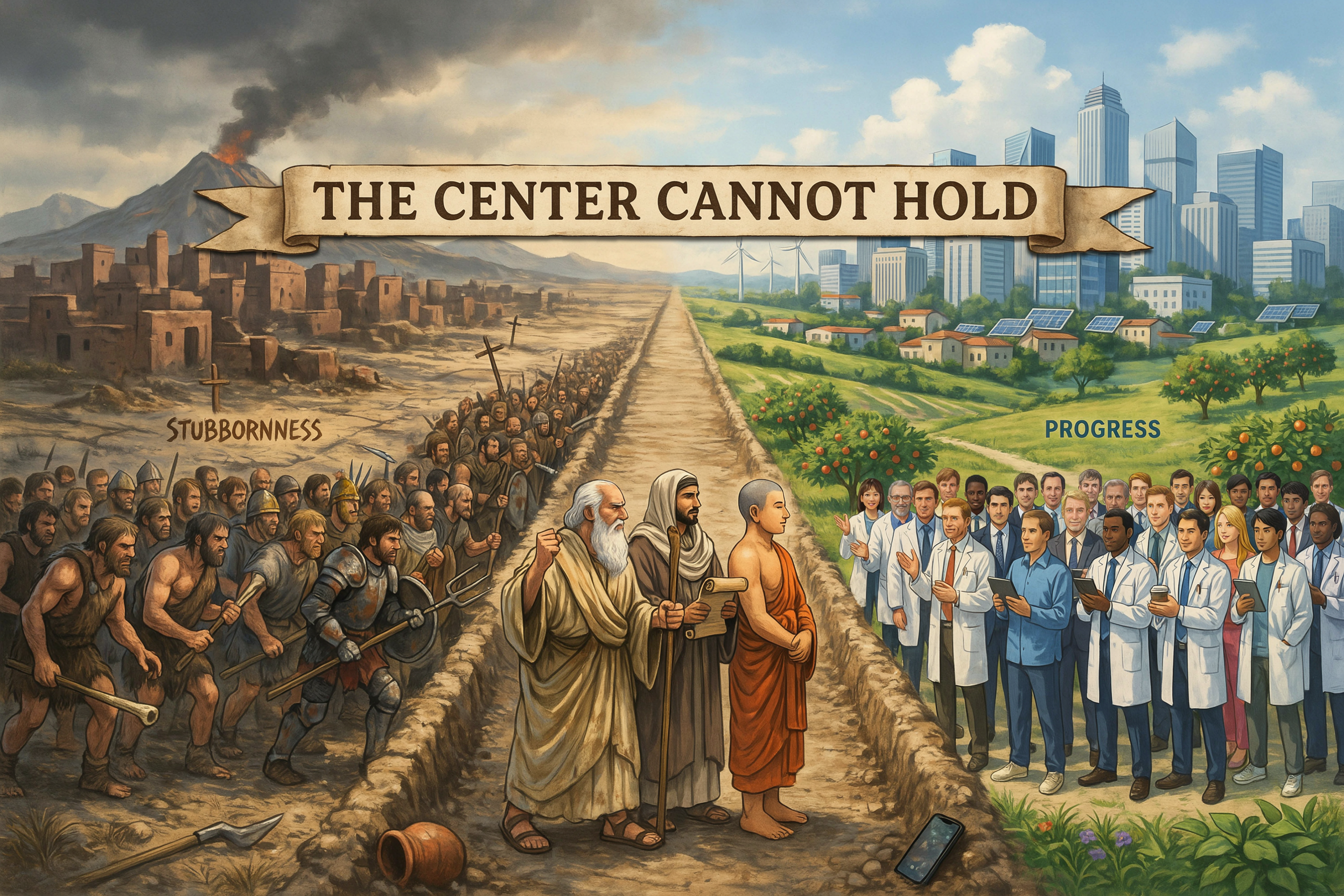
Anthropocentrism and the Persistent Illusion of Human Centrality in Science, Philosophy, and Imagination
anthropocentrism
an·thro·po·cen·trism /ˌanTHrəpōˈsentrizəm/ (noun)
- A worldview or mode of thought that places human beings at the center or apex of significance, interpreting reality, value, and purpose primarily in human terms.
- In philosophy and ethics, the position that human interests, experiences, and perspectives are the primary or exclusive basis for moral consideration.
- In epistemology and science, the tendency to treat human cognitive structures, sensory capacities, or scales of observation as representative of reality itself rather than as contingent limitations.
Usage notes:
Anthropocentrism often operates implicitly, shaping assumptions about nature, evolution, and the cosmos. It is frequently criticized for introducing bias, particularly when human traits are projected outward as universal standards.
Related terms:
- ethnocentrism (cultural extension of the same bias)
- teleology (attributing purpose or design)
- human exceptionalism (belief in inherent human superiority)
Example sentence:
“The claim that ecosystems exist for human benefit reflects a deeply anthropocentric framing of the natural world.”
Anthropocentrism, in its most compact dictionary sense, is the practice of regarding human beings as the central or most significant entities in the world. Standard lexicons frame it as a belief that value, meaning, and purpose radiate outward from human existence, rather than being distributed across or independent of it (Oxford English Dictionary, “Anthropocentrism,” 2020). That definition looks tame on the surface. It reads like a harmless preference. But the history of the term tells a sharper story, one that runs through theology, natural philosophy, colonial encounters, and modern science, leaving a long record of mistaken certainty.
I first ran into that “harmless preference” as something less harmless in an anthropology classroom, where ethnocentrism, anthropocentrism’s close cousin, was introduced not as a moral failing but as a default setting. I remember watching John Marshall’s The Hunters and feeling the subtle pull of its narrative, how the Ju/’hoansi were framed as if suspended outside of history, defined almost entirely by subsistence and the spectacle of the giraffe hunt (Marshall, The Hunters, 1957). At the time it felt like documentation. Later it read as projection. The film seemed to ask me to see them as a kind of living past, a human origin story preserved for observation, which says more about the observer than the observed. That recognition followed me into work as an information architect, where I kept seeing the same pattern under a different name. Categories presented as neutral would quietly encode assumptions about what counts, what persists, what matters. Taxonomies flatten complexity in ways that feel efficient and inevitable until you ask who built them and for whom. In both cases, the move is familiar. Start with a human frame, often my own, then let it dissolve into the background until it looks like the structure of reality itself.
The word itself took shape in the nineteenth century, when European intellectuals were already confronting the erosion of Earth’s central place in the cosmos. Copernicus had already displaced geographic centrality. Darwin then unsettled biological centrality by placing humans within evolutionary continuity rather than above it (Darwin, On the Origin of Species, 1859). Anthropocentrism persisted anyway. It simply migrated. Humans were no longer physically central, so the argument shifted. Perhaps the universe was tuned for us. Perhaps evolution was moving toward us. Perhaps the structures of nature anticipated our needs. You can hear the adjustment happening.
I have always found that shift more instructive than the original belief. During my anthropology training, ethnocentrism was treated as a methodological hazard, something to identify early and discipline out of one’s analysis. Boas was explicit about it. Cultural forms are not distorted approximations of Western rationality but coherent systems on their own terms (Boas, The Mind of Primitive Man, 1911). Later, studying information science, I saw a parallel problem. Data is rarely neutral. It is collected, structured, and interpreted through human frameworks that feel universal only because they are familiar. The same habit shows up in both domains. We begin with ourselves. Then we forget that we did.
Fine tuning is the most recognizable modern expression. The constants of physics appear to permit life. Therefore, it is said, they must have been adjusted with life in mind. But what does “life” mean in that sentence? Often it means carbon based organisms at human scale and temperature. The argument quietly narrows the range of possibilities, then treats the surviving case as extraordinary (Barrow and Tipler, The Anthropic Cosmological Principle, 1986). A narrative example appears in popular science writing that marvels at how slight changes in gravity or electromagnetism would prevent human bodies from forming. Of course they would. We are built from those constants. Reverse the logic and the conclusion dissolves.
The reversal is almost trivial once the human reference point is removed. Imagine beginning not with “life like us” but with the full, indifferent range of possible physical conditions. In that framing, there is no requirement that the constants produce carbon chemistry, stable stars, or bodies that metabolize oxygen. Most configurations would not support anything recognizable as human, and nothing in that absence would register as a problem. Douglas Adams captured the shift more plainly with his puddle analogy, where a sentient puddle marvels that the hole fits it perfectly, concluding the hole must have been made for it, right up until the water evaporates (Adams, The Salmon of Doubt, 2002). The mistake is the same. The fit feels meaningful only because the observer has already adapted to the conditions. Shift the premise and the “improbability” evaporates. It is not that the universe is tuned for life; it is that any form of life that arises will necessarily find itself in conditions compatible with its own existence. The appearance of special calibration is a byproduct of perspective, not a feature of the system itself.
Teleological bias feels even more familiar. Plants exist to feed animals. Rivers exist to supply cities. I have heard variations of this in field conversations with people describing landscapes as if they were infrastructural assets waiting to be used. In literature, Daniel Defoe’s Robinson Crusoe quietly performs the same move, converting an island into a system of resources calibrated for one man’s survival (Defoe, Robinson Crusoe, 1719). The problem is not just moral. It is conceptual. Function is mistaken for purpose.
The old geocentric model is the cleanest example of the privileged position fallacy. Earth sits at the center because humans matter. That logic persists in weaker forms. Observational cosmology sometimes slips into language that treats our location as a vantage point rather than an accident of position. The Copernican principle exists precisely to counter that temptation (Sagan, Cosmos, 1980). Still, the instinct returns. Why are we here, in this particular epoch? Why now? Temporal anthropocentrism reframes coincidence as significance.
Anthropic probability arguments amplify the confusion. Human life appears highly improbable, therefore it must be meaningful or intended. Yet improbable relative to what sample? When I worked through datasets in information science courses, the lesson was constant. Probability depends on framing. Change the reference class and the improbability dissolves. In cosmology, the same error appears when the only outcome considered is one that produces observers like us.
There is a simple way to watch that framing collapse, and it looks less like philosophy than bookkeeping. In one of my information science assignments, we modeled probability over large datasets with shifting reference classes, and the results changed in ways that felt almost dishonest until you realized nothing in the underlying data had moved. Take something ordinary. The exact sequence of cards in a freshly shuffled deck has a probability of about 1 in 8×10⁶⁷. That number is so small it borders on meaningless, yet every shuffle produces one such sequence. No one treats the outcome as designed or intended because we understand that any arrangement would have been just as improbable ex ante. Now return to cosmology. If the reference class includes only universes that produce human observers, then our existence looks vanishingly unlikely. Expand the class to all possible configurations, and our case becomes just one realized outcome among many that could never remark on themselves. The sense of improbability is not discovered, it is constructed, and once you see how the construction works, it is difficult to take the conclusion at face value.
Observer centered reasoning goes further. It assumes reality must be intelligible to human cognition. Mathematics maps onto the world, so the world must be structured for minds like ours. Eugene Wigner called this the “unreasonable effectiveness of mathematics” (Wigner, “The Unreasonable Effectiveness of Mathematics,” 1960). But reverse the relationship. Our cognitive tools developed within this environment. Of course they fit. A species that could not model its surroundings would not persist.
That reversal becomes harder for people to accept once the language of physics begins to sound like it is inviting them back in. The “observer effect” in quantum mechanics is a good example, often pulled out of context and reshaped into a claim that human consciousness somehow brings reality into being or guides outcomes. In more popular or speculative corners, it drifts further, into psychology, into spiritualism, into vague assertions that attention or intention shapes the structure of the world. Yet in its actual formulation, the observer is not a human mind but any physical interaction that constrains a system, a detector, a photon, a measuring apparatus. Nothing in the mathematics requires awareness, let alone human awareness. The appeal comes from slipping the everyday meaning of “observer” back into a technical term and letting the ambiguity do the work. I have seen this move in classroom discussions and outside them, where the idea that reality depends on us feels less like a hypothesis and more like reassurance. But the effect is the same as before. A local feature of our experience is elevated into a universal principle, and for a moment it seems plausible that the universe is not just intelligible to us but contingent on us.
Evolutionary exceptionalism might be the most persistent narrative failure. Humans as the pinnacle. The Great Chain of Being arranged organisms in a vertical hierarchy culminating in rational man. That framework lingered well into the nineteenth century and still surfaces in casual language about “higher” and “lower” species (Lovejoy, The Great Chain of Being, 1936). Yet evolution has no apex. It branches. I remember a lab discussion where someone asked, almost reflexively, what species might come “after” humans. After, as if evolution were a queue.
That assumption leaks into a more defensive posture as well, where the language of branching evolution is resisted outright. We have all heard people reject the classification of humans as apes or even as animals, as if the label itself were a demotion rather than a description of lineage. Darwin anticipated this discomfort, noting how quickly objections to common ancestry turned on wounded pride rather than conflicting evidence (Darwin, The Descent of Man, 1871). The resistance often takes familiar forms. Humans are said to be uniquely rational, uniquely moral, uniquely conscious, with each distinction treated as categorical rather than continuous. Yet the biological record does not cooperate. Genetic, anatomical, and behavioral continuities place humans squarely within primate evolution, whether or not that placement feels acceptable. What stands out is not the classification itself but the effort to evade it. If humans are part of the same branching process as every other organism, then the narrative of culmination weakens, and with it the sense that evolution was moving toward us at all.
Moral anthropocentrism carries the same structure into ethics. Only human interests count. Environmental philosophy has spent decades pushing against this, arguing for biocentric or ecocentric frameworks (Naess, “The Shallow and the Deep,” 1973). Still, policy decisions often revert to human benefit as the sole metric. Forests are carbon sinks or timber stocks. Oceans are fisheries. What disappears in that framing?
That narrowing of value has not stayed abstract. It shows up in the material record of extinction curves and atmospheric data, in the quiet absence of species that were treated as expendable and the accumulating signal of a climate altered by extraction and consumption. Hunting campaigns that drove megafauna to extinction, industrial fishing that collapses entire populations, forests reduced to yield calculations, all of it follows from the same premise that nonhuman systems exist primarily as inputs to human ends. The justification often arrives after the fact, framed as necessity, progress, or even stewardship, while the underlying assumption remains untouched. We have heard the denials as well, the insistence that the scale of impact is exaggerated or that the systems in question will absorb whatever we impose on them. It is a convenient position. If the world is fundamentally for us, then its degradation can be recast as use rather than loss. The pattern is not subtle, just persistent, a way of maintaining the same hierarchy even as the consequences become harder to ignore.
Scale bias operates more quietly. We assume that what is intuitive at human scale reflects the structure of reality. Quantum mechanics and relativity exist as ongoing corrections to that intuition. Time dilates. Space curves. Causality behaves strangely. The discomfort people express toward these theories often sounds like resistance to leaving the human frame.
The design analogy persists in arguments that compare the universe to a machine. Machines have designers. Therefore, the universe does. David Hume dismantled this reasoning centuries ago by pointing out the weakness of the comparison (Hume, Dialogues Concerning Natural Religion, 1779). Yet the analogy returns, often updated with contemporary technology. The universe as computer. The same structure, new vocabulary.
The design analogy has a familiar set of variations, each one shifting the surface comparison while retaining the same underlying move. The watchmaker argument treats the universe as an intricate mechanism, invoking craftsmanship as the only plausible source of ordered complexity. The architectural version imagines laws of physics as blueprints, implying intention behind structural regularity. More recent iterations replace clocks and buildings with software, suggesting that reality itself runs like code on some deeper substrate. Each version depends on a transfer of intuition from human artifacts to the natural world. Yet that transfer fails once the human reference point is set aside. Complexity does not uniquely signal intention. Order can arise from constraint and interaction without foresight. Systems can exhibit regularity without being planned. Hume’s critique holds because the analogy never establishes necessity, only familiarity.
Remove the anthropocentric premise and the analogy loses its force almost immediately. Machines require designers because they are embedded in human practices of construction and use. Natural processes do not share that context. To assume they do is to import a framework rather than discover one. When people encounter organized complexity and reach for design, they are often responding to a mismatch between expectation and observation, not to evidence of intention. The argument works by anchoring explanation in what we know how to make, then projecting that knowledge outward. Once that anchoring is recognized as contingent, the conclusion no longer follows. The universe does not resemble a machine in any way that requires it to have been built, and the insistence that it must says more about the limits of the analogy than about the structure of reality.
Survivorship bias adds another layer. We notice a world compatible with observers because incompatible worlds are unobserved. That statement feels trivial, but it dismantles a surprising number of claims about rarity and purpose (Nick Bostrom, Anthropic Bias, 2002). The logic is uncomfortable because it removes the sense of special placement. It is also one that directly supports fine tuning and other fallacies in the same category.
Consciousness centered arguments elevate subjective experience to cosmic necessity. If consciousness exists, the universe must be structured to produce it. Science fiction often stages this belief. Stanislaw Lem’s Solaris presents a non human intelligence so alien that human categories fail to engage it (Lem, Solaris, 1961). The novel asks, without resolving, whether understanding is a human expectation rather than a universal feature.
A different version of that claim shows up in arguments that treat consciousness itself as something anomalous, almost supernatural, rather than as a process embedded in physical systems. In my earlier essay, I pushed back on that framing by arguing that what we call consciousness is not a singular substance or property but a layered process, an emergent pattern arising from perception, integration, memory, and response (CeleryKills,“Consciousness is Not Magic,” 2026). The sense that it is mysterious or irreducible often comes from isolating one aspect, subjective experience, and treating it as if it exists apart from the systems that produce it. That isolation is not neutral. It reflects a familiar narrowing in which human introspection becomes the defining feature of mind, while other forms of awareness are minimized or dismissed. Once that boundary is drawn, the remaining phenomenon looks exceptional by design.
If that boundary loosens, the picture shifts. Instead of a single kind of consciousness that must be specially explained, there is a continuum of cognitive and perceptual processes distributed across organisms, none of which require cosmic prioritization. The features we elevate, self narration, abstraction, symbolic thought, begin to look like local elaborations rather than universal standards. From that perspective, the idea that the universe must be structured to produce consciousness, or specifically human consciousness, becomes harder to sustain. It starts to read as a projection of familiarity rather than a discovery about reality. What felt like a metaphysical revelation resolves into something narrower, a reflection of how we define and recognize our own experience (CeleryKills, “Consciousness is Not Magic,” 2026).
Beauty as evidence appears softer but works the same way. The universe is beautiful. Therefore, it was made for us. Yet aesthetic judgment is culturally and biologically conditioned. What would beauty mean to a radically different organism? Would it track anything we recognize? Human recognition of beauty is a benefit of consciousness, an evolutionary advantage taken to the point where we rationalize why our perceptions show something is edible or not, that a mate is healthy and a sound choice, or a tool will be fit to purpose.
Cognitive fit assumptions complete the circle. We can understand the universe, so it must be suited to our minds. Again the direction of explanation is inverted. We fit the conditions in which we evolved. We understand the universe only to the extent that we are capable and to extent we have made discoveries, nothing more. Quantum mechanics is full of cases where out intuition, our core understanding, is not aligned, not suited to our minds. Then again, it’s simpler than that… ask anyone off the street to describe why gravity works.
These patterns reinforced older systems of thought. The Great Chain of Being depended on ranking existence from matter to God with humans in a privileged middle. Teleological evolution imagined progress toward rationality. Apocalyptic narratives often center human moral drama as the axis of cosmic fate. Natural structures are cast as provisions, forests for timber, rivers for mills, animals for labor. Each case begins with human significance and projects it outward.
Anthropology has treated ethnocentrism as a close cousin. Early ethnographies often interpreted other cultures as incomplete versions of Western society. Boas and his students worked to dismantle that hierarchy by insisting on cultural relativism. Not moral relativism, but methodological restraint. Describe before judging. I carry that habit into discussions of technology. Information systems embed assumptions about users, categories, and values. Whose categories? Whose values? If a database schema feels obvious, that is often a sign of unexamined anthropocentrism.
Science fiction keeps returning to this problem because it exposes the limits of projection. Ursula K. Le Guin’s The Left Hand of Darkness removes fixed gender categories and watches human assumptions collapse in response (Le Guin, The Left Hand of Darkness, 1969). Ted Chiang’s stories frequently place human cognition next to alternative logics that do not map cleanly onto it. These works are not just imaginative exercises. They are methodological critiques.
Science fiction keeps pressing on this fault line by constructing worlds where the usual human frame simply does not hold. Isaac Asimov’s The Gods Themselves dissolves anthropocentric physics itself by presenting parallel universes with entirely different physical laws, where what counts as stable matter or viable life shifts beyond recognition (Asimov, The Gods Themselves, 1972). The point is not just speculative physics. It is the quiet removal of the assumption that “our” constants are the natural baseline. Stanislaw Lem does something similar at the level of cognition in His Master’s Voice, where scientists confront an extraterrestrial message that resists decoding not because it is complex, but because it is structured in ways that do not align with human expectations of communication (Lem, His Master’s Voice, 1968). In both cases, understanding fails not from lack of effort, but from the limits of the conceptual tools brought to the problem.
Other works take aim at teleology and human-centered purpose more directly. In Arthur C. Clarke’s Rendezvous with Rama, an enormous alien artifact passes through the solar system, indifferent to human presence, uninterested in contact, offering no narrative of intent or meaning that centers observation itself (Clarke, Rendezvous with Rama, 1973). The absence feels deliberate. There is no revelation waiting inside, no confirmation that the structure exists for us to discover. Even in film, Annihilation presents an ecology that mutates and reorganizes life without regard to human categories of self or function, producing forms that resist interpretation as either hostile or benevolent. What looks like design dissolves under closer inspection into process without intention. The familiar questions, what is it for, why is it here, begin to lose traction.
Then there are stories that quietly remove human exceptionalism by extending continuity rather than rupture. Octavia Butler’s Lilith’s Brood trilogy reframes humanity as one participant in a broader exchange of biological traits, where intelligence, identity, and survival are negotiated rather than inherited as fixed advantages (Butler, Lilith’s Brood, 1987–1989). Ted Chiang’s “Story of Your Life” unsettles temporal anthropocentrism by presenting a mode of perception where time is not experienced sequentially, dissolving the assumption that human temporal intuition reflects any universal structure (Chiang, Stories of Your Life and Others, 2002). These narratives do not argue against anthropocentrism directly. They bypass it, constructing conditions where starting from the human perspective leads to error, confusion, or irrelevance. The effect is less like critique and more like exposure.
So what remains? If anthropocentrism is unreliable as a starting point, what replaces it? The Copernican impulse offers one answer. Assume no special position unless evidence demands it. In practice, that feels less like a doctrine and more like a habit. Notice when an explanation begins with us. Ask whether the framing is necessary. Ask whether the conclusion would hold if the human reference point disappeared.
I find myself circling a simple question that refuses to settle. When we describe the world, how much of it is the world, and how much is the shape of our own attention? If the answer shifts depending on where we stand, is that a defect in our knowledge or the only kind we can have?
References
- Adams, Douglas. The Salmon of Doubt. 2002.
- Asimov, Isaac. The Gods Themselves. 1972.
- Barrow, John D., and Frank J. Tipler. The Anthropic Cosmological Principle. 1986.
- Boas, Franz. The Mind of Primitive Man. 1911.
- Bostrom, Nick. Anthropic Bias. 2002.
- Butler, Octavia. Lilith’s Brood. 1987–1989.
- Chiang, Ted. Stories of Your Life and Others. 2002.
- Clarke, Arthur C. Rendezvous with Rama. 1973.
- Darwin, Charles. On the Origin of Species. 1859.
- Darwin, Charles. The Descent of Man. 1871.
- Defoe, Daniel. Robinson Crusoe. 1719.
- Hume, David. Dialogues Concerning Natural Religion. 1779.
- Le Guin, Ursula K. The Left Hand of Darkness. 1969.
- Lem, Stanislaw. Solaris. 1961.
- Lem, Stanislaw. His Master’s Voice. 1968.
- Lovejoy, Arthur O. The Great Chain of Being. 1936.
- Marshall, John. The Hunters. 1957.
- Naess, Arne. “The Shallow and the Deep, Long Range Ecology Movement.” 1973.
- Oxford English Dictionary. “Anthropocentrism.” 2020.
- Sagan, Carl. Cosmos. 1980.
- CeleryKIlls. “Consciousness is Not Magic.” 2026. https://celerykills.com/2026/05/20/consciousness-is-not-magic/
- Wigner, Eugene. “The Unreasonable Effectiveness of Mathematics.” 1960.

Leave a Reply