
Federal enforcement, civilian risk, and the politics of escalation
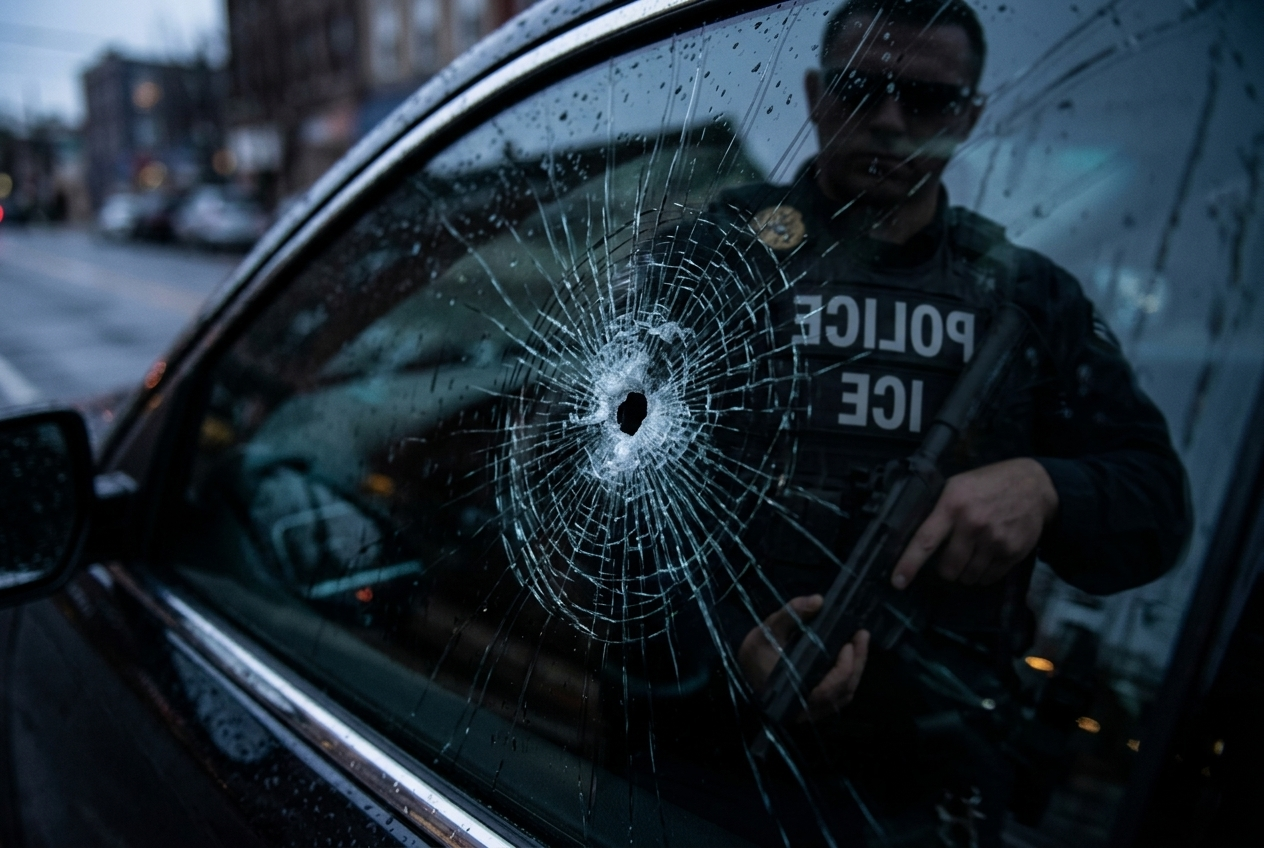
It’s a regular overcast morning in the PNW, something which will burn off, but something which lingers with feeling for the events of the day. I read a CNN report on the Harrisburg ICE incident less as an isolated news item and more as a small but telling fragment of a larger shift. The facts are straightforward. Federal agents conduct a vehicle stop, the situation escalates, a window is broken, and an officer fires at a fleeing SUV, which then hits a parked car. What interests me is not only what happened, but how it is framed, how it is normalized, and what gets left underexamined.
From my perspective, the first issue is the calmness of the framing relative to the stakes. The CNN piece relies heavily on official statements and expert commentary, but it does not fully press the implications of those facts. A vehicle stop that ends with gunfire and civilian property damage is treated as a procedural anomaly rather than as a moment that raises serious questions about federal enforcement tactics. I find that restraint notable… and concerning. It reads as a kind of narrative smoothing, where the edge of the event is softened by institutional language.
I don’t dismiss the reporting outright. It does include critical voices. A former NYPD chief points out that the tactical setup was ineffective and that officers missed safer options, citing inexperience in real-world execution. That detail is important because it suggests structural issues, not just individual error. But even that critique is contained. It is presented as a technical failure, not as part of a broader question about whether these operations, in their current form, are appropriately designed for the environments they are operating in.
What I see, and what I think the article only partially acknowledges, is a pattern of harm that extends beyond the immediate encounter. The same reporting situates this incident alongside other recent cases involving fatal shootings during ICE vehicle stops. Those are not abstract data points. They are real events with real consequences for bystanders and communities. When federal officers engage in tactics that escalate quickly to force, the risk is not confined to the intended target. It spills outward, into the surrounding space, into the people who are adjacent to the operation.
I am not claiming a wholesale breakdown of federal law enforcement. That would be too broad, and it would miss the more precise issue. The concern, as I see it, is the increasing alignment of enforcement with political objectives that prioritize visibility and assertiveness over restraint. A place where regular people pay the price. The article hints at this through its discussion of surveillance footage contradicting official accounts. That tension matters. It suggests that public narratives about these incidents are not always stable, and that the interpretation of force is often negotiated after the fact. This is not service, this is a sign of hiding mistakes and knowing you are doing wrong.
So, this is where I think the reporting could go further. It notes that video evidence can undermine official statements, but it does not fully explore what that means for institutional accountability. If the public understanding of these encounters depends on competing narratives, then the question becomes not just what happened, but who gets to define what happened. That is a political question, not just a journalistic one.
I also want to be clear about my own position here. I am not arguing that every federal officer is a hazard, or that enforcement is inherently illegitimate. My concern is more specific. It is about the conditions under which these operations occur, and the way those conditions are shaped by policy, training, and institutional pressure. When officers “make it up as they go along,” as the former NYPD chief puts it, that is not only a training issue. It is a design issue. And design choices have consequences.
What I find missing in the article is a more explicit acknowledgment of those consequences. The harm is not hypothetical. It shows up in damaged vehicles, escalated confrontations, and in some cases loss of life. These are not incidental outcomes. They are part of the operational footprint of a system that is expanding its reliance on vehicle stops as a primary enforcement tool.
Again, my critique lands in two places at once. First, the reporting is cautious to the point of understatement, which risks flattening the urgency of the situation. Second, the situation itself reflects a broader trend where federal enforcement is becoming more entangled with political imperatives, and where that entanglement has measurable effects on public safety.
I don’t think you need to overstate the argument to make it compelling. The facts already carry weight. An officer fires at a fleeing vehicle, a civilian car is struck, and experts point to tactical failures. The question is whether we treat that as a one-off mistake or as evidence of a system that is drifting in a direction that deserves closer scrutiny. I lean toward the latter. Not because I assume bad intent, but because I think the pattern, taken seriously, is hard to ignore.
References
- CNN (Shimon Prokupecz, Nicki Brown), “An ICE officer fired at an SUV fleeing a car stop in Pennsylvania. That’s not how it should happen, policing experts say,” 2026.
- USA Today, “Vehicle stops can be dangerous. So why is ICE relying on them?” 2026.

Leave a Reply