
Probability, Constraint, and the Human Habit of Calling It Design
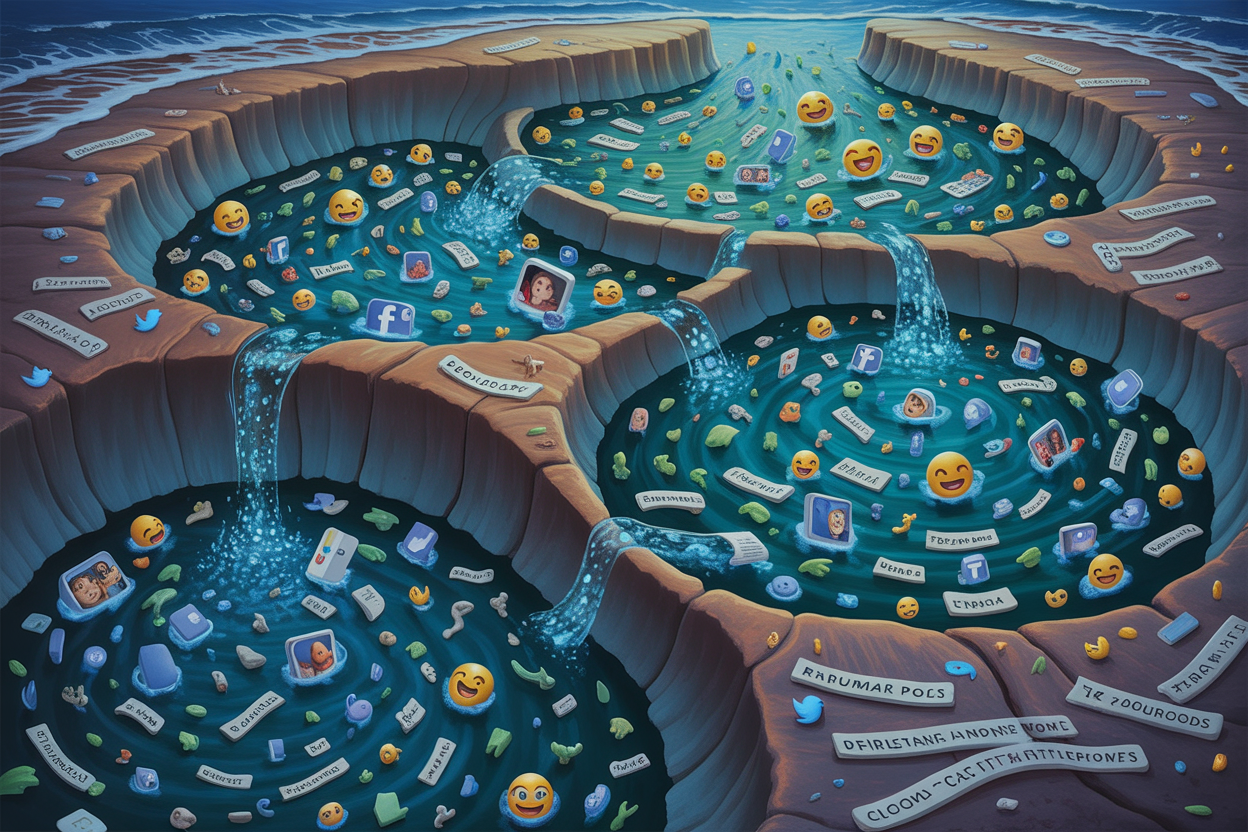
Facebook, and to a slightly lesser degree Threads and Twitter, have become strange little tide pools of thought. You get polished arguments, half‑formed intuitions, outright nonsense, and every so often a philosophical carbuncle that’s oddly worth examining. Not because it’s correct, but because it reveals how people are thinking. Away from comment‑bombing, away from one‑upmanship, away from the need to score points, some of these posts are actually good prompts for adult conversation.
The intelligent‑design question
“Everyone wants a life of meaning. But where does meaning come from: evolution, society, or a Creator?”
is one of those. It sounds earnest. It sounds reflective. It isn’t quite either. It’s a carefully narrowed doorway pretending to be an open field.
What struck me when I read it wasn’t the conclusion it was steering toward, but the assumption sitting quietly underneath it. Meaning is being treated as a thing that exists independently of humans, floating out there like gravity or electromagnetism, waiting to be discovered. That’s already a philosophical commitment, not a neutral starting point. Once you notice that, the rest of the post reads differently. Evolution is dismissed because it doesn’t hand out purpose. Society is dismissed because it’s allegedly arbitrary. A Creator is left standing not because it’s demonstrated, but because the other options were defined so they couldn’t possibly succeed.
A better version of the question has already been asked, and it avoids all of this sleight of hand. Kant asked it cleanly when he separated teleology as a regulative concept from teleology as a constitutive feature of nature. In the Critique of Judgment, he argued that we may find it useful to think in terms of purpose when dealing with organisms, because organisms are systems whose parts make sense only in relation to the whole. But that usefulness does not license the claim that purpose exists objectively in nature as a causal force. Purpose, for Kant, belongs to our judgment, not to the world itself (Kant, Critique of Judgment, 1790). That move matters because it dissolves the forced trilemma entirely. Meaning does not have to come from evolution or society or a Creator as a metaphysical substance. Meaning arises from how finite, rational agents make sense of a world governed by constraints. Once framed that way, the problem stops being “where does meaning come from” and becomes “what are we doing when we talk about meaning at all,” which is a far more honest and durable question.
Biology was never meant to answer questions of meaning. Natural selection explains why traits persist under constraints. It does not assign value. Expecting evolution to produce purpose is a category error, like criticizing calculus for not writing poetry. Darwin’s real contribution was removing teleology from explanations of form and function so that biology could become predictive rather than theological (Darwin, On the Origin of Species, 1859). Ernst Mayr later made the distinction explicit. Purpose language survives in biology as shorthand, not as causal explanation (Mayr, Toward a New Philosophy of Biology, 1988).
People try to tie biology, and especially evolution, to questions of purpose because leaving evolution value‑neutral feels existentially intolerable to them. Evolution strips away a very specific comfort: the idea that meaning is built into the structure of the world rather than negotiated by the beings who inhabit it. By insisting that evolution must either provide purpose or be incomplete, this framing quietly misstates what evolution claims to explain. Evolution is about differential survival under constraint, not about why survival should matter. When critics demand that biology answer the question of purpose, they are really objecting to the moral vacancy that remains once teleology is removed from nature. The theological goal is not to correct a scientific gap, but to reinsert an external authority that can guarantee meaning, value, and obligation without human authorship. Purpose is being smuggled back in not because biology failed, but because the alternative forces people to confront the uncomfortable fact that meaning is something we generate, justify, revise, and sometimes abandon ourselves. That discomfort is then misdirected at evolution, as if the theory were responsible for the loss, rather than the messenger that made the absence visible.
The move to a Creator doesn’t actually solve the problem it claims to solve. It relocates it. Declaring that meaning comes from God doesn’t tell you what that meaning is, how it’s known, or why incompatible claims of divine purpose should be resolved one way rather than another. History shows that appeals to God‑given purpose have justified radically different and mutually exclusive moral systems. That’s not a bug in interpretation. It’s a consequence of treating purpose as external and unquestionable. Once meaning is declared objective in that way, it becomes a tool of authority rather than a guide to living (Berlin, Two Concepts of Liberty, 1969).
One concrete way this plays out in Christianity is through doctrines that treat women’s social position as divinely purposed rather than historically contingent. Appeals to God‑given roles have been used to justify women’s legal subordination, denial of education, marital coercion, and exclusion from political life, often with explicit claims that these arrangements reflect God’s design rather than human choice. The point isn’t that Christianity uniquely produced these outcomes, but that framing purpose as externally fixed made them resistant to challenge. When subordination is described as ordained, dissent becomes rebellion against God rather than critique of power. The long delay in recognizing women’s legal personhood, property rights, and bodily autonomy in Christian‑majority societies wasn’t a failure of compassion. It was the predictable consequence of treating meaning as unquestionable authority rather than revisable judgment (Brown, The Body and Society, 1988; Lerner, The Creation of Patriarchy, 1986).
The same pattern appears elsewhere, even as the theological language changes. In Islamic contexts, appeals to divinely mandated gender roles have been used to constrain women’s mobility, testimony, and inheritance, with reformers repeatedly running into the problem that arguing from purpose entrenches interpretation as law (Hallaq, An Introduction to Islamic Law, 2009). In Hindu traditions, cosmic order and dharma have historically been invoked to naturalize women’s subordination within family and caste structures, again insulating social arrangements by treating them as reflections of a higher purpose rather than negotiable human norms (Doniger, The Laws of Manu, 1991). Even Buddhism, often presented as less theistic, has not escaped this dynamic. Monastic hierarchies and doctrinal claims about karmic destiny have been used to rationalize unequal access to religious authority and education for women, despite Buddhism’s philosophical resources for rejecting essentialism (Gross, Buddhism After Patriarchy, 1993). Across traditions, the damage isn’t caused by belief per se. It’s caused by elevating purpose into an external mandate that outranks lived experience. When meaning is treated as something handed down rather than worked out together, it stops guiding life and starts governing it.
I’ll be personal here, because this is where the discussion usually gets abstract in unhelpful ways. I write about science, history, and philosophy precisely because I care about meaning. I just don’t think meaning arrives pre‑installed in the universe. What I see instead is a world governed by probabilities and constraints, and within that world, creatures like us negotiating what matters. Purpose shows up when we decide that some futures are worth more than others, and then live accordingly. That doesn’t make meaning thin. It makes it fragile, shared, and real in the only way it can be.
Philosophers have been circling this point for centuries. Hume warned against projecting human intentions onto the universe and mistaking that projection for explanation (Hume, Dialogues Concerning Natural Religion, 1779). Kant located purpose in rational agents, not in nature itself (Kant, Critique of Judgment, 1790). The existentialists took the final step and said the quiet part out loud. Meaning isn’t found. It’s made, and making it carries responsibility (Sartre, Existentialism Is a Humanism, 1946; Camus, The Myth of Sisyphus, 1955).
What the intelligent‑design framing really offers is relief. If meaning is objective and assigned from outside, you don’t have to imagine it. You don’t have to revise it. You don’t have to take responsibility for it. Someone else has already done the hard work. But that relief comes at a cost. When purpose is handed down rather than constructed, dissent becomes error and creativity becomes disobedience. History is not kind to societies that make that trade.
So yes, everyone wants meaning. That part is uncontroversial. The mistake is assuming that desire implies an external source. Wanting certainty doesn’t make certainty real. Wanting cosmic purpose doesn’t mean the cosmos is obligated to provide it. What we actually have is something harder and more interesting. A world that doesn’t tell us what matters, and minds that won’t stop asking anyway.
That’s not a failure of evolution or society. It’s the condition of being human. And pretending otherwise doesn’t elevate meaning. It just avoids the work of making it.
References
- Berlin, Isaiah. Two Concepts of Liberty. 1969.
- Camus, Albert. The Myth of Sisyphus. 1955.
- Darwin, Charles. On the Origin of Species. 1859.
- Hume, David. Dialogues Concerning Natural Religion. 1779.
- Kant, Immanuel. Critique of Judgment. 1790.
- Mayr, Ernst. Toward a New Philosophy of Biology. 1988.
- Sartre, Jean‑Paul. Existentialism Is a Humanism. 1946.
- Brown, Peter. The Body and Society. 1988.
- Doniger, Wendy. The Laws of Manu. 1991.
- Gross, Rita M. Buddhism After Patriarchy. 1993.
- Hallaq, Wael B. An Introduction to Islamic Law. 2009.
- Lerner, Gerda. The Creation of Patriarchy. 1986.

Leave a Reply