
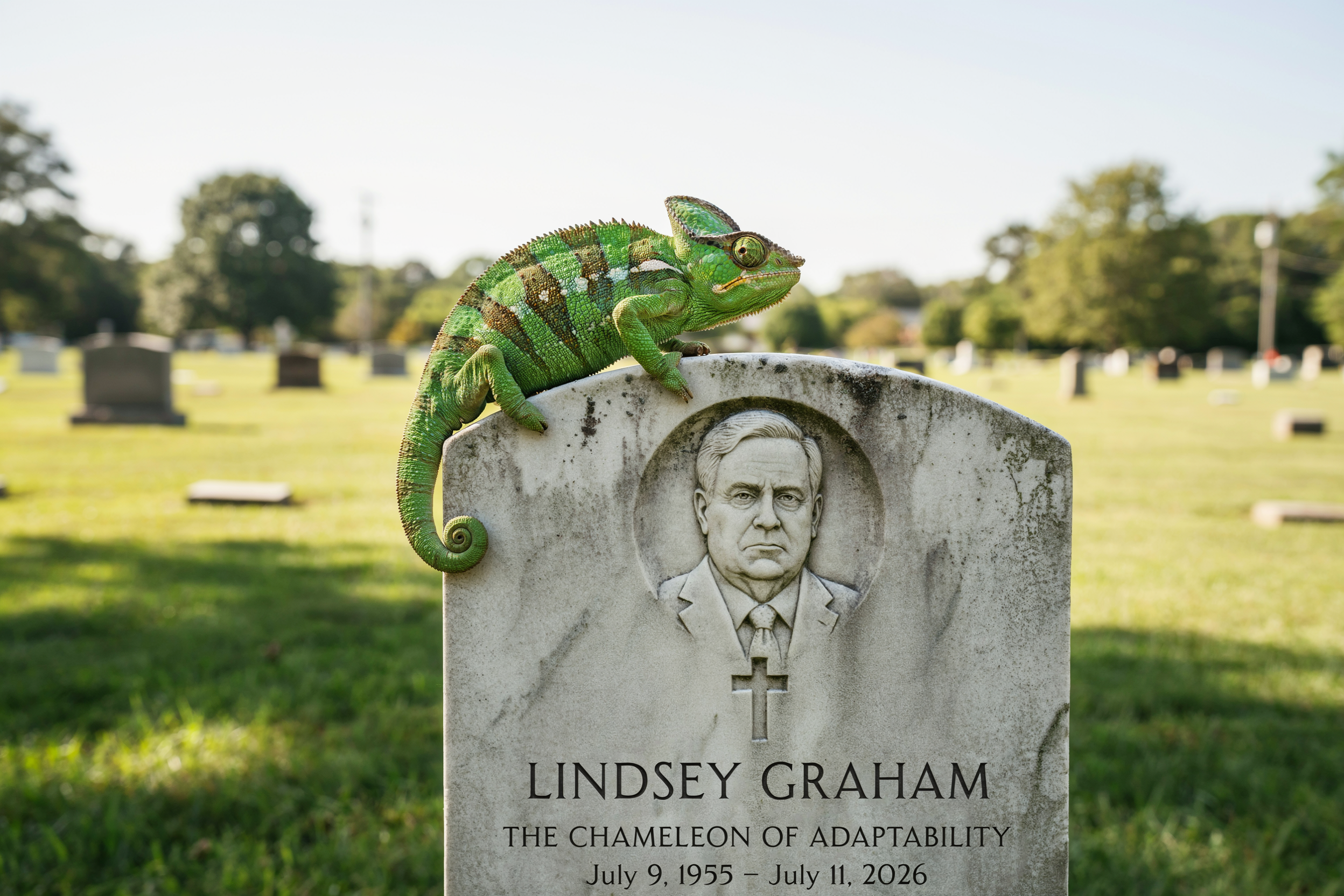
Act IV: drying out in the sun
Lindsey Graham died this morning, and the timing feels almost too clean for a career defined by elasticity. I don’t mean that in a poetic sense. I mean it in the way a pattern completes itself just as you’re still adjusting your hand on the thread. His long arc now reads less like evolution and more like a sequence of alignments that never quite settled into anything permanent.
He began as a South Carolina Republican with enough institutional fluency to move between factions without friction. I remember watching him early on and thinking he had a kind of calibrated ambiguity, a willingness to sound like whoever needed him at the moment. That wasn’t yet a flaw. It was a tool. Then the national stage hardened, and the tool became the identity. He moved with the post‑9/11 Republican consensus into expanded executive power, war authorization, and surveillance frameworks that reshaped the boundary between security and constraint. Those votes are not abstract. They have downstream effects that persist in budgets, contracts, and the quiet normalization of state capacity. (Congressional Record, 2002–2008)
The bipartisan posture came and went in cycles. The Gang of 14 episode briefly suggested restraint, a senator negotiating the edges of judicial power. But even that looked, in retrospect, like another form of positioning. The center of gravity kept shifting, and Graham kept moving toward it. When Trump rose, he initially resisted, then recalibrated with a speed that was almost legible as habit. The rhetorical reversal is well documented, but what interests me more is the ease of it. I don’t think it was ideological conversion so much as operational adaptation. (Cramer, The New York Times, 2020)
That adaptation had consequences. The 2017 tax legislation, which he supported, delivered its benefits unevenly, concentrating gains at the top while introducing longer‑term fiscal tradeoffs that would be carried by others. This is the kind of policy where the distribution is not hidden, just deferred. The money moves first, and the costs arrive later, dispersed. (Tax Cuts and Jobs Act, 2017; Congressional Budget Office, 2018)
On judicial politics, Graham became part of a machinery that outlasts any single term. The confirmations he facilitated helped lock in a jurisprudential direction that affects labor, regulation, and environmental policy. I find myself thinking about how often these outcomes are framed in procedural terms, as if procedure were neutral. It isn’t. It shapes who bears risk and who collects reward. (U.S. Senate Judiciary Committee records, 2017–2020)
Foreign policy remains the throughline. Graham’s alignment with defense expansion and interventionist doctrine tied him to a system where public expenditure flows into a narrow band of contractors and strategic interests. It’s not subtle when you look at the structure: long contracts, recurring appropriations, and a feedback loop between threat framing and funding. I’ve never found that kind of stability accidental.
The Trump years crystallized his role. Graham became a translator of necessity, able to shift tone without losing position. That is a form of political skill, but it’s also a form of dependence. The question I keep circling is whether the alignment ever reverses, whether the system uses the individual or the individual becomes indistinguishable from the system’s needs. In his case, the answer tilts toward the latter.
Now that he is gone, the trajectory is easier to trace. The early ambiguity, the moments of restraint, the eventual consolidation around power. Each phase narrowed the range of possible speech until there was almost no tension left between stance and structure. I don’t feel closure, exactly. I feel a kind of analytical clarity that comes from seeing the line all at once.
What do you call a career that ends where it was always heading? That’s the question I’m left with, and I’m not sure it’s rhetorical. What I sure of is that dried up chameleons are forgotten every day.
References
Cramer, Phil. “Lindsey Graham, Once Trump’s Critic, Now His Ally.” The New York Times, 2020.
Congressional Budget Office. The Budget and Economic Outlook: 2018 to 2028, 2018.
U.S. Congress. Congressional Record, various sessions, 2002–2020.
Tax Cuts and Jobs Act of 2017, Pub. L. No. 115‑97.
U.S. Senate Judiciary Committee. Nomination Records, 2017–2020.

Leave a Reply