
I’m not sure about what it is on quiet Sunday mornings that brings out the most existential views. It could be the memories of being woken up at 5 AM to go to church in the snow, and how we walked past my grandfather’s grave to get there. It could be the oversized Americano I get on Sunday morning, just as the coffee shop opens, and I see the expressions of both happiness to see me and wonder I am up this early. Or, it could be that I take out the dog to a different park on Sunday, and it seems like she still chases the same squirrel up the same tree.
There’s a particular kind of silence that isn’t empty. It just refuses to say what it is. I’ve been circling this for a while, nudging it from different angles, watching it shift like a thing that doesn’t want to be named. Nothing is doing a lot of work here, again. I can feel it. It’s the sort of word that behaves like a placeholder but sneaks in as a conclusion.
I’ve tried proceeding from dictionaries, but give no real work, it fails to be a lens.
nothing n.
From Old English nāht (“no thing”), from ne (“not”) + āht (“anything”).
- Not anything; no thing, no object, no presence.
- The state, condition, or fact of absence.
- Zero amount or quantity; naught.
- Nonexistence; the absence of all being.
That definition always reminds me of Jethro from the Beverly Hillbillies;
“Them zeros is naughts with a cross through ’em…”
Better to start with the strict constructionist version. Nothing is literally no thing. No object, no entity, no presence. Simple enough until you try to apply it. The moment you say “nothing is here,” you’ve already filled the space with a subject, a verb, a location, and a metaphysical suspicion that something is lurking just off camera. I have personally tried to hold the idea of no thing in my head and discovered, inconveniently, that my head is not designed for that job. Philosophers have been crying about this since before we had indoor plumbing. The problem is not lack of effort. It is that language refuses to let nothing stay clean.
Then there is the mathematical version. In set theory, the empty set, denoted ∅, is a perfectly respectable object. It contains no elements, but it is itself an element of the mathematical universe. That’s the trick. Nothing becomes something you can count, manipulate, and prove things about. The empty set is not “no thing” in the everyday sense. It is a thing defined by the absence of things, which is the kind of sentence that makes a logician nod slowly and a normal person reach for coffee. The zero set is the same family of idea, a structure defined by absence, which still manages to behave like a structure. I like to imagine it sitting there politely in a corner, the philosophical fly, insisting it is nothing while clearly participating in the conversation.
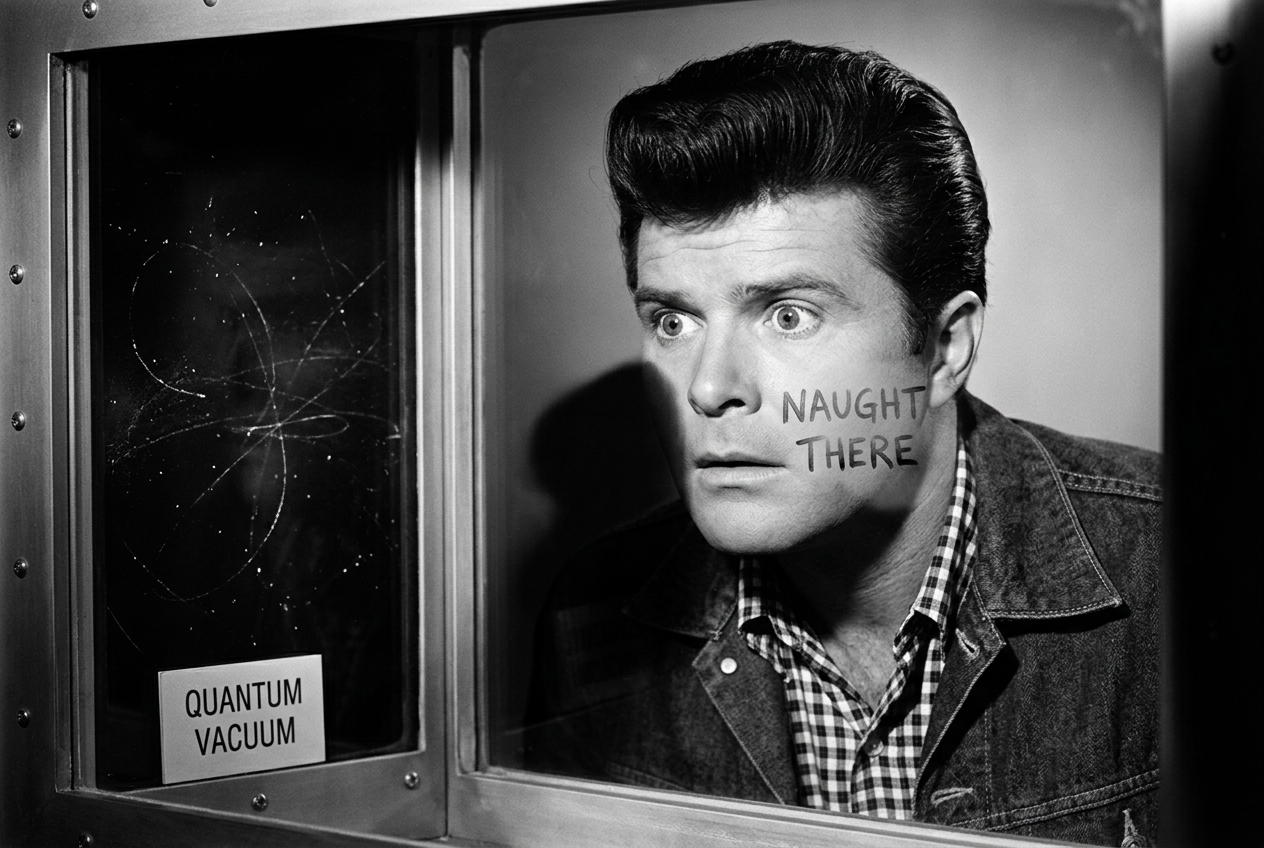
Physics gets more uncomfortable. Classical physics gives us vacuum as “empty space,” but even there, the emptiness is curated. Fields persist. Potentials remain. Space itself is doing something, even when there is nothing in it. Quantum theory tightens the screws. A vacuum is not a blank slate but a fluctuating baseline, full of activity that refuses to settle into nothingness. The more you subtract, the more you realize subtraction is not the same as absence. I find this mildly irritating, in a personal way. I would prefer a clean nothing. Physics keeps handing me something wearing a disguise.
Physicists did not help matters when they began importing “nothing” into public-facing explanations. The problem is not that they were wrong, but that they were trying to compress a system that resists compression, and the compression itself became the misunderstanding. “Nothing” turns into a kind of rhetorical lubricant, smoothing over the technical friction until the concept looks simpler than it is. I have heard it used like a magic trick. The scientist waves a hand, says the word, and the audience leaves thinking the universe started from a blank.
Richard Morris is often cited in popular discussions of cosmology for the way he frames vacuum fluctuations. In simplifying the idea, he writes, “empty space is not empty” (Morris, Cosmic Questions, 1997). That line is meant to clarify, but it also collapses a distinction the lay reader never gets to see.
His better attempt was
“In modern physics, there is no such thing as ‘nothing.’ Even in a perfect vacuum, pairs of virtual particles are constantly being created and destroyed.”
But “Empty space” and “nothing” still slide together under the same word, and the result is a kind of conceptual blur. I do not think Morris intended harm, but the phrase does a quiet kind of damage. It replaces a structured absence with an intuitive one, and then pretends the intuition is sufficient.
Peter Higgs, for his part, has been hauled into these conversations with a quotation that gets repeated until it loses its context. In explaining the Higgs field, he said, “the vacuum is not empty” (Higgs, interview, 2013). And later “When you look at a vacuum in a quantum theory of fields, it isn’t exactly nothing.”
Again, true. Also, not what most people mean when they say nothing. The simplification does its job at the level of outreach, but it invites a misunderstanding that is hard to undo. I have seen people walk away from that line believing that physics has shown that nothing is actually something, as if the word had been exposed as fraudulent rather than merely overloaded.
Stephen Hawking presents the most famous version of the problem. In A Brief History of Time, he writes, “because there is a law like gravity, the universe can and will create itself from nothing” (Hawking, A Brief History of Time, 1988). That sentence has probably done more rhetorical work than any other in modern cosmology, and it is also the one that most urgently needs unpacking. Hawking is working within a very specific definition of “nothing,” one that includes laws, structure, and a quantum framework. But the word itself carries none of that baggage in ordinary language. The result is a sentence that sounds like metaphysical closure but functions as technical shorthand, and the shorthand gets mistaken for the idea.
I have a personal suspicion here, which is that the real issue is not misuse by the physicists, but the gap between their internal definitions and the linguistic habits of everyone else. The word “nothing” is doing double duty. It is supposed to mean absence, but it is also being used to describe a vacuum with properties, a field with fluctuations, a state that behaves like something under certain conditions. And once the public hears “nothing,” it is very hard to remember that the word was already under strain before it left the room. The harm is subtle, more like a slow drift than a mistake, but it accumulates.
It’s almost like there should be a better word for use in physics… try this one on for size (or mouth stretchiness):
kenon n. (κενόν)
/ˈkeɪ.nɒn/ (KAY-non) or /ˈkiː.nɒn/ → “KEE-non”
From Ancient Greek kenón, neuter of kenós “empty, void.”
- (Physics) The quantum vacuum: the lowest‑energy state of a field, characterized by the absence of real particles but not by the absence of physical structure or activity.
- (General) A state of emptiness understood as a physical condition rather than absolute nonexistence.
Usage note:
Kenon is distinct from philosophical “nothingness.” It denotes a structured emptiness—a vacuum with measurable properties (e.g., fluctuations and field effects)—and should not be interpreted as literal non-being.
So, what about the phrase “nothing created everything”? It appears most frequently in popular science summaries, internet debates, and more than a few creationist arguments that lean on it as if it were a conceptual trump card. I have seen it used like a verbal shrug, a way to close the book on cosmology and open a different one entirely. The phrase is rarely used by working scientists because it collapses under its own phrasing. If “nothing” is taken as strict absence, then there is no mechanism, no condition, no spacetime, no law to do any creating. If it is taken as a physical vacuum, then it is not nothing. If it is taken as a zero set, then it is a mathematical object, not a causal origin. The phrase slides between meanings without committing to any of them, which is why it sounds profound in one context and empty in another.
One recent claim on Facebook went like this:
“If someone says God cannot exist, life came from nothing, order came from chaos, and consciousness is just an accident, that is also a massive claim. Christians are constantly asked to explain creation, but skeptics should also be willing to explain how nothing created everything.”
I have a soft spot for the way people deploy it anyway. It has the cadence of certainty. It feels like an answer. But it is really a question pretending to be a declaration. Nothing created everything. Which nothing? The one that is no thing, or the one that is a structured absence, or the one that quantum fields call home when they are bored? The sentence doesn’t hold still long enough to be evaluated. It keeps changing costumes mid-stage.
Historically, the appeal is obvious. The phrase functions as a boundary marker between explanatory frameworks. It lets you avoid the technical mess of cosmology and leap straight to a metaphysical claim. It also carries rhetorical weight. Saying “nothing” sounds like the most extreme possible condition, so whatever follows must be equally extreme. I get it. I have used the word nothing to mean “I don’t want to talk about this right now,” which is probably its most honest usage.
There is a personal angle here that I cannot ignore. I once tried explaining to a friend that the vacuum is not empty and watched their eyes glaze over with what I can only describe as philosophical fatigue. They said, “So nothing isn’t nothing,” and I said, “Yes, but also no,” which is about where most conversations about nothing tend to end. We both agreed to stop and eat something, which is perhaps the most sensible response to the entire topic (CeleryKills. 2026).
The deeper issue is that nothing resists stabilization. It cannot be pinned down without becoming something else. The moment you define it, you have already lost it. That is why it keeps appearing in different guises: as zero in mathematics, as vacuum in physics, as absence in language, as a rhetorical device in arguments that want to sound foundational. Each version solves a different problem, and each version introduces a new tension. The word itself becomes a kind of conceptual mirror, reflecting whatever system tries to contain it.
If you want a challenge, try this. Ask yourself whether “nothing” can be part of a causal story without ceasing to be nothing. Then ask whether your answer depends on whether you are thinking like a mathematician, a physicist, or someone who just got tired of thinking. Then notice how quickly the problem expands. I have watched this happen in real time. It is not dramatic, but it is persistent.
I once tried this myself, with a friend who leans more mathematician than physicist. They said, almost immediately, that nothing can be modeled as zero, and therefore it can sit comfortably inside equations as a boundary case. I said that in physics, nothing is never zero, it is a vacuum with structure, and structure does not behave like absence. They replied that the zero object in mathematics is still an object, which is precisely why it can participate in relations. I pointed out that participation already assumes a system, and systems are exactly what nothing is supposed to lack. We went back and forth for a few minutes, each version of nothing migrating into a different framework, each framework quietly redefining what counts as legitimate. At some point they said, “So it works in math, but not in physics,” and I said, “No, it doesn’t really work anywhere cleanly,” which is where the conversation started to fold in on itself. The problem was not disagreement so much as drift. The more precise we tried to be, the further the word slipped. I have watched that happen more than once. It is not dramatic, but it is persistent. The explanation keeps expanding until the original question is no longer visible, only its debris.
There is also the question of why we are so invested in nothing at all. We stumble into a quieter trap here, one that feels almost embarrassing once you notice it. The word nothing starts behaving like a thing, not because it is, but because we forget the construction that made it intelligible in the first place. We treat it as if it can act, as if it can produce, as if it can do work in a sentence without us propping it up. I have caught myself doing this, giving nothing a kind of agency it does not earn, like it is out there making decisions instead of being a grammatical absence dressed up as a concept. It is a small sleight of hand, barely perceptible, until the whole discussion starts to look like nothing is the actor, when really we are the ones doing the acting. Maybe that is the real misdirection. We talk about nothing so fluently that we forget we built the stage it stands on. Maybe because it promises a clean starting point. Or because it feels like the ultimate simplification. Or because it gives us a way to talk about limits without admitting we are talking about our own inability to push further. I suspect it is all of these, and none of them quite fit.
What makes philosophers cry is not that nothing is unknowable. It is that nothing keeps showing up where it is not supposed to be, interfering with categories, refusing to stay put. You think you have it defined, and then it slips into another domain and behaves differently. The word does not fail so much as it over-performs.
So I keep coming back to it. Not because I expect a final definition, but because every attempt to settle it reveals something about the framework doing the settling. Nothing is less a destination than a diagnostic. It tells you what kind of thinking you are doing. And if you are paying attention, it tells you when your thinking has quietly turned into something else entirely.
Maybe that is the real trick. Nothing is never just nothing. It is always more about what we are trying to say than what is actually there. And that, inconveniently, is still something.
References
- Aristotle, Physics, ca. 350 BCE.
- Barman, N. et al., “Quantum vacuum and its fluctuations,” Reviews of Modern Physics, 2015.
- Cantor, G., Contributions to the Founding of the Theory of Transfinite Numbers, 1895.
- Hawking, S., A Brief History of Time, 1988.
- Hume, D., A Treatise of Human Nature, 1739.
- Newton-Smith, W. H., The Structure of Time, 1980.
- Russell, B., Introduction to Mathematical Philosophy, 1919.
- CeleryKills. “Nothing Is Doing a Lot of Work Here”. 2026

Leave a Reply