
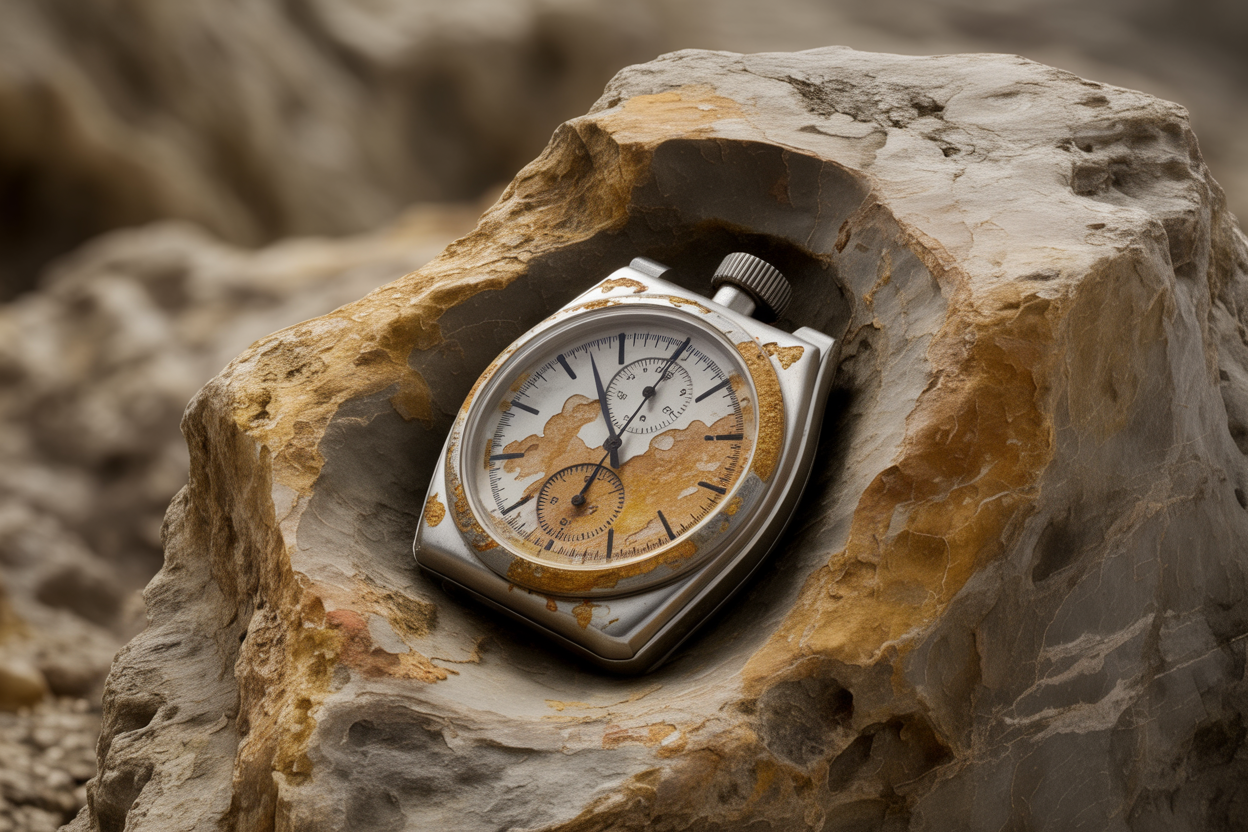
Fossilization, Misdirection, and the Quiet Order of the Rocks
Facebook and Threads are an endless buffet of unsupported assertions, eccentric opinions, and the occasional gem that accidentally teaches you something by being wrong in an interesting way. Most of it isn’t worth responding to. But every now and then a question shows up that isn’t really a question at all. It’s a rhetorical diversion wearing a question mark, and that’s where things get educational.
The Lost World Museum post asking “How long does fossilization take? Days, weeks, years, millions?” is a good example. On the surface it sounds like curiosity. In practice, it’s a setup. The framing quietly invites the reader to collapse several different geological processes into a single stopwatch and then act surprised when the numbers don’t line up. That surprise is the point. It creates the illusion of contradiction where none exists.
The trick is that fossilization isn’t one thing. It’s a family of preservation pathways, each with its own chemistry, physics, and timeline. Mineralization can begin quickly under the right conditions. Petrification can start fast in silica‑rich environments. Concretions can form around organic material in years to centuries, sealing it off from decay so effectively that soft tissues survive. None of this is controversial. None of it threatens geology. What gets left out is the context those processes occur in. Preservation speed and the age of the surrounding rock are not the same variable, and treating them as if they are is how the misdirection works.
To slow the misdirection down properly, it helps to linger on what those preservation terms actually describe in the real world, not in infographic summaries. Fossilization, in the strict geological sense, is about mineral movement through buried material. Once organic remains are isolated from oxygen, groundwater becomes the active agent. Minerals precipitate into pore spaces, reinforce cellular structures, or gradually replace organic compounds. This can begin surprisingly fast, sometimes within years, especially in mineral‑rich, low‑oxygen settings. But that beginning is not the end. Completion depends on groundwater chemistry, temperature, pressure, and burial depth. A bone can be stabilized early and still sit there undergoing slow chemical replacement for tens or hundreds of thousands of years. The speed of onset tells you nothing about the duration of the surrounding geologic history (Prothero, Bringing Fossils to Life, 2013).
Petrification is often treated as if it were a different category entirely, when it is really an extreme case of the same process. Silica‑rich waters can infiltrate wood rapidly, especially in volcanic terrains, replacing organic material molecule by molecule. Petrified forests form this way. The key variable is not time alone but geochemical context. That replacement can start quickly, but the resulting petrified wood is still found embedded in sedimentary units that record long depositional histories. The petrification explains the state of the wood, not the age of the rock enclosing it (Mustoe, “Silicification of Wood,” 2017).
Concretions are where the rhetorical confusion really accelerates. Because concretions can form rapidly, sometimes in decades, they are often presented as if they collapse geological time altogether. In reality, concretions form inside already‑deposited sediment, as mineral precipitation creates a localized cement around an object. Pearls are the everyday analogy, but geological concretions occur wherever mineral‑rich fluids move through sediment, including mine tunnels and marine shales. The concretion seals and preserves what’s inside. It does not create the sedimentary layer itself. That layer may have taken millions of years to accumulate before the concretion ever formed (Berner, Early Diagenesis, 1980).
And not all preservation fits neatly into any of those categories. We also see carbon films, molds and casts, impressions, amber entrapment, freezing, desiccation, and asphalt preservation. Different mechanisms, same requirement: rapid burial followed by long‑term stability.
This distinction is the hinge everything turns on. Preservation pathways explain how remains survive. Stratigraphy explains where they sit in time. Mixing those two questions produces the illusion of contradiction. Keeping them separate dissolves it.
That’s why my response focused on strata rather than stopwatches. You can preserve a fish quickly. That fish can be preserved inside shale that took millions of years to accumulate. You can mineralize a tree rapidly. That tree can be entombed in sandstone recording repeated depositional cycles, soil horizons, ash layers, and magnetic reversals that have independent ages. The fossil doesn’t date the layer. The layer dates the fossil. This is basic stratigraphy, not a loophole.
Eric’s follow‑up comment sharpened that point by addressing what the original framing tries to avoid. Fossil preservation refutes a global flood and young‑earth timelines not because fossils take a long time to form, but because the geological structures they sit within do. Trackways, burrows, reefs, coal seams, evaporites, and laterally continuous strata require stable conditions over long spans. A single chaotic event does not produce ordered, time‑correlated sequences of life. It produces mixtures. The fossil record is not mixed. It is patterned, repeatable, and predictive. That pattern is called faunal succession, and it was recognized long before Darwin (Boggs, Principles of Sedimentology and Stratigraphy, 2012).
One of Eric’s strongest examples was trackways, because they refuse to cooperate with flood narratives in a very physical way. Dinosaur footprints, human trackways, and invertebrate trails aren’t just impressions. They are behaviors frozen in time. An animal walks across soft sediment, leaves a print, the sediment partially dries or firms up, and then another layer gently buries it without erasing the detail. Many trackways show multiple overprints, changes in gait, slipping, stopping, and turning. That sequence requires exposed surfaces, time between steps, and calm burial conditions. A turbulent, year‑long global flood would obliterate them. Instead, we see ordered horizons of tracks repeated at different stratigraphic levels, which is exactly what you expect from long‑lived landscapes, not a single catastrophe (Boggs, Principles of Sedimentology and Stratigraphy, 2012).
Eric also pointed to reefs and coal seams, which quietly demolish the “fast burial fixes everything” idea. Coral reefs don’t form as piles of dead coral swept together. They grow in place, upward, generation after generation, tracking sea level over long periods. Fossil reefs are found stacked vertically, sometimes hundreds of meters thick, recording repeated cycles of growth, drowning, and regrowth. Coal seams tell a similar story on land. Thick coal beds represent peat accumulation in stable wetlands, with root structures preserved in place. Many coal seams are interbedded with soils, river deposits, and marine sediments, showing repeated environmental shifts. You don’t get that from a brief global flood. You get it from long‑term stability interrupted by change (Nichols, Sedimentology and Stratigraphy, 2009).
The third example Eric highlighted was evaporite deposits, especially massive salt and gypsum formations. These minerals precipitate when seawater evaporates repeatedly in restricted basins. The chemistry is sequential and predictable. Carbonates drop out first, then gypsum, then halite. Many evaporite sequences preserve dozens of these cycles stacked neatly on top of one another. Flood conditions do the opposite of what evaporites require. They dilute basins, they don’t concentrate them. The existence of thick, laterally extensive evaporite layers is direct evidence of repeated drying, refilling, and drying again over long timescales. There is no shortcut explanation that keeps the stratigraphy intact while compressing the time (Berner, Early Diagenesis, 1980).
Taken together, these examples show why the fossil record isn’t just “not mixed,” but actively structured. The order is not incidental. It’s behavioral, ecological, chemical, and physical. That’s why Eric’s point lands so cleanly. The problem for young‑earth framing isn’t how fast a fish can fossilize. It’s why the rocks around that fish remember environments, pauses, surfaces, and sequences that only make sense if time was allowed to do its work.
That’s what the original question tries to avoid. And that avoidance is the real story.
The misinformation attached to the post makes the diversion explicit. Terms like “initial fossilization,” “true fossil age,” and “complete mineralization” are presented as if they’re standard geological categories. They aren’t. They don’t appear in paleontology textbooks, stratigraphy manuals, or peer‑reviewed literature. They exist to keep the focus on how fast something can be preserved while quietly ignoring what happens after burial. Compaction, compression, lithification, and deformation under the weight of overlying sediments are not optional add‑ons. They are unavoidable consequences of deep time. You can’t get flattened fossils, sheared bones, pressure‑distorted shells, and coal seams from a short‑term event without destroying the fine‑scale order that we actually observe (Nichols, Sedimentology and Stratigraphy, 2009).
What makes this worth writing about isn’t that the question is wrong. It’s that the question is aimed at the wrong target. “How long does fossilization take?” is easy to answer in isolation. The correct question is “How does rapid preservation fit inside long depositional histories?” Once you ask that, the apparent mystery evaporates. Rapid burial becomes a requirement, not a problem. Long‑term stability becomes the real clock.
There’s a kind of grim humor in watching this play out online. Someone posts a false dichotomy. Others rush in to argue timelines. Meanwhile, the actual geology sits there quietly, unchanged, with its layered rocks, consistent sequences, and independent dating methods, waiting for someone to notice that the trick isn’t in the answer. It’s in the question.
What tends to get quietly attacked next, once the fossilization diversion runs out of steam, is the dating of the strata themselves. That’s not an accident. If you accept that the rocks can be dated independently of the fossils they contain, the whole rhetorical house collapses. So the argument shifts from “fossils form fast” to “you can’t really know how old the rocks are anyway.” That move shows up constantly, and it’s why I wrote the piece on dating sedimentary rocks in the first place. Not because it’s exotic science, but because it’s boringly redundant. Geologists don’t date sedimentary layers by guessing. They date them by bracketing, cross‑checking, and stacking independent clocks until the answer stops moving.
Igneous bracketing is the simplest example. Sedimentary layers themselves aren’t dated directly with radiometric methods, but volcanic ash layers above and below them are. If a fossil‑bearing shale sits between two tuffs dated to 510 and 505 million years, the shale is older than one and younger than the other. That isn’t philosophical. It’s arithmetic. When those brackets agree across regions, continents, and isotope systems, the uncertainty shrinks fast. This is why formations like those hosting the Burgess Shale are not just “assumed” to be ancient. They’re pinned in place by independent clocks that don’t care what fossils you find inside them (Gaines et al., Geology, 2008).
Then there are methods like optically stimulated luminescence, which date the last time sediment grains were exposed to light. That’s a completely different physical principle, based on trapped electrons, not radioactive decay. OSL doesn’t date fossils. It dates burial. When OSL ages line up with radiometric brackets and stratigraphic position, it becomes very hard to maintain that everything was deposited in a single recent event. The layers remember darkness, pressure, and time whether you want them to or not (Aitken, An Introduction to Optical Dating, 1998).
Index fossils add yet another constraint, and this is where the predictive power becomes obvious. Certain species appear only within narrow stratigraphic ranges. Once those ranges are established, finding the fossil tells you where you are in the column before you date anything else. That system was built long before Darwin, long before radiometric dating, and it still works because life does not appear randomly in the rock record. Intelligent design and young‑earth arguments often pretend this is circular reasoning. It isn’t. It’s triangulation. Fossils predict rock ages, rock ages predict fossil assemblages, and independent physical dating methods constrain both. Break one leg of that tripod and the other two still stand (Prothero, Bringing Fossils to Life, 2013).
This is why strata are such a persistent target. You can argue endlessly about how fast something decays or mineralizes. You can invent new categories of “initial” and “true” fossil age. But you cannot hand‑wave away thousands of meters of layered rock that record repeated environments, pauses, reversals, and stresses, all agreeing with clocks based on unrelated physics. The geology doesn’t argue back. It just sits there, quietly consistent, waiting for someone to stop asking the wrong question long enough to notice how many answers already line up.
And that’s the part that keeps getting missed online. The controversy isn’t in the data. It’s in the refusal to follow the data past the point where it becomes inconvenient.
So yes, some fossils form quickly. That’s expected. It’s required. What never gets explained by intelligent‑design framing is why those quickly preserved remains are consistently found in ordered, laterally continuous strata that line up across continents and agree with radiometric clocks, paleomagnetism, and tectonic history. That’s the real problem for young‑earth claims, and it’s why redefining fossilization terms doesn’t help.
The fossil is not the clock.
The strata are.
Once you stop asking the wrong question, the rest of geology doesn’t need defending. It just needs to be read.
References
- Aitken, M. J. An Introduction to Optical Dating. 1998.
- Berner, Robert A. Early Diagenesis: A Theoretical Approach. 1980.
- Boggs, Sam. Principles of Sedimentology and Stratigraphy. 2012.
- Gaines, Robert R., et al. “Mechanisms of Burgess Shale–Type Preservation.” Geology. 2008.
- Mustoe, George E. “Silicification of Wood.” Geosciences. 2017.
- Nichols, Gary. Sedimentology and Stratigraphy. 2009.
- Prothero, Donald R. Bringing Fossils to Life. 2013.
- Celerykills. Dating Sedimentary Rocks: From Igneous Bracketing to OSL and How Index Fossils Tie It All Together. 2026. https://celerykills.com/2026/02/14/dating-sedimentary-rocks-from-igneous-bracketing-to-osl-and-how-index-fossils-tie-it-all-together/

Leave a Reply