
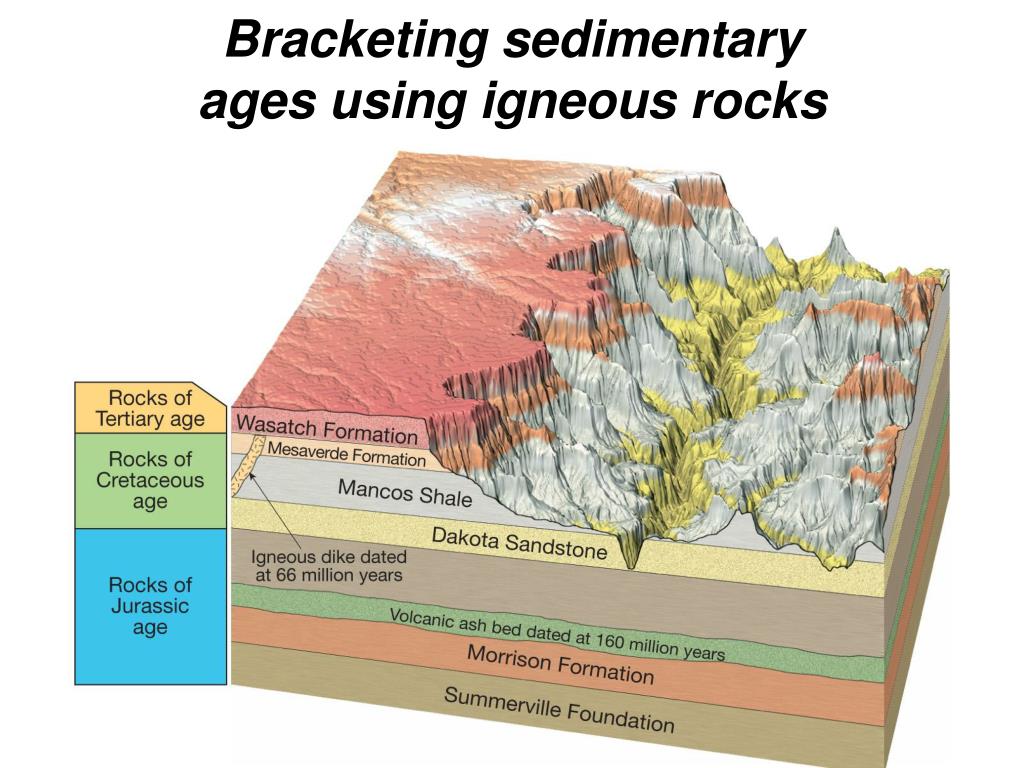
I grew up in a place where rock cuts, glacial terraces, volcanic dykes and ash layers are part of the scenery. From the east coast where I grew up to out in the PNW where I now live, you learn quickly that most fossils live in sedimentary rocks, but most clocks do not. The practical challenge is simple to state and hard to solve: how do we put a defensible age on a sedimentary layer that rarely contains minerals that formed at the same moment the sediment was deposited? The toolbox is larger than many realize. Below I walk through the major techniques we actually use in practice, why they work, and how index fossils keep the whole chronology honest.
Igneous Bracketing: The Workhorse
When a sedimentary sequence is interbedded with volcanic ash or bounded by lava flows, we can date those igneous horizons radiometrically and “bracket” the age of the sedimentary unit in between. In real projects that means U Pb on zircon from ash beds, or K Ar / Ar Ar on feldspar or micas in tuffs and lavas. The philosophy is straightforward: date the time the ash crystallized, not the time the sediment accumulated, and use those ages above and below to constrain the depositional window. This is textbook practice for older fossil sites where radiocarbon cannot reach (UC Berkeley, “Radiometric dating”; Peppe & Deino, Nature Education, 2013).
In volcanic terrains or basins dusted by distant ash, this approach is often the cleanest route to a numerical age model for sedimentary successions. It is also the easiest way to cross-check biostratigraphic claims when a spectacular fossil horizon needs an independent anchor (UC Berkeley; Peppe & Deino, 2013).
Detrital Zircon U Pb: Maximum Depositional Ages and Provenance
Zircon is small, tough, and common. It weathers out of igneous and metamorphic rocks and becomes a detrital grain in sandstones, siltstones, and some conglomerates. Because zircon can host uranium and exclude lead at crystallization, each grain carries a U Pb clock from its source rock. A population of grains from a bed yields a maximum age for deposition, never a minimum, and a fingerprint of provenance that maps where the sediment came from. Zircon in sedimentary rocks is dominantly detrital; authigenic zircon is rare and often hydrothermal (Wikipedia, “Zircon”; Hoskin & Schaltegger, 2003).
In practice, detrital zircon is indispensable when ash is absent. It sets the upper bound on when a bed could have formed and helps reconstruct shifting drainage networks and tectonics through time (Wikipedia; Hoskin & Schaltegger, 2003).
Cosmogenic Nuclides: Exposure and Burial Histories
When cosmic rays strike minerals at the surface, they produce rare isotopes such as ¹⁰Be, ²⁶Al, or ³⁶Cl. Measuring their concentrations in quartz-bearing rocks and sediments gives either the length of surface exposure or, when paired (e.g., ¹⁰Be–²⁶Al), a burial duration if production ceased underground. For sedimentary geology, that means we can time terrace stabilization, alluvial-fan construction, dune migration, or the burial of cave fills and river gravels. These methods offer ages from hundreds to millions of years, precisely where radiocarbon fades and ash is scarce (USGS, “A beginner’s guide to dating (rocks),” 2024).
Cosmogenic datasets are sensitive to snow cover, erosion, shielding, and lithology. The power lies in pairing carefully designed sampling with straightforward physics to translate nuclide inventories into exposure or burial chronologies (USGS, 2024).
Luminescence (OSL): Dating the Moment of Deposition
Optically Stimulated Luminescence (OSL) dates the last time quartz or feldspar grains saw sunlight. Sunlight empties electron traps. After burial, natural radiation fills them again at a known rate. In the lab, light stimulation releases those electrons and the emitted photons record time since burial. It is one of the few techniques that dates sediment deposition directly, not a bounding event or a detrital source. In aeolian sands, fluvial bars, beach ridges, dunes, and loess, OSL is often the most practical clock for the late Pleistocene to late Holocene, typically from a few hundred to a few hundred thousand years (Longstaffe, Isotopic Methods in Sedimentology, 2013).
The method requires adequate bleaching at deposition. Partial bleaching can bias ages older, so field strategy, dose-rate control, and statistical treatment of single-grain data are part of doing OSL well (Longstaffe, 2013).
Paleomagnetism: Reversal Chronology in Sedimentary Sequences
Fine-grained sediments can lock in the direction of Earth’s magnetic field as they settle. Because the geomagnetic field has reversed many times, a vertical sequence of normal and reversed polarity can be matched to the global polarity time scale. Paleomagnetism provides either relative order or, when tied to radiometric control, robust numerical ages across long sections that lack datable minerals. It is especially useful in marine and lacustrine records and in long continental basins where reversals are well preserved (Peppe & Deino, 2013; USGS, 2024).
Direct Dating of Sedimentary Materials: U Pb Carbonates, Re Os Shales, and Phosphates
It is not all bracketing and proxies. Several systems can directly date sedimentary materials under the right conditions. U Pb in some carbonates, Re Os in organic rich black shales, and U Pb or Lu Hf in phosphate phases can return depositional or early diagenetic ages. These approaches require careful screening for open-system behavior, but when the geochemistry cooperates, they supply numerical ages where ash, lava, or luminescence cannot. A comprehensive review highlights these as the most promising direct tools for Phanerozoic sedimentary deposits (Rasbury & Cole, Paleontological Society Papers, 2006).
How These Clocks Interlock With Index Fossils
Index fossils remain the backbone of biostratigraphy, but they are only as strong as their calibration. The modern workflow is reciprocal. Date bracketing ashes or lavas to anchor fossil zones in absolute time. Use OSL in non volcanic settings to put late Quaternary fossil assemblages on a calendar. Apply paleomagnetism to carry those calibration points across long sections. Where radiometric anchors are absent, well defined index fossils still correlate units regionally or globally; when igneous bracketing or luminescence data later appear, the fossil zones sharpen and sometimes shift. This is exactly how geochronology and biostratigraphy reinforce each other in practice (Peppe & Deino, 2013; UC Berkeley, “Radiometric dating”).
This interplay matters. Detrital zircon can constrain maximum ages for fossil beds and test whether a faunal turnover is truly synchronous or diachronous across a basin. Cosmogenic burial dating can put hard numbers on cave sequences with rich faunas but zero ash. Paleomagnetism can extend fossil timelines through long intervals where no single mineral clock works. When we treat index fossils as calibrated signals rather than free standing clocks, the whole chronology becomes more resilient to later revisions.
Why the Sequence Matters in the Field
I often approach a basin the way a carpenter approaches a complicated build. Start with bracketing if there is ash or lava. If not, ask whether OSL can tackle the targeted horizons. If neither is possible, pull detrital zircon to get maximum ages and provenance and run paleomagnetism to marshal reversals. Cosmogenic exposure or burial fills in where surfaces and caves dominate. Finally, evaluate whether the geochemistry of the rocks allows direct U Pb carbonates, Re Os shales, or phosphate dating. The order is pragmatic, not doctrinal, and it leans on what the rocks and the logistics allow (UC Berkeley; Peppe & Deino, 2013; Longstaffe, 2013; Rasbury & Cole, 2006; USGS, 2024).
Three Questions for Readers to Push This Further
1. In mixed settings where OSL, detrital zircon, and paleomagnetism each return slightly different age models, which discrepancies reflect geology and which reflect method limits, and how do we adjudicate them in a single basin model (Peppe & Deino, 2013; Longstaffe, 2013)?
2. If cosmogenic burial and paleomagnetism disagree in cave sequences, are we underestimating burial shielding or over simplifying magnetization lock in, and what field tests can resolve that (USGS, 2024; Peppe & Deino, 2013)?
3. Direct U Pb carbonates and Re Os shales can revolutionize stratigraphy where they work, but what screening thresholds should we require before trusting a depositional age that will reset a regional biostratigraphic scheme (Rasbury & Cole, 2006)?
I prefer to leave a basin with converging clocks and fossil zones that can survive a skeptical audit. That takes more time in the field and in the lab, but it also makes every correlation stronger when the next road cut, core, or outcrop turns up something unexpected.
References
• UC Berkeley, Understanding Evolution. “Radiometric dating.” University of California Museum of Paleontology.
• Peppe, D. J., & Deino, A. L. “Dating Rocks and Fossils Using Geologic Methods.” Nature Education Knowledge 4(10):1 (2013).
• USGS. “A beginner’s guide to dating (rocks).” Yellowstone Volcano Observatory, April 8, 2024.
• Longstaffe, F. J. “Isotopic methods in sedimentology.” In Encyclopedia of Sediments and Sedimentary Rocks (Springer, 2013).
• Rasbury, E. T., & Cole, J. M. “Directly Dating Sedimentary Rocks.” The Paleontological Society Papers 12 (2006).
• Wikipedia. “Zircon.” Accessed 2026.
• Hoskin, P. W. O., & Schaltegger, U. “The Composition of Zircon and Igneous and Metamorphic Petrogenesis.” Reviews in Mineralogy and Geochemistry (2003).

Leave a Reply