
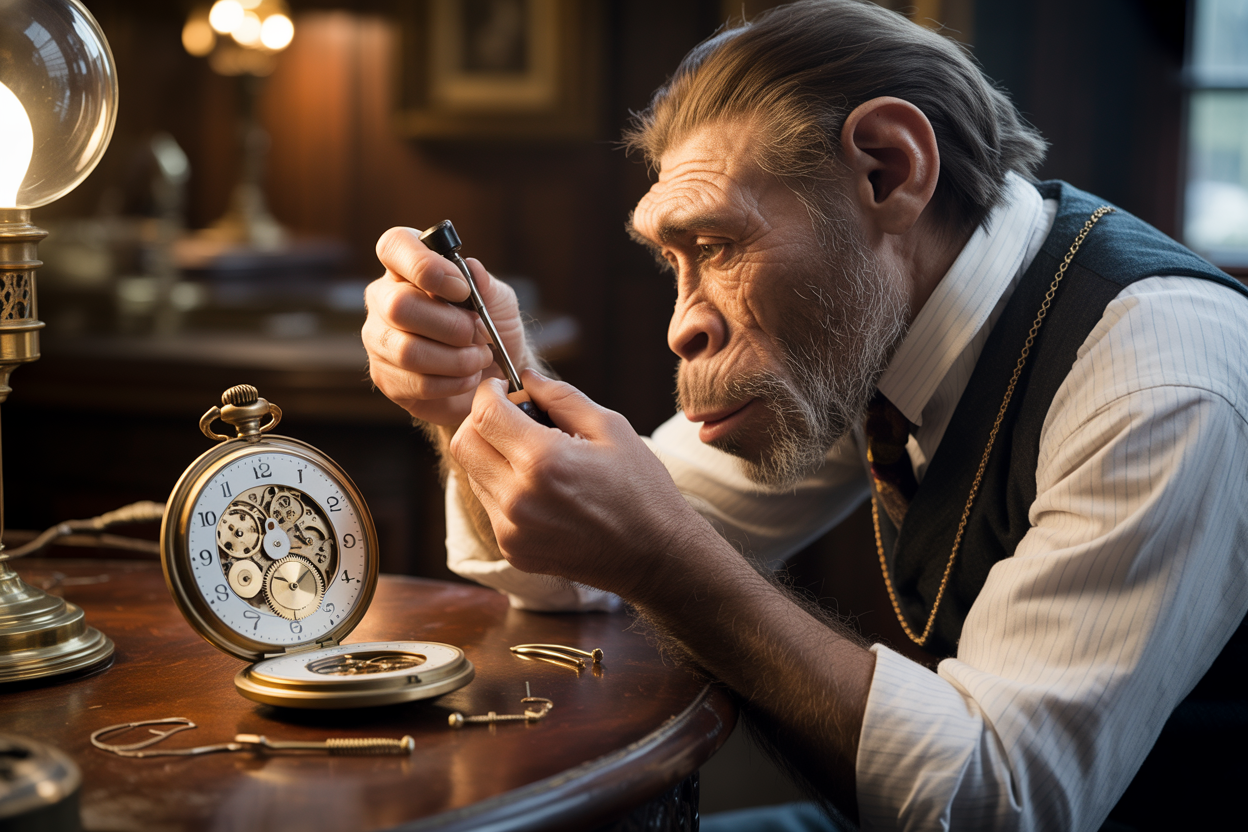
It was another quiet Monday when I saw this one, halfway down a Facebook thread that had already lost its sense of proportion. The group’s title promised a debate between Intelligent Design and naturalism, but the tone was less dialogue and more alternating sermon and rebuttal. Scroll a bit, and you could predict the rhythm. A confident assertion. A few approving replies. Then someone tries to push back, and suddenly the room gets very certain of itself. These threads are gems for essay ideas.
The post that caught my attention read:
“Physical forces arrange matter solely in accordance with physical laws. Only intelligent agents can rearrange matter in accordance with purposes. Prove me wrong.”
You can infer the context immediately. This isn’t a neutral observation. It’s a staged conclusion with a challenge attached. The terms are already framed: “physical laws” are passive, “intelligent agents” are purposeful, and the implication is that anything that looks purposeful must come from the latter. The burden of proof is inverted. The conclusion is baked in.
What they seem to think they’re doing is establishing a clean, intuitive dividing line. If something follows “laws,” it must be blind. If something exhibits “purpose,” it must come from intelligence. It feels like common sense because it mirrors everyday experience. We build things with intent, tools get used for reasons, messages have authors. The poster leans on that familiarity and quietly extends it outward, assuming the same logic applies everywhere. The “prove me wrong” framing is part of the setup. It functions as a kind of rhetorical trap, presenting the dichotomy as obvious and daring anyone to break it without first accepting its terms. But the force of the argument comes less from evidence than from how natural it sounds at first pass, especially if you’ve already been primed to see intention as the only plausible source of organized outcomes.
I have seen versions of this argument before, typically sometime around week four of a Philosophy 101 class, where the watchmaker analogy makes its annual appearance and everyone briefly treats it like a fresh insight. It’s not fresh. It’s persistent.
The problem begins with the word “purpose.” Not how it sounds, but how it is being used. The claim assumes purpose exists out there in the world as an intrinsic property, something detectable the way we detect mass or motion. But that assumption does not come from observation. It comes from us.
We infer purpose in human behavior because we already know humans act with intention. We have direct experience with minds, planning, goals. That inference is grounded in prior knowledge. Extending that same inference to the entire universe quietly switches categories. It treats a concept that depends on known agents as if it applies in contexts where no such agents are established. This is the old problem Hume pointed out when he dismantled design analogies: similarity in appearance does not justify similarity in cause (Hume, Dialogues Concerning Natural Religion, 1779).
There are a few overlapping reasons this move toward “purpose” happens, and none of them require that purpose actually be present. At a basic level, it reflects a deeply ingrained human tendency to interpret the world through agency. We are pattern‑recognizing animals, but more than that, we are agency‑detecting animals. It has been evolutionarily safer to assume “something is acting” when encountering ambiguity than to assume nothing is. A rustle in the grass might be the wind, or it might not. The brain is biased toward “might not,” and that bias doesn’t shut off when the patterns get more abstract. Complexity starts to look like intention because that’s the interpretive framework we default to.
That impulse didn’t begin with formal philosophy or theology. It runs back through our anthropological history. Early human explanations for natural phenomena were not mechanistic but intentional. Storms were expressions of will. Illness had agents behind it. The world was populated with actors because that is the most intuitive way to make sense of events when you lack explanatory models. Those habits of thought sediment over time. They don’t disappear just because we now have more detailed accounts of how systems behave. They remain as a kind of cognitive shorthand, ready to be reactivated whenever a pattern feels too intricate to be impersonal.
The theological layer builds on that foundation rather than creating it. Religious systems formalize and stabilize the intuition that order implies intention, giving it narrative structure and metaphysical backing. Once you’re in that framework, purpose is no longer something inferred cautiously. It becomes an expected feature of reality. The presence of structure confirms the expectation rather than testing it. At that point, interpreting patterns as purposeful feels less like a leap and more like recognition.
But none of that tells us what the patterns are, only how we are inclined to read them. The psychological habit, the anthropological inheritance, and the theological framing all point in the same direction. They make purpose feel like the obvious interpretation. What they don’t do is demonstrate that purpose exists independently of that interpretation.
So what is being observed here? Not purpose itself. Only arrangement. Structure. Pattern.
The move from “pattern” to “purpose” is where the argument slips.
In natural systems, patterns do not require intent. They require conditions. Snowflakes form intricate geometries, not because they are aiming at symmetry, but because water molecules interact under specific temperature and pressure constraints. Rivers branch. Crystals lattice. Galaxies spiral. None of these are pursuing outcomes. They are expressions of constraints playing out across time.
A good example of how easily “purpose” gets smuggled into systems that don’t contain it shows up in how people talk about quantum mechanics. Take the so‑called “observer effect.” It’s often described in popular terms as if particles somehow “decide” how to behave when we look at them, as though observation imposes intention on the system. That language is misleading. What’s actually happening is that measurement involves physical interaction. When you measure a quantum system, you’re not passively watching it, you’re coupling it to another system, and that interaction constrains the outcomes you can observe. Nothing in that process requires awareness, intent, or purpose. Yet the phrasing invites it. People hear “observer” and unconsciously substitute “observer with a mind,” then infer something like intention where none exists.
You see the same interpretive drift in discussions of wavefunction “collapse,” as though the system is moving toward a preferred state. But the mathematics doesn’t describe goals. It describes probabilities updating under interaction. The system doesn’t aim. It resolves within constraints. What gets labeled as “mysterious” or “purposeful” is often just unfamiliar behavior being forced into familiar conceptual boxes. The lesson is consistent with the simpler examples: when we lack intuitive traction, we reach for intention. But the underlying processes don’t need it. They operate through conditions, interactions, and limits, not purposes waiting to be fulfilled.
What makes biological complexity feel different is not that it has purpose, but that it accumulates. Evolution by natural selection provides a mechanism where variation is filtered over time, producing systems that appear highly organized and functional without any foresight involved. No one is aiming. There is no blueprint in advance. Yet complexity builds, step by step, through differential survival and reproduction (Dawkins, The Blind Watchmaker, 1986).
That still makes some people uneasy. I understand that. It removes intention from places where intention feels natural. But replacing explanation with discomfort doesn’t strengthen the argument. It just reveals the preference behind it.
There’s another layer here, quieter but just as important. The language itself. “Physical laws.”
We talk about laws as if the universe is following instructions. That phrasing slips in agency where none is implied. In physics, laws are descriptive. They summarize observed regularities. They do not prescribe behavior in the way human rules do. The universe is not checking a rulebook before acting. It simply behaves consistently enough that we can model those behaviors and call the models “laws” (Carroll, The Big Picture, 2016).
When the post divides reality into “matter obeying laws” versus “agents imposing purpose,” it builds a false contrast out of two anthropocentric assumptions. First, that laws are something like commands. Second, that purpose is something like a universal property rather than a human attribution.
A simple example shows up in how people talk about gravity. It’s common to hear that objects “fall because gravity pulls them down, as if the law of gravity is instructing matter to behave in a certain way. That framing subtly turns a description into a command. Newton’s law, and later Einstein’s account of spacetime curvature, don’t tell matter what to do. They describe how mass and energy interact across space. Nothing is being directed. Nothing is being told to move. Yet in everyday language, that descriptive model becomes a kind of invisible authority, and once it’s treated that way, it becomes easy to ask why it doesn’t also “direct” things toward goals. From there, purpose slips in as if it were just a more complex version of the same kind of influence.
The error comes from how humans relate to rules in their own lives. We’re used to laws as prescriptions, traffic laws, legal codes, instructions, all backed by intention and enforcement. So when we reuse the word “law” for physics, we carry over the same mental model without noticing. It feels natural to ask what the law is “for,” or why it produces certain outcomes, as if outcomes were intended. But that’s imported meaning, not something the system itself contains. The pattern is being described, not directed, and confusing those two is what opens the door for purpose to be treated as an inherent property rather than something we’re layering onto it.
What remains, once those assumptions are stripped away, is something less theatrical and more interesting. Complex systems forming through interaction, constraint, and time. No intention required. No cosmic project manager.
The claim also leans on a familiar pattern in Intelligent Design arguments, where gaps in explanation are treated as evidence for intervention. But that depends on ignoring the progress science has already made. Biological information, often framed as requiring a mind, arises through mutation and selection processes that are well documented. Genetic variation is not guided. It is filtered. Over long stretches of time, that filtering generates the appearance of design without invoking a designer.
This is where the pseudoscientific character of Intelligent Design becomes difficult to ignore. It borrows language from information theory, from molecular biology, from cosmology, and rearranges it into a narrative that points to external intention. But it does not produce testable mechanisms, predictive models, or falsifiable claims. It mixes scientific terminology with metaphysical conclusions and treats the result as if it carries the same evidentiary weight. It doesn’t.
What lingers in the original post is the confidence of a dichotomy that never needed to be drawn. Either matter behaves blindly, or it is guided by purpose. But why accept that framing at all? Why assume purpose is the default category?
It’s worth asking, honestly, what we mean when we say something has purpose. Is it really out there in the thing itself, or is it something we recognize because it resembles things we already understand? A bird’s wing looks purposeful because it functions. But function, in evolutionary terms, is not intention. It is the result of what worked, repeated across generations.
I find myself returning to that initial sentence. “Prove me wrong.” It carries a certain confidence, as if the position is obvious and the burden lies elsewhere. But the argument depends on assumptions that are neither demonstrated nor necessary.
What’s interesting is that the breakdown already does answer the challenge, just not on its own terms. The claim assumes that if purpose is removed, something essential is missing from the explanation. But once you follow the argument through, you find that nothing actually depends on purpose being there in the first place. The structures, patterns, and complexities in question are already accounted for by conditions, interactions, and cumulative processes. The “proof” isn’t a counterexample where matter clearly acts with purpose. It’s the demonstration that purpose was never required as an explanatory category to begin with.
So the response ends up inverted. Instead of showing where purpose exists independently in nature, the analysis shows how the idea gets introduced as an interpretive layer after the fact. The original challenge asks for proof against a claim about reality, but the real work happens one step earlier, at the level of definitions and assumptions. Once those are corrected, the claim doesn’t need to be disproven in the way it demands. It simply loses its footing.
If anything, the more interesting question is not whether nature has purpose, but why we are so inclined to see it there. What does that say about how we interpret the world? About the frameworks we bring with us before we start observing?
As a reader, take the claim seriously for a moment and push it further. If purpose is really out there in nature, independent of us, where exactly does it reside? In the object? In the process? In the outcome? What would count as evidence for it that isn’t just interpretation layered onto pattern? And if every example of “purpose” ultimately depends on importing human concepts of intention, planning, or goal‑directed behavior, then what are we actually detecting? Something external, or just a familiar frame applied in unfamiliar places?
That’s the step most people skip. Not whether purpose exists, but whether we’ve ever observed it apart from ourselves.
Maybe that’s the real exercise left over from Philosophy 101. Not deciding whether the universe is designed, but noticing how quickly we design it ourselves.
References
- Carroll, Sean. The Big Picture. 2016.
- Dawkins, Richard. The Blind Watchmaker. 1986.
- Hume, David. Dialogues Concerning Natural Religion. 1779.
- Dennett, Daniel C. Darwin’s Dangerous Idea. 1995.
- Mayr, Ernst. What Evolution Is. 2001.
- Monod, Jacques. Chance and Necessity. 1970.
- Russell, Bertrand. Religion and Science. 1935.
- Deacon, Terrence. Incomplete Nature. 2011.
- Barrow, John D., and Tipler, Frank J. The Anthropic Cosmological Principle. 1986.

Leave a Reply