
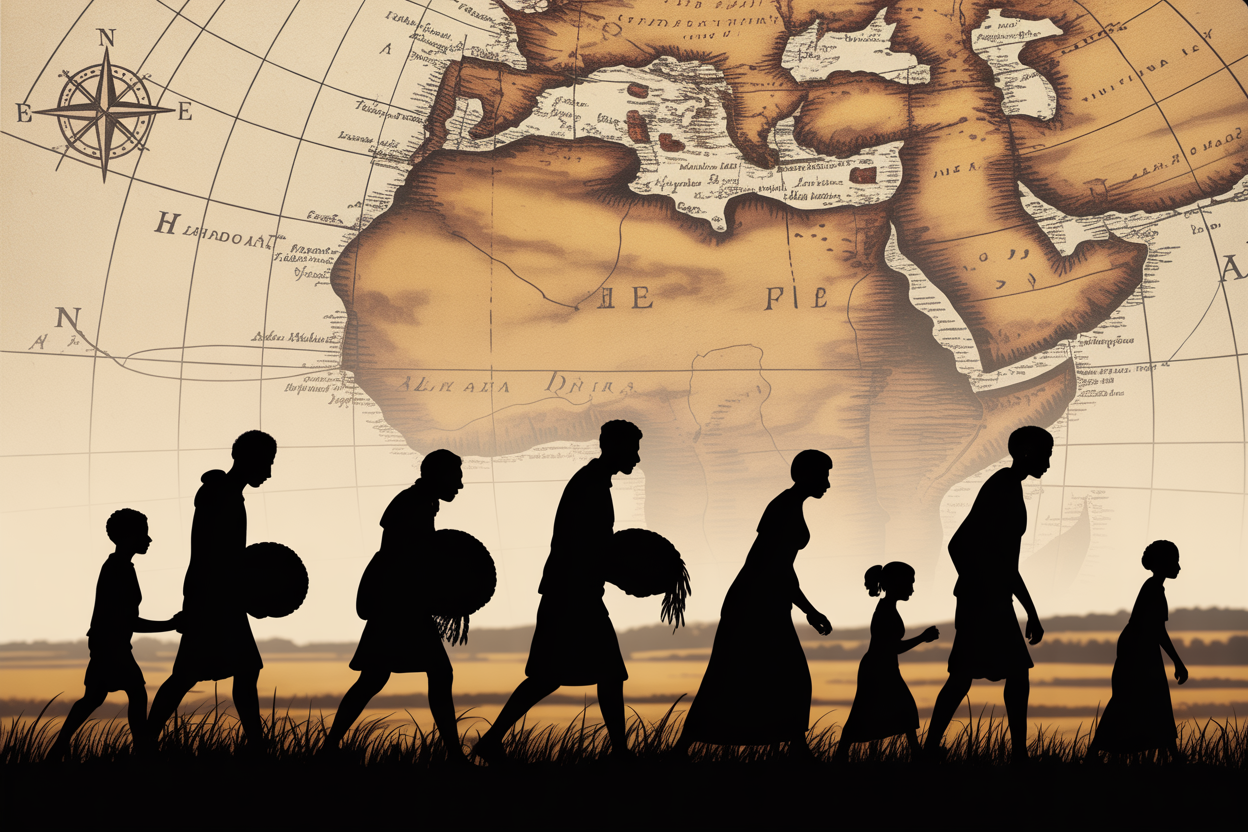
The Sahara is often written like a barrier. A clean geographic severance. Sand as punctuation. But that reading feels wrong the moment you start tracing the movement of people across it. The crossings were constant, older than most states, older than most of the religions invoked to justify them. I keep coming back to that discomfort. It suggests the slave trade tied to sub‑Saharan Africa was not an episode but a structural habit, adjusted repeatedly rather than abolished.
Before Islam, the pattern was already legible. Egyptian campaigns into Nubia involved the capture of prisoners who were redistributed north as labor (Trans‑Saharan slave trade, Wikipedia). Greek and Roman accounts describe Saharan intermediaries seizing “Ethiopians” and feeding markets in the Mediterranean (Trans‑Saharan slave trade, Wikipedia). Within sub‑Saharan societies, enslavement often followed war, debt, or criminal sanction, with captives sometimes folded into households rather than reduced to perpetual chattel (Lowcountry Initiative, Slavery Before the Trans‑Atlantic Trade, n.d.).
It is tempting, maybe too convenient, to call this a fundamentally different system. Less brutal, more porous. That claim appears often in introductory texts. Yet even in these early phases, the trade outward from sub‑Saharan regions already involved commodification at scale. Markets in Carthage and Rome did not operate on kinship logic. They converted people into distance, then into price.
What shifts, quietly but decisively, is not only scale but legal imagination. Pre‑Islamic systems tended to treat enslavement as contingent, tied to war or debt and therefore potentially reversible. Under expanding Islamic polities, jurists and administrators worked to define categories that could travel. Enslavement became legible across distance. A person taken in the Sahel could be bought in Fez or Basra under a shared vocabulary of law, even if practice varied on the ground (Islamic views on slavery, Wikipedia). This is not a minor semantic detail. It meant the trade no longer depended solely on local recognition. It could scale outward because recognition itself had been systematized. I keep noticing how that abstraction mirrors other imperial systems. Once the categories stabilize, movement accelerates.
Long before Islamic jurists began refining categories, older civilizations had already supplied the conceptual scaffolding. Aristotle, writing in Politics, argued that “from the hour of their birth, some are marked out for subjection, others for rule,” and more starkly that a slave is one “who, while being human, is by nature not his own but of someone else” (Aristotle, Politics, cited in Natural Slavery, Wikipedia). That language feels almost clinical. Ownership is framed not as violation but as alignment with nature. Roman law, in turn, codified this into something colder. “Servitus… est constitutio iuris gentium qua quis dominio alieno contra naturam subicitur,” slavery as a legal condition by which a person is subjected to another’s dominion, even while acknowledging it runs against nature (Buckland, Roman Law of Slavery). The contradiction is striking. They knew it violated some deeper principle and formalized it anyway. In practice, Roman society treated enslaved people as property without legal personhood, subject to punishment, sale, and extraction at scale (Slavery in ancient Rome, Wikipedia).
Biblical sources do something different, though not necessarily less decisive. They normalize the institution through regulation and moral framing rather than philosophical justification. “When you buy a Hebrew slave, he shall serve six years,” begins Exodus 21, proceeding to detail conditions, inheritance, and permanence. Elsewhere, the logic becomes behavioral: “Slaves, obey your earthly masters with fear and trembling… as you would Christ” (Ephesians 6:5). I find that turn revealing. The text does not need to argue that slavery is natural or inevitable. It treats it as already embedded, then shifts the emphasis to conduct within it. Even Greek historical writing echoes this ambient assumption. Herodotus recounts moments where defeated populations are reduced to servitude without pausing to question the legitimacy, describing captive Egyptians led “in the dress of slaves” after conquest (Herodotus, Histories). The act is narrated, not interrogated. Across these traditions, the pattern converges. Slavery appears either as nature, law, or order, but rarely as anomaly.
There is also the question of who could be enslaved, and why that boundary mattered so much. Islamic legal traditions generally restricted the enslavement of free Muslims while permitting the enslavement of non‑Muslims captured in war or acquired from outside Islamic territory, a distinction that created a persistent external demand zone (History of slavery in the Muslim world, Wikipedia). Conversion, in theory, complicated status but did not always reverse it in practice. The result was a directional pull southward and outward, toward populations defined as religiously and politically outside. I find that boundary unsettling because it reads as both precise and elastic. It narrows the field in principle while widening it in effect. Over time, it helps explain why sub‑Saharan Africa became such a consistent source region without being the only one.
Islam did not invent this network. It standardized it. After the 7th century, Islamic legal and commercial frameworks regularized the capture, transport, and sale of enslaved people, defining legitimate sources of enslavement and embedding the trade within expanding imperial routes (Islamic views on slavery, Wikipedia). The scale becomes harder to ignore here. Estimates suggest 6 to 10 million sub‑Saharan Africans were transported to North Africa and the wider Muslim world across trans‑Saharan routes alone, with broader “Arab” or Indian Ocean systems pushing totals higher (History of slavery in the Muslim world, Wikipedia; Trans‑Saharan slave trade, Wikipedia). Some estimates extend to 11–17 million across all connected circuits (DBpedia summary).
Numbers flatten people, but they force comparison. The transatlantic trade moved about 12.5 million Africans, with roughly 10.7 million surviving the Middle Passage (NEH, Transatlantic Slave Trade Database). The Atlantic system concentrated extraction into a shorter period and was male‑skewed due to plantation labor demands (SlaveFreeSeas, 2026). By contrast, the trans‑Saharan and Indian Ocean trades often drew heavily on women and children for domestic labor, concubinage, and reproductive roles, while a significant portion of enslaved males were castrated, sometimes lethally, to create eunuchs (grokipedia summary).
That demographic divergence matters. It shaped how populations disappeared. In the Atlantic world, enslaved populations grew through reproduction. In many Islamic regions, enslaved populations had to be continuously replenished. This is one reason the trade persisted over thirteen centuries (FairPlanet, Koigi, 2023).
And the sources were never exclusively sub‑Saharan. European captives from Mediterranean raids, Slavic populations from eastern Europe, Central Asians, and peoples from the Caucasus and the Indian subcontinent moved through adjacent circuits into Muslim markets (History of slavery in the Muslim world, Wikipedia; Trans‑Saharan slave trade, Wikipedia). These flows were stratified. Enslaved Europeans often occupied administrative or military roles. African captives were disproportionately directed into labor systems tied to agriculture, transport, and domestic service. Not universal, but patterned enough to reveal preference.
Religion threads through all of this in ways that resist tidy judgment. Islamic texts assumed slavery as a condition of the world and offered regulations and incentives for manumission while permitting enslavement through warfare and purchase (Islamic views on slavery, Wikipedia). Jewish and Christian texts did the same. Biblical law regulated servitude rather than abolishing it, and later Christian theologians justified Atlantic slavery through interpretations of scripture and race. Secondary writings across all three traditions spent centuries normalizing the institution before abolition emerged as a serious ethical claim in the eighteenth and nineteenth centuries (Brown, Slavery and Emancipation in the Sharia, 2024).
Islamic writing rarely rejects slavery outright in its formative period. It organizes it. The Qur’an repeatedly references “those whom your right hands possess,” a phrase that signals accepted ownership while embedding it in a moral vocabulary that encourages restraint rather than prohibition (Islamic views on slavery, Wikipedia). Hadith literature goes further in normalization through proximity. Reports describe Muhammad acquiring and freeing enslaved people, creating a model where participation and mitigation coexist rather than cancel each other. Later jurists systematized this into doctrine. Slaves could be taken in war, inherited, or purchased beyond the boundaries of Islamic rule, and manumission became a recommended act of piety, not a structural requirement for abolition (Islamic views on slavery, Wikipedia). I notice how often this is framed as ethical reform from within. It narrows cruelty, encourages release, but leaves the core institution intact. That tension persists in secondary literature. As Brown puts it, for centuries “every major religious and philosophical tradition considered [slavery]… proper, and even natural,” and debates about its intrinsic morality arrived late and unevenly (Brown, Slavery and Emancipation in the Sharia, 2024).
Jewish and Christian traditions echo this layered acceptance. The Hebrew Bible regulates ownership with procedural clarity. “If you buy a Hebrew servant, he shall serve six years,” followed by rules about family, permanence, and release (Exodus 21:2). The text does not hesitate over the initial act of buying. It defines its boundaries. The New Testament shifts tone but not structure. “Slaves, obey your earthly masters… as you would Christ” (Ephesians 6:5) replaces legal framing with moral obedience, but the hierarchy remains assumed. Later Christian writers extended this logic outward. Pro‑slavery theologians in the Atlantic world cited Pauline obedience to defend plantation systems, often fusing biblical precedent with emerging racial theories. Even in moments of critique, the language tends to reform behavior rather than dismantle the institution. The result, across traditions, is a dense archive of normalization. Not identical arguments. More like converging habits of thought. Slavery is permitted, regulated, moralized, rarely treated as fundamentally illegitimate until much later.
I find myself uneasy with how often religion is framed as either culprit or scapegoat. It functioned more like infrastructure. It did not create demand, but it stabilized it. Legal language made ownership legible, transferable, defensible. Without that, scale would have been harder to maintain.
By the early modern period, the so‑called Muslim trade and the transatlantic trade were not isolated systems. They fed each other. European traders largely purchased captives from African intermediaries who were themselves embedded in older trans‑Saharan and regional slave networks (Atlantic slave trade, Wikipedia). Raiding intensified inland as demand surged on both coasts. Firearms flowed in. Political fragmentation followed. It is difficult to disentangle cause from amplification. The Atlantic system did not invent African slavery, but it industrialized its extraction and redirected its geography.
Why sub‑Saharan Africa? Geography and political structure converge here in ways that feel almost mechanical. The region’s ecological diversity, from forest to savanna, limited centralized control across vast distances. Communities defined identity sharply at the local level, which made captives from outside the group easier to classify as enslaveable others (OpenWA Pressbooks, West Africa and the Role of Slavery, n.d.). Trade routes already linked interior zones to both Mediterranean and Indian Ocean markets. Add camel transport across the Sahara and monsoon navigation along the East African coast and you get corridors that reward extraction. Not destiny, but pressure.
Modern discussions rarely hold this complexity. Online discourse fragments the history into competing moral exhibits. The Atlantic trade is often framed primarily through capitalism and race. The trans‑Saharan trade is alternately minimized as “different” or weaponized as a counter‑accusation, leaning into religious bias or deflection. Both moves feel incomplete. Each trade had distinct logics, but they overlapped, reinforced, and sometimes synchronized.
In formal writing, the fragmentation shows up less as open argument and more as competing emphases that quietly harden into doctrine. One recent synthesis calls for moving “beyond the ‘Atlantic’… bias in our understanding of the history of slavery,” noting that scholarship has disproportionately concentrated on Atlantic systems while treating others as peripheral or derivative (van Rossum, Slavery and Its Transformations, 2021). That bias is structural. Atlantic slavery benefits from dense archives, shipping logs, plantation records, insurance claims, datasets that allow quantification.
By contrast, historians working on sub‑Saharan and trans‑Saharan systems repeatedly note “far fewer surviving centralized archival records,” with reliance on scattered Arabic texts and limited archaeology, producing a thinner evidentiary footprint that distorts attention (Factually summary, 2026; Lane, Cambridge World History of Slavery, 2021). The result is not silence but asymmetry. One system becomes legible enough to dominate curricula and public consciousness. The other remains diffuse, easier to contest, easier to appropriate. It is telling how often modern comparative essays feel compelled to correct this imbalance with almost programmatic language. “By narrowing the lens to Western involvement alone, a dangerous misconception takes root,” one contemporary article argues, framing the Islamic trade as a neglected counterweight rather than an integrated system (Orr, Reexamining Narratives, 2024). Even that corrective tone risks becoming its own form of distortion. It recenters the debate without necessarily reweaving the connections.
Online discourse compresses this fragmentation into something sharper and less patient. Social media amplifies simplified narratives because it rewards emotional clarity over structural ambiguity. Research consistently finds that these platforms “increase citizens’ likelihood of exposure to… false, and prejudicial content,” especially around religion and identity, while also normalizing hostility through repetition and algorithmic reinforcement. The slave trade becomes a rhetorical device inside those currents.
One strain reduces the trans‑Saharan system to deflection, a way to relativize Atlantic slavery. Another inflates it into a moral counterweight framed explicitly in religious terms. You see language like “the Islamic world is astonishingly silent on its… history of slavery,” paired with claims that public discourse is dominated by Atlantic memory while other regions evade scrutiny (Marozzi, 2025). The phrasing is blunt, almost prosecutorial. It invites reaction rather than synthesis.
Elsewhere, popular commentary leans the other direction, stressing that the Atlantic system was uniquely industrial and racialized, implicitly minimizing other trades by collapsing them into “different” categories (comparative essays, 2024). What I keep seeing is not disagreement over facts so much as disagreement over framing. Capitalism, religion, race, colonialism. Each becomes the primary lens, and each lens excludes something essential. The fragmentation feels less accidental than functional. It allows people to select the version of history that best aligns with their present argument, then circulate it until it hardens into common sense.
There is also suppression, both historical and contemporary. The trans‑Saharan and Indian Ocean trades generated fewer centralized records, which has allowed their scale to be contested or softened. Colonial narratives sometimes downplayed Islamic systems to elevate European abolition. Postcolonial discourse can avoid the topic to resist external critique. Meanwhile, forms of slavery persist. Hereditary servitude in parts of West Africa and exploitative labor systems like kafala in the Gulf echo older hierarchies, even as they operate under modern legal frameworks (Marozzi, 2025).
I am left wondering what counts as closure. The transatlantic trade has monuments, curricula, and a shared vocabulary of atrocity. The trans‑Saharan system feels more diffuse, less anchored in public memory. Maybe that is because it lasted longer, changed shape more often, and never fully stopped. Or maybe it is easier to narrate an ending than a continuity.
That unease stays with me. It complicates the instinct to assign singular blame or singular meaning. The routes remain, even if the caravans do not look the same.
References
Brown, Jonathan A. C. Slavery and Emancipation in the Sharia, 2024.
Koigi, Bob. Forgotten slavery: The Arab-Muslim slave trade, 2023.
Marozzi, Justin. “Slaves still stalk the Muslim world,” 2025.
National Endowment for the Humanities. Transatlantic Slave Trade Database, n.d.
OpenWA Pressbooks. West Africa and the Role of Slavery, n.d.
Lowcountry Digital History Initiative. Slavery Before the Trans-Atlantic Trade, n.d.
Wikipedia. Atlantic slave trade, n.d.
Wikipedia. History of slavery in the Muslim world, n.d.
Wikipedia. Islamic views on slavery, n.d.
Wikipedia. Trans-Saharan slave trade, n.d.
Wikiwand. Trans-Saharan slave trade, n.d.
DBpedia. Trans-Saharan slave trade summary, n.d.
SlaveFreeSeas. Atlantic vs Indian Ocean Slave Trade, 2026.
Grokipedia. Trans-Saharan slave trade, n.d.

Leave a Reply