
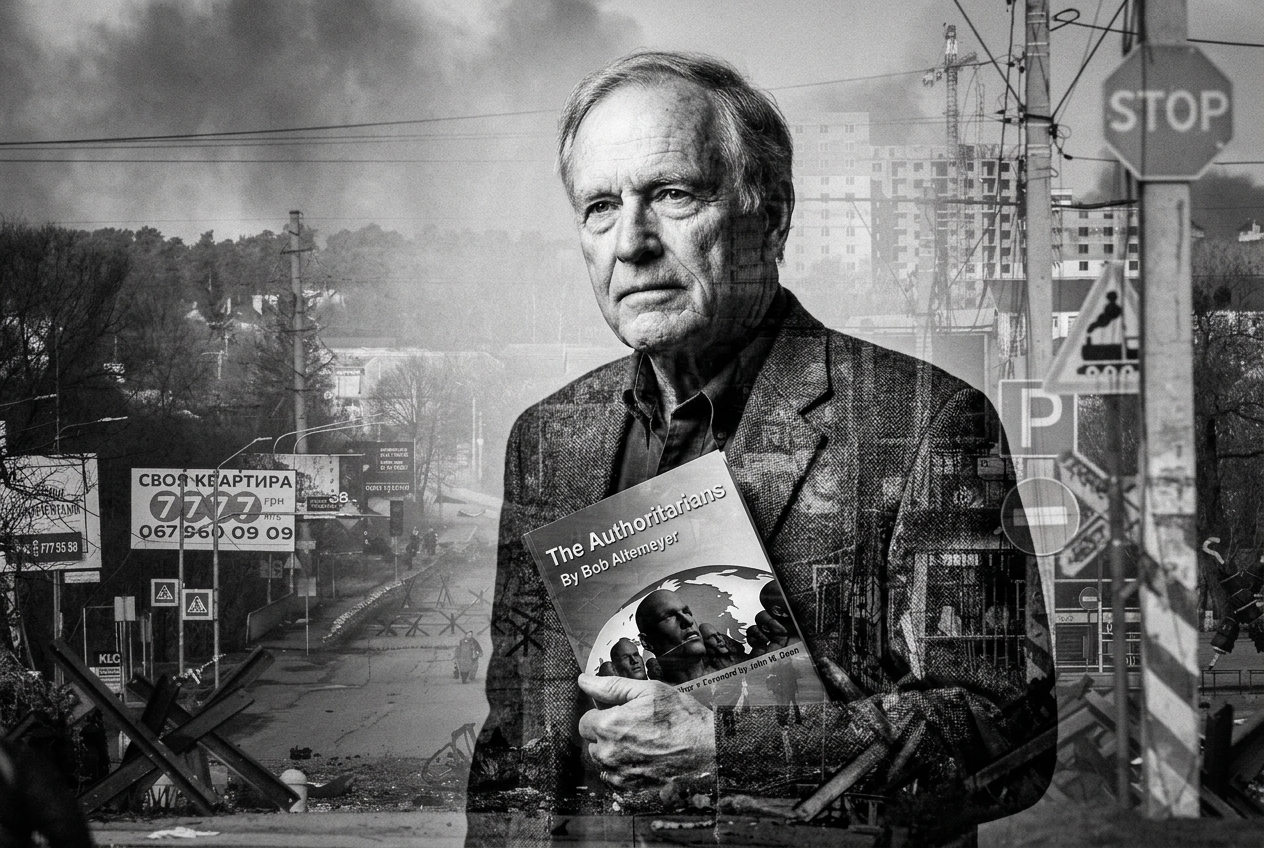
I remember sitting in a high school classroom, somewhere between not paying enough attention and thinking I understood more than I did, listening to a lecture on authoritarianism and thinking it felt abstract. Sociology had that problem for me back then. It seemed like a discipline that explained behavior in broad strokes after the fact, like weather reports written a week too late. Patterns, surveys, tendencies. Interesting, but not urgent.
It’s always not urgent until it is.
Many years later, the topic appeared again, and Bob Altemeyer came up in that context, briefly, the way ideas do when they don’t seem immediately useful. His work on authoritarian personalities. Right‑wing authoritarianism in particular. The phrasing sounded dated, almost Cold War‑ish. It didn’t land. Not then. Not in a room where democracy felt like a natural condition rather than something assembled and maintained.
What I missed was that Altemeyer wasn’t describing a system. He was describing a tendency.
The Structure That Waits
That’s about where I realized I didn’t actually understand the mechanism I was hearing described. It felt familiar, but not precise. Like recognizing a shape without being able to name the structure. So I did what I usually do when something starts to matter more than it should. I went to my eldest brother. He’s the one who took sociology seriously enough to make a career out of it, the one who doesn’t treat it like background noise. I remember laying it out, probably less clearly than I thought I was, expecting a quick answer. What I got instead was a kind of slow unpacking. Not dramatic, not urgent, just steady. As if the thing I was asking about wasn’t new at all, just something I hadn’t learned how to recognize yet.
Altemeyer’s model is deceptively simple. Authoritarian submission, authoritarian aggression, and conventionalism. Three traits that don’t look dangerous on their own. Respect authority. Enforce norms. Maintain tradition. Nothing unusual there (Altemeyer, The Authoritarians, 2006).
The issue is when they converge and lock in.
- Submission looks like trust, until it becomes dependence.
- Aggression looks like order, until it becomes punishment.
- Conventionalism looks like stability, until it hardens into resistance.
This is where political theory starts leaning on sociology. The traits Altemeyer measured map directly onto behavior that political systems either contain or amplify. Democracy relies on tension. On disagreement without annihilation. On authority that can be challenged without collapsing the structure.
Authoritarian systems remove that tension.
They replace conflict with alignment.
Historical Examples That Didn’t Surprise Anyone Studying the Pattern
The historical record doesn’t treat this as abstract.
Weimar Germany didn’t collapse because one person arrived with a plan. It shifted because institutional fragility met a population segment primed for certainty and order. The National Socialist movement aligned with authoritarian tendencies already present. Submission to leadership, aggression toward out-groups, enforcement of social conformity. The system didn’t introduce those features. It organized them (Paxton, The Anatomy of Fascism, 2004).
Italy follows a similar path. Mussolini didn’t invent authoritarian sentiment. He mobilized it. The appeal was not complexity. It was clarity. A state that resolves conflict by removing it.
You see the pattern elsewhere. Franco’s Spain. Military regimes in Latin America during the twentieth century. Even outside explicitly fascist systems, moments of democratic erosion often follow the same alignment. Institutions weaken. Authority consolidates. Dissent reframes into disloyalty.
But stopping there misses something important. The pattern doesn’t belong to fascism alone. It shows up just as cleanly in systems that claimed entirely different ideological foundations. Maoist China carried a revolutionary narrative, not a fascist one, yet the structure aligns uncomfortably well. Authority centralized around a singular figure. Dissent reframed as counter‑revolutionary threat. Conventionalism recoded as ideological purity. The system presented itself as participatory, even democratic in origin, but that phase was brief enough that it gets smoothed out in hindsight (Dikötter, The Cultural Revolution, 2016).
Stalinist Russia follows the same arc. Early revolutionary ideals, fragments of participatory governance, quickly consolidated into enforced cohesion. Authority became unquestionable not because it declared itself to be so outright, but because the cost of questioning rose steadily until no meaningful opposition remained. The appearance of collective rule lingered in structure, but not in function. People remember the end state. They forget how quickly the transition occurred (Figes, Revolutionary Russia, 2014).
That’s the part that echoes back into Altemeyer’s work. The ideological label doesn’t matter as much as people think it does. Fascist, communist, nationalist. Different language. Same structural alignment when authoritarian tendencies are activated and reinforced. The veneer changes. The pattern stays consistent.
Altemeyer’s work reads less like theory when you place it next to these cases. It reads like a diagnostic tool.
The Leaders Who Fit Too Well
Altemeyer also pointed to another category. Social dominators.
I remember pressing my brother on that, because it still felt remote to me, something that belonged in textbooks rather than real time. He didn’t argue in abstractions. He pointed to patterns. The Nixon administration, he said, wasn’t an outlier as much as it was an example in motion. The signs weren’t hidden. Expansion of executive authority positioned as necessity. Increasing distrust of external criticism, especially from the press. The quiet normalization of loyalty over institutional independence. He talked about how dissent began to be reframed, not just as disagreement, but as threat to stability. It wasn’t dramatic enough to feel like collapse, but it was structured in a way that should have made people uncomfortable.
What stuck with me was how he described the alignment. Not ideology, not party, but behavior. When leaders begin to treat systems as tools rather than constraints, and followers accept that shift because it promises order, the pattern starts to close. He didn’t say it as a warning. More like an observation. The kind you make when you’ve seen it before, in different contexts, under different names, and recognize the early stages before anyone else is willing to call it that.
They don’t necessarily share the same psychological profile as authoritarian followers. They tend to be lower in empathy, higher in dominance orientation, more willing to use the structure for personal or strategic gain (Altemeyer, 2006).
That pairing matters.
- Followers seek certainty and order.
- Leaders provide it in concentrated form.
The system doesn’t require deception. It requires alignment.
You can see that adaptability in modern movements that should not overlap but do, structurally. Prosperity‑gospel evangelism, for example, reshapes theology around outcomes that resonate with its audience. Wealth becomes evidence of favor. Authority becomes evidence of blessing. The message adjusts, subtly, to match what people already want to believe about success and meaning, and in doing so it strengthens loyalty without needing to enforce it directly. The leader doesn’t demand obedience in crude terms. The system rewards alignment and calls it faith. It feels voluntary. That’s why it works.
At the other end, movements tied to white supremacist ideology operate with a different vocabulary but a similar mechanism. Identity becomes the stabilizing principle. Threat is amplified. Loyalty is framed as preservation. Leaders in that space don’t need a fixed doctrine as much as they need a consistent signal. Who belongs. Who doesn’t. What must be protected. The rhetoric shifts depending on context, sometimes overt, sometimes coded, but the structure underneath stays recognizable. Authority gathers around whoever can articulate that alignment most effectively. It doesn’t matter if the messaging is coherent across time. It only needs to stay coherent enough in the moment to hold the group together.
In both cases, ideology isn’t the anchor people assume it is. It’s the vehicle. What holds the system together is the feedback loop between leader and follower, the sense that the leader reflects what the follower already believes or wants confirmed. That’s the part that makes it resilient. Not uniform thought, but synchronized reinforcement.
Some of the most effective authoritarian leaders weren’t ideologues in the strict sense. They were adaptive. They recognized which signals activated loyalty and which narratives justified control. The ideology becomes flexible. The structure stays consistent.
Democracy as a Temporary Achievement
What I didn’t understand in that classroom is that democracy isn’t the default state of a society. It’s a configuration that only works under specific conditions.
- It requires tolerance for ambiguity.
- It requires acceptance of loss.
- It requires trust that outlasts disagreement.
Those aren’t universal preferences.
When enough people begin prioritizing certainty over ambiguity, alignment over plurality, authority over negotiation, the system tilts. Not abruptly. Gradually. Policies framed as protection. Consolidation disguised as efficiency. Language shifting just enough that questioning begins to look like instability.
In a modern context, the pattern doesn’t arrive with uniforms or declarations. It shows up in language that feels familiar, almost practical. The “war on crime” frames expanded enforcement and surveillance as necessary protection, shifting focus from systemic causes to individual threat, and in doing so builds tolerance for increased authority in exchange for perceived safety. Abortion debates move from policy disagreement into moral absolutism, where dissent is no longer part of democratic negotiation but treated as complicity in harm. Gun rights discussions follow a similar compression, where alignment becomes identity and compromise begins to look like betrayal. In each case, the underlying move is the same. Complexity narrows. Positions harden. Authority steps in as the stabilizing force that resolves the tension by removing it. It doesn’t feel like losing something. It feels like gaining clarity.
It doesn’t feel like collapse while it’s happening.
That’s what makes it effective.
Science Fiction Saw It Clearly First
The pattern shows up in science fiction with uncomfortable clarity.
In Star Wars, the fall of the Republic into the Galactic Empire doesn’t come from external conquest. It comes from internal transformation. Emergency powers granted. Security prioritized. Authority concentrated until it becomes irreversible.
Or take 1984. Orwell strips the system down to its core components. Submission. Surveillance. Control of truth itself. No ambiguity allowed. Reality becomes what authority declares (Orwell, 1984, 1949).
Even The Handmaid’s Tale operates this way. Institutions don’t vanish overnight. They are redirected. Norms become rules, rules become enforcement, enforcement becomes identity (Atwood, The Handmaid’s Tale, 1985).
None of these stories feel unrealistic because the underlying structure isn’t fictional.
It’s recognizable.
The Part That Feels Familiar Now
This is where the classroom memory shifts from abstract to specific for me.
I used to think authoritarianism required something dramatic. A clear break. A visible takeover. Now it looks more like accumulation. Small, justifiable shifts that align in one direction.
- Trust becomes loyalty.
- Disagreement becomes risk.
- Authority becomes protection.
I’ve seen versions of that on smaller scales too. In organizations. In communities. Even in conversations where certain positions stop being questioned, not because they’re settled, but because questioning them carries a cost.
I saw a version of it play out most visibly in places like Loudoun County, Virginia, where school board meetings over curriculum and policy became national signals of something shifting locally. What began as disagreement over specific materials narrowed into a pattern of alignment and pressure. Public comment periods grew more performative and less discursive. Teachers and administrators who raised questions about implementation or interpretation often found themselves positioned as obstacles rather than participants. The framing moved quickly from “what should we teach” to “what must be protected,” and once that shift happens, disagreement doesn’t feel like part of the process anymore. It starts to look like interference.
What stayed with me wasn’t any single decision or policy. It was the contraction. People who would normally engage stepped back, either out of fatigue or calculation. The meetings still happened, the structures were still there, but the range of acceptable positions narrowed in ways you could feel more than see. Authority didn’t need to assert itself directly. It became the easiest path through a situation already saturated with conflict. You didn’t have to be forced into agreement. You just had to notice what happened when you weren’t aligned and adjust accordingly. And once enough people make that adjustment, the system doesn’t look any different from the outside. Same institutions, same procedures. But something essential has shifted underneath, and it doesn’t shift back on its own.
That’s the part that unsettles me.
Not the extreme cases. The ordinary ones.
A Question That Doesn’t Resolve
So here’s where this lands for me now.
Not in theory, not in the classroom, but in the pattern itself.
Where do you see these traits clustering in your own environment? Not as labels. As behaviors.
Where does preference for certainty start outweighing tolerance for process? Where does authority become insulated from correction?
And the harder one.
If the shift toward authoritarian structure happens gradually, in reasonable steps that feel justified in isolation, how do you recognize the point where the system stops being what it claims to be?
I didn’t think sociology had much to offer when I first sat through those lectures.
Turns out it was describing something I just hadn’t learned to see yet.
References
- Altemeyer, Bob. The Authoritarians. 2006.
- Atwood, Margaret. The Handmaid’s Tale. 1985.
- Cohen, Shaye J. D. The Beginnings of Jewishness: Boundaries, Varieties, Uncertainties. 1999.
- Dikötter, Frank. The Cultural Revolution: A People’s History, 1962–1976. 2016.
- Figes, Orlando. Revolutionary Russia, 1891–1991. 2014.
- Goodman, Martin. Rome and Jerusalem: The Clash of Ancient Civilizations. 2007.
- Lewis, Bernard. The Jews of Islam. 1984.
- Orwell, George. 1984. 1949.
- Paxton, Robert O. The Anatomy of Fascism. 2004.

Leave a Reply