
Evolutionary Algorithms, Artificial Intelligence, and the Misplaced Leap to Design
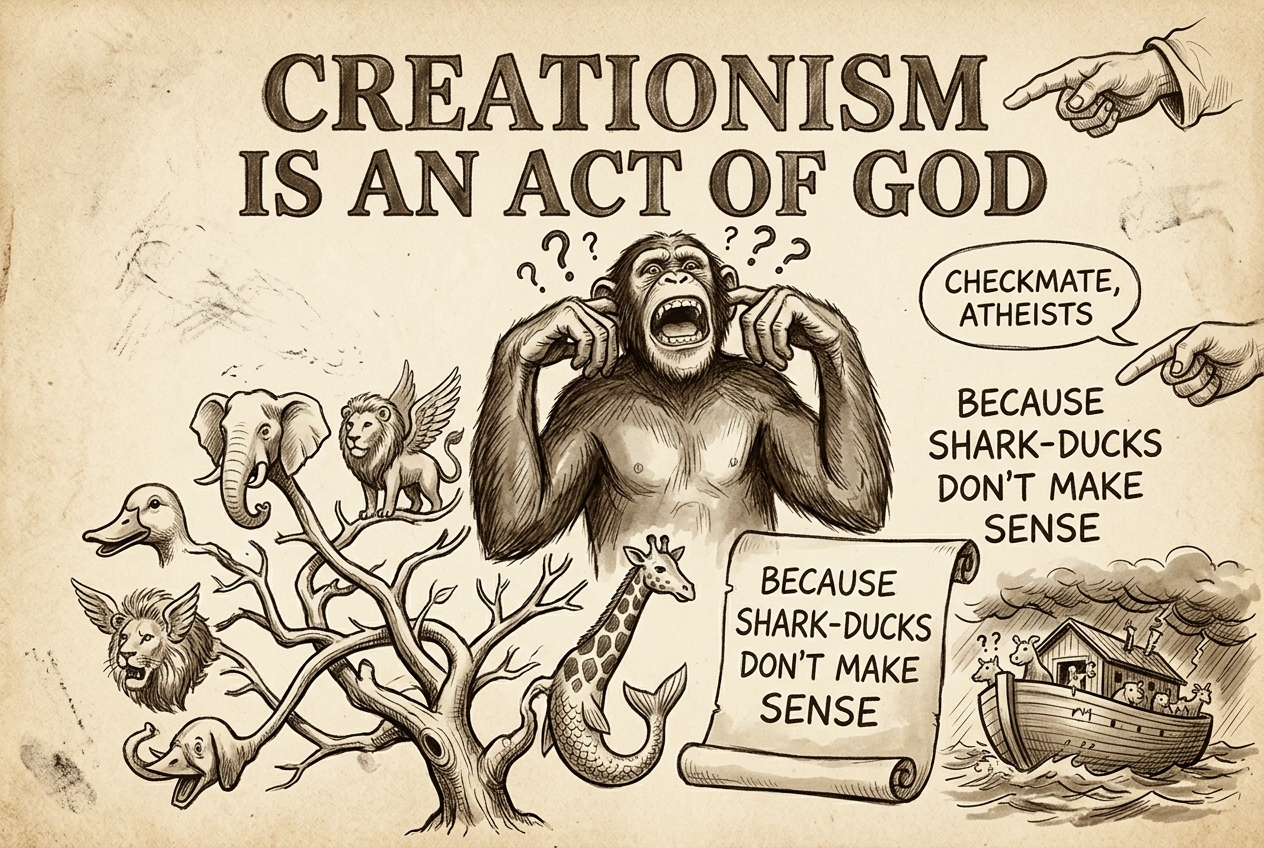
This little gem showed up wedged between ordinary things, the kind of post that announces itself with certainty before it offers anything like proof. A few bold claims, a meme stitched together with familiar faces and sharper slogans, and one central idea. Evolution only works when it is implemented as an artificial system, and because that system is written with intent, the natural process it mirrors must also be intentional.

Framed more carefully, the post is arguing that what is commonly called “evolution” only produces meaningful results when instantiated inside a human-designed computational system. It points to evolutionary algorithms as evidence, noting that these systems rely on defined fitness criteria, structured constraints, and intentional setup by programmers. From there it draws a broader conclusion that the appearance of order, adaptation, and complexity in nature cannot arise from undirected processes alone, since even the artificial analog requires guidance. In that sense, the post treats the computational model not as a simulation of a natural mechanism, but as a proof that the mechanism itself is inseparable from prior intelligence.
That’s the core of it. Everything else is decoration.
On the surface, the argument feels clean. Humans build evolutionary algorithms. Those algorithms produce structured results. They are designed programs. Therefore, evolution itself must require a designer. It reads like symmetry pretending to be evidence.
There is, to be fair, a piece of truth at the beginning. Evolutionary algorithms are real and widely used. Engineers and researchers rely on them because they solve problems that resist tidy solutions. NASA has used them to generate antenna shapes that look odd but perform well under constraints (Hornby, Automated Antenna Design, 2006). Machine learning researchers use them to explore neural network architectures too large for direct human design (Real, Large-Scale Evolution of Image Classifiers, 2017). These are not fringe tools. They are part of the working toolkit.
But what those systems actually do is much less magical than the language suggests. They cycle through variation and selection. Small changes are introduced into a population of solutions, performance is evaluated against a defined constraint, and the better outcomes are retained. Then it repeats. No foresight. No internal understanding. Nothing inside the system “knows” what it is doing or why it works (Holland, Adaptation in Natural and Artificial Systems, 1975). The result looks purposeful only because unsuccessful variations disappear from view.
And there are recent, concrete examples that show exactly what these systems are doing when stripped of their marketing language. In 2024, researchers combined evolutionary algorithms with reinforcement learning to improve optimization performance across complex problem spaces, showing how variation and selection can enhance learning without introducing any internal understanding (Li, Bridging Evolutionary Algorithms and Reinforcement Learning, 2024). Around the same time, evolutionary methods were applied to automatically optimize neural network architectures, reducing complexity while maintaining performance, again through iterative selection rather than insight or intention (Landa, Optimization of Deep Neural Networks Using a Micro Genetic Algorithm, 2024). And in robotics, evolutionary strategies were used to refine gait and control systems across varying robot forms, producing functional movement through repeated variation and filtering rather than any embedded notion of purpose (van Diggelen, Comparing Robot Controller Optimization Methods, 2024).
What the post does is take that process and translate it into words that imply intention. “Design.” “Goal.” “Intelligence.” Those words carry weight. They bring a human frame into a system that does not operate with one. The shift is subtle, and once it lands, the conclusion feels natural. But it was not derived from the mechanism. It was introduced through vocabulary.
The reasoning falters more clearly when you step sideways into other fields. We simulate weather systems with extraordinary precision. Entire disciplines depend on computational models of atmospheric behavior. Storms are represented in code, iterated, refined, compared against observations. Yet no one looks at those models and concludes that hurricanes require programmers. The simulation is a reflection, not a cause.
Astronomy follows the same pattern. Scientists simulate galaxy formation, gravitational interactions, cosmic structure at massive scales (Springel, Simulations of the formation of galaxies, 2005). These models are built by humans, filled with parameters, adjusted constantly. Still, no one suggests that galaxies themselves are artifacts of an external designer because simulations exist. The symmetry dissolves the moment you look at it evenly.
Chemistry offers an even closer parallel. Reaction-diffusion systems generate complex patterns from simple local interactions. Turing showed how biological forms could arise from straightforward chemical processes without guidance (Turing, The Chemical Basis of Morphogenesis, 1952). These systems are simulated, studied, sometimes even recreated in the lab. The existence of a model does not imply an external author of the phenomenon.
So the question turns back on itself. Why does the logic apply here and nowhere else? Why does evolution alone trigger the leap from simulation to designer?
The answer sits outside the science. It lives in expectation.
There is also a second move in the meme that deserves attention. It treats evolutionary algorithms as a form of artificial intelligence that “intelligently designs systems.” That phrasing collapses the distinction between optimization and cognition. Most evolutionary algorithms are not intelligent in any meaningful sense. They do not possess beliefs, awareness, or reasoning. They operate within a search space defined by external constraints (Russell, Artificial Intelligence: A Modern Approach, 2010). Calling them intelligent is not an observation. It is a rhetorical upgrade.
And once that upgrade is accepted, the final step becomes easier. If the algorithm is intelligent, and the algorithm produces structure, then the structure itself must come from intelligence. The mechanism disappears behind the metaphor.
For anyone watching from the sidelines, that is the pattern to notice. A real system is acknowledged. Its workings are reframed with language that implies more than the mechanics support. The conclusion inherits that implication without ever being tested against reality. Evidence does not carry the argument. Terminology does.
The deeper issue is that the conclusion being reached is not testable. If the claim is that evolution requires an external intelligence, what observation would contradict that? What experiment would falsify it? Without that, the claim cannot compete with models that generate predictions, withstand correction, and change when the data changes. It remains interpretive. It explains by overlay, not by demonstration (Pennock, Tower of Babel, 1999).
I find myself circling back to something simple. The systems being pointed to as proof of design are used precisely because they do not require understanding to produce structured results. That is why they are useful. That is why engineers trust them. The argument takes that strength and flips it into evidence for something entirely different.
It’s a clever move. It feels intuitive for a moment.
Then it doesn’t.
References
- Hornby, G. Automated Antenna Design with Evolutionary Algorithms. NASA, 2006.
- Real, E. Large-Scale Evolution of Image Classifiers. 2017.
- Holland, J. Adaptation in Natural and Artificial Systems. 1975.
- Russell, S., Norvig, P. Artificial Intelligence: A Modern Approach. 2010.
- Springel, V. Simulations of the formation of galaxies. 2005.
- Turing, A. The Chemical Basis of Morphogenesis. 1952.
- Pennock, R. Tower of Babel: The Evidence Against the New Creationism. 1999.
- Li, P., Hao, J., Tang, H. Bridging Evolutionary Algorithms and Reinforcement Learning. 2024.
- Landa, R., Tovias-Alanis, D., Toscano, G. Optimization of Deep Neural Networks Using a Micro Genetic Algorithm. 2024.
- van Diggelen, F., Ferrante, E., Eiben, A. Comparing Robot Controller Optimization Methods on Evolvable Morphologies. 2024.
Appendix
Simple Genetic Algorithm in C#
using System;using System.Linq;using System.Collections.Generic;class GeneticAlgorithm{ static Random rand = new Random(); static string target = "HELLO WORLD"; static string chars = "ABCDEFGHIJKLMNOPQRSTUVWXYZ "; static void Main() { int populationSize = 50; int generation = 0; // Initialize population List<string> population = new List<string>(); for (int i = 0; i < populationSize; i++) population.Add(RandomString(target.Length)); while (true) { generation++; // Evaluate fitness var scored = population .Select(s => new { Genome = s, Fitness = Fitness(s) }) .OrderByDescending(x => x.Fitness) .ToList(); // Print best result Console.WriteLine($"Gen {generation}: {scored[0].Genome} (Score: {scored[0].Fitness})"); if (scored[0].Genome == target) break; // Selection (top 20%) int survivorsCount = populationSize / 5; var survivors = scored.Take(survivorsCount).Select(x => x.Genome).ToList(); // Reproduce population.Clear(); while (population.Count < populationSize) { var parent = survivors[rand.Next(survivors.Count)]; var child = Mutate(parent); population.Add(child); } } } static string RandomString(int length) { return new string(Enumerable.Range(0, length) .Select(_ => chars[rand.Next(chars.Length)]).ToArray()); } static int Fitness(string s) { int score = 0; for (int i = 0; i < s.Length; i++) if (s[i] == target[i]) score++; return score; } static string Mutate(string s) { char[] arr = s.ToCharArray(); for (int i = 0; i < arr.Length; i++) { // small mutation chance (~5%) if (rand.NextDouble() < 0.05) arr[i] = chars[rand.Next(chars.Length)]; } return new string(arr); }}

Leave a Reply