
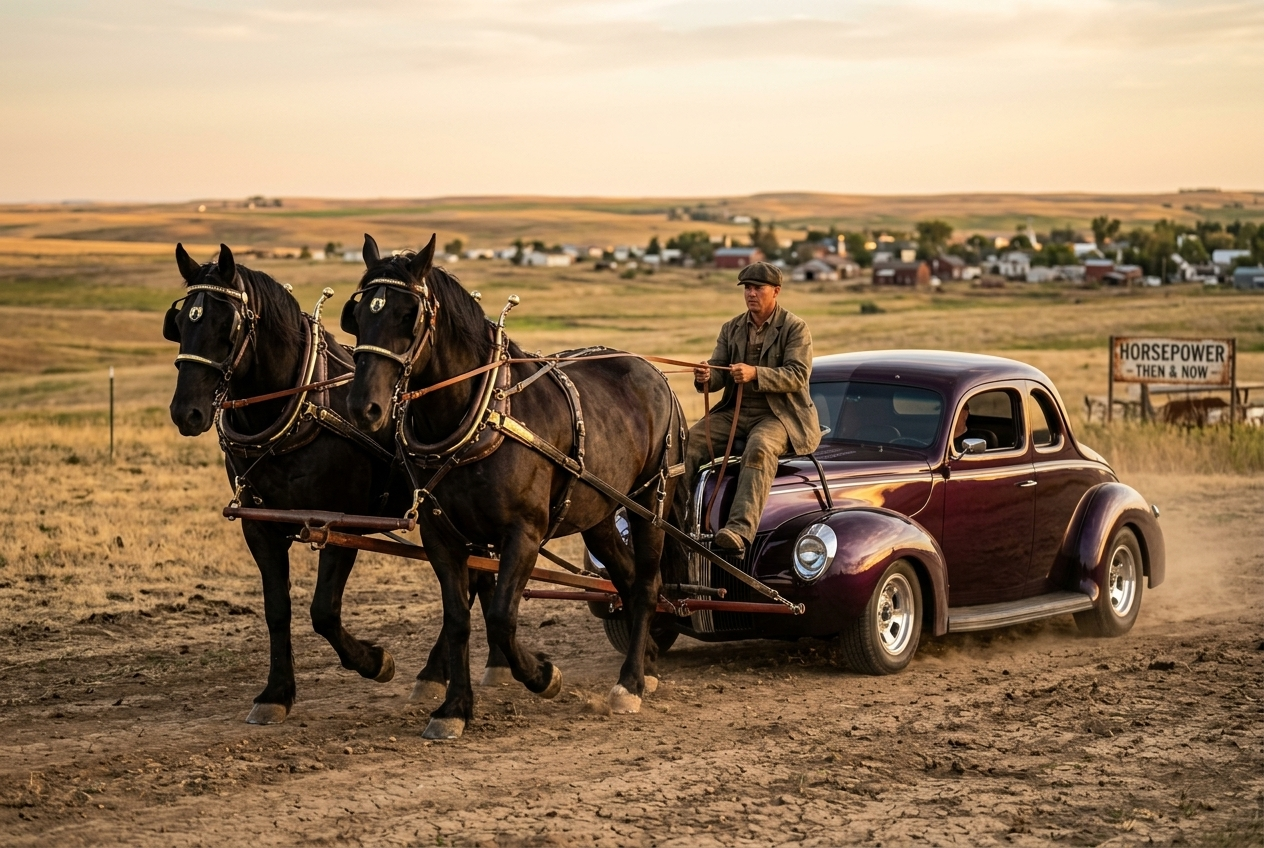
It started, like most things do now, with music playing somewhere it wasn’t supposed to matter. Meat Loaf first, loud enough to remind me how long ago that voice anchored a kind of theatrical certainty that felt normal at the time. “Ain’t no Coupe DeVille hiding on the bottom of a Cracker Jack’s box.” Then the Beach Boys, all sun and compression, “My little deuce coupe… you don’t know what I got.” And then Manfred Mann, bending the word sideways, “cut loose like a deuce, another runner in the night.”
Three songs, same word, different shapes.
That’s usually where I start paying attention.
Because words that travel like that tend to carry history quietly, the way an old road still runs under a newer one if you know where to look.
The trail moves backward through French, where coupé means “cut.” That’s it. Something reduced, shortened, shaped by removal. A carriage trimmed down into a tighter body. Fewer passengers. Less weight. A deliberate absence.
Before it touched the automobile, the coupe was already a decision about proportion.
And before that, it shares a root with something that seems unrelated until it isn’t. The cupola. A small dome, perched on top of a building. Italian, Latin before that, cupula, a little cup, a hollowed curve. Churches used them. Civic buildings used them. Not just decoration, though it looks that way from the outside. A cupola encloses space, gathers light, defines an interior without walls doing all the work.
That curvature matters. The enclosure matters.
Because when the carriage became the coupe, that same idea followed. A smaller body, often with a curved or cloth top. A contained space carved out of something larger. You don’t notice it until you trace the word backward and the shape snaps into focus.
By the time the automobile inherits the term, the logic is already in place. Early cars didn’t invent their own vocabulary. They borrowed it from what people already understood. So a coupe becomes a two‑seat car with a shortened body and a defined roofline, often echoing the covered carriage it replaced.
The cloth top wasn’t just practical. It was continuity.
Even when metal replaced fabric, the idea stayed. A coupe wasn’t just a car with two doors. It was a car that had been reduced, shaped, tightened into something more focused. Less space, more intention.
That reduction is what carried it forward.
“Coupe DeVille” complicates it again. Now the cut object becomes something extended, elongated, carrying more presence than its origin would suggest, but still clinging to the name. The word detaches a little further from the act of being cut down and starts attaching itself to identity. Refinement, status, the sense that this particular shape means more than the mechanics underneath it. The architecture gets abstracted into reputation.
And then Meat Loaf drops a Cracker Jack’s box into the conversation and everything snaps back to scale. If you grew up with those boxes, you remember what came inside. A whistle, if you were lucky. A paper toy that lasted about as long as the caramel stuck to your fingers. A sticker you pressed onto something you forgot about a week later. The prize was never the point. It was the idea of getting something for almost nothing, something small, trivial, briefly interesting.
So when he says there’s no Coupe DeVille hiding at the bottom, it’s not about the car itself. It’s about value. You don’t pull something that deliberate, that engineered, that layered in meaning out of a container designed to give you the smallest possible reward. A coupe might show up as a toy, a die-cast version, simplified down to something you can hold between your fingers. But the thing itself, the real object with its history and weight, doesn’t belong in that exchange. That’s the line the lyric is drawing. Not about cars, but about expectation.
Then there’s the “deuce.”
The Beach Boys treat it like everyone knows what it is. A 1932 Ford, stripped down and rebuilt until it becomes something else entirely. The “flathead mill” sits under the hood, simple, durable, endlessly modifiable. Not an abstract machine. Something you could touch, dismantle, improve.
That phrase always felt grounded in a way the word coupe didn’t. One speaks to structure, the other to function. One to design, the other to motion.
Manfred Mann flattens it further. “Cut loose like a deuce.” At that point the word isn’t even about a car anymore. It’s about velocity, escape, movement through darkness without obligation to explain itself. The meaning sheds its origin completely.
Words don’t break when they do that.
They stretch.
Somewhere in all this, the coupe stops belonging to its origin and starts belonging to whoever is using it. That’s the part I keep coming back to. A word built from reduction becomes associated with identity. A shortened carriage becomes a symbol of style, then power, then motion itself.
And underneath it, the old idea is still there.
A space carved out.
A form defined by what’s been removed.
That shows up in more places than we like to admit.
I remember looking at old carriage diagrams once, the way the body sits on the frame, the curve of the top, the relationship between passenger and structure. It didn’t look that different from the silhouettes you still see on the road. The materials changed. The speed changed. The logic stayed.
That continuity is easy to miss if you’re only looking at the surface.
So here’s the part that lingers.
The coupe didn’t start as a symbol of speed or status. It started as a subtraction. A shorter carriage, a tighter space, a deliberate reduction that made the rest of the structure matter more.
That’s what survived.
And it makes me wonder what else we’re using every day that carries the same kind of history. Words that began as something precise and physical, something tied to shape or function, and then stretched into abstraction until the original meaning is almost invisible.
If you traced them back far enough, would you recognize them.
Or would they look like something you thought you understood, until you gave it a second and realized you didn’t.
I don’t think that question resolves quickly.
Which is probably why it sticks.

Leave a Reply