
I find when people ask “which evolved first, male or female,” the question usually smuggles in an assumption that sex appeared as two neatly formed categories right from the start. That is not how evolution works. As someone who has spent years reading evolutionary biology for both curiosity and grounding, I can tell you this is one of those questions that sounds simple until you look at what life was actually doing billions of years ago. And once you look, the puzzle dissolves.
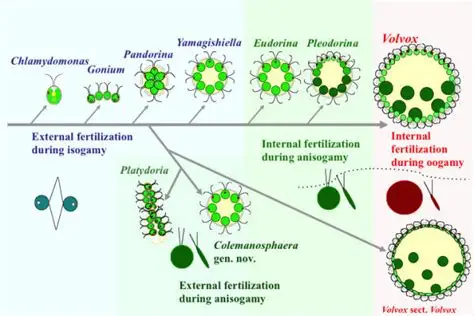
Sexual reproduction evolved long before animals existed. Early life was single‑celled, and reproduction was basically cloning. At some point, certain lineages discovered that mixing genetic material between individuals allowed faster repair of damaged DNA and better adaptation. This process is the ancestor of sex as we know it. But here is the key point: these organisms had no “males” or “females.” They were isogamous, meaning their gametes were the same size. You can see living examples today in many algae species, where mating types are different but neither partner is male or female in the modern sense (Maynard Smith & Szathmáry, The Major Transitions in Evolution, 1995).
So, when did male and female appear? They arose only after anisogamy evolved. That is the shift from equal‑sized gametes to two strategies: produce many small, mobile gametes, or produce fewer, larger nutrient‑rich gametes. Once those strategies diverged, the line that made many small gametes became “male” and the one that made large gametes became “female” (Parker, Baker & Smith, “The Origin and Evolution of Gamete Dimorphism,” 1972). In other words, males and females evolved together as opposite solutions to the same reproductive tension. Asking which came first is like asking whether the left blade of scissors evolved before the right. Neither works without the other.
I’ve spent enough time hiking along the coast here watching spawn‑clouds of marine invertebrates to appreciate how messy and gradual these transitions were. Nature rarely flips a switch. It tinkers. The move from identical gametes to divergent ones took countless generations, with intermediate populations showing partial size differences. Only later, in multicellular organisms, did these differences scale up into full‑bodied sexual dimorphism (Ridley, Evolution, 2004).
If you think about it, what would it even mean for one sex to “evolve first”? Without complementary gametes, the fitness advantage of sex disappears. Without simultaneous divergence, the system collapses. Evolution only retains strategies that work, and the male–female split only works as a coordinated pair. So a better question might be: what ecological pressures made it advantageous for gametes to diverge in the first place?
Sex did not start with Adam and Eve‑style binaries. It started as gene swapping among organisms that didn’t know or care about gender. Male and female are later inventions of evolutionary history, not primordial categories. Once you see that, the question shifts from “which came first” to “how did cooperation and conflict shape the reproductive strategies we see now?” And that’s where the science gets genuinely interesting.
References
Maynard Smith, J. & Szathmáry, E. The Major Transitions in Evolution. Oxford University Press, 1995.
Parker, G. A., Baker, R. R., & Smith, V. G. F. “The Origin and Evolution of Gamete Dimorphism.” Journal of Theoretical Biology, 1972.
Ridley, M. Evolution. Blackwell Publishing, 2004.

Leave a Reply