
If you’ve been reading any of my other essays, by now you realize I get a lot of starting point from all the bizare I read from the overly confident but woefully undereducated crowds on both Facebook and Threads (I no longer wade in X (the former media know as Twitter), as it is now a cesspool).
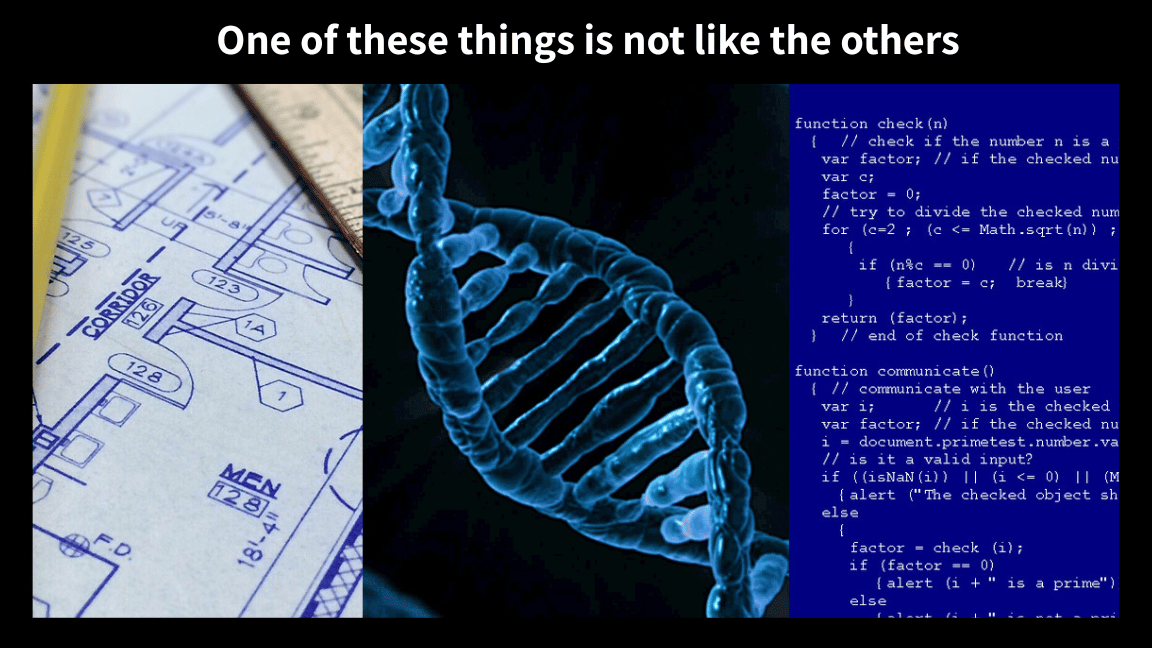
This exchange unfolded in the Facebook group Atheists Vs Theists, beneath a post advancing what advocates often call the “Functional” or “Information” view of DNA. The central claim was familiar: DNA is code, code requires a coder, therefore life points to an intelligent designer. The supporting comment walked through transcription, translation, codons, amino acids, and protein synthesis, presenting the molecular machinery as if describing the mechanism somehow established the designer hiding behind it.
The argument itself is hardly new. It belongs to a long tradition of design reasoning that has repeatedly rebranded itself while retaining the same core premise. In recent decades it has appeared as “Specified Complexity,” “Functional Specification,” “Specified Functional Integrated Complexity,” and related concepts associated with Intelligent Design advocates such as William Dembski (The Design Inference, 1998) and Michael Behe (Darwin’s Black Box, 1996). Those ideas, in turn, are modern descendants of William Paley’s watchmaker argument in Natural Theology (1802), where apparent complexity and purpose were treated as evidence of a supernatural designer. The terminology has changed from watches to DNA and from craftsmanship to information theory, but the underlying inference remains strikingly similar.
What caught my attention was how quickly the conclusion arrived. The biochemical details were real. The leap from those details to a designer was not. The existence of codons, ribosomes, and translation machinery was treated as though it automatically established intention, authorship, and agency. The coder was already hidden inside the premise, waiting to be revealed as the conclusion.
At first glance it sounds technical. Technical language has that effect. A person can describe every part of a steam locomotive and still fail to prove there is a dragon in the boiler.
The reply it received cut directly to the problem:
“The ‘DNA proves God’ argument has two problems:
DNA isn’t literally computer code. ‘Genetic code’ is scientific shorthand for biochemical processes.
Even if it were code, the argument never identifies the coder.”
That is where the discussion should have ended. Instead, the response doubled down on the vocabulary. DNA has an alphabet. It has codons. It carries information. Therefore it is code.
I always find this argument oddly circular. The conclusion is already tucked inside the word being emphasized. Call DNA “code” often enough, and eventually the human mind starts importing all the baggage associated with human-made codes. Programmer. Author. Designer. Intention. Meaning.
That baggage is doing far more work than the biology.
The phrase “genetic code” refers to the relationship between nucleotide triplets and amino acids. Molecular biologists adopted the term because it was a useful description of a mapping system involved in protein synthesis (Crick, On Protein Synthesis, 1958; Stegmann, Genetic Coding Reconsidered, 2015). The term succeeded because it helped scientists discuss a biochemical mechanism. It did not transform DNA into computer software. It did not sneak a programmer into the cell.
How to Spot the “DNA Is Code” Information Argument
After seeing this argument recycled so many times, I’ve noticed that it tends to follow the same script regardless of whether the speaker invokes “specified complexity,” “functional information,” “intelligent design,” or simply “all code requires a coder.” Different packaging, same engine.
The first clue is that a legitimate scientific description is presented as if it were evidence for a theological conclusion. In the comment, the author writes:
“Scientifically and functionally, yes, DNA is coded.”
That statement is uncontroversial until the word coded is quietly switched from a biological description into a philosophical argument. The scientific observation is that codons correspond to amino acids. The hidden assumption is that any system described as a code must have been intentionally written.
The second clue is the introduction of communication language. Terms such as:
- “alphabet”
- “words”
- “translation”
- “stored data”
- “instructions”
are all real metaphors used in molecular biology, but the argument treats the metaphors as literal properties. The language of communication is substituted for the chemistry itself. Instead of discussing molecular binding, catalytic interactions, and biochemical constraints, the discussion shifts toward authors, messages, and intentions.
The third clue is the unsupported leap from pattern to agency. Notice how the comment states:
“DNA functions identically to a digital code.”
This is where the argument leaves biology and enters assertion.
A digital code is a symbolic system intentionally created by known minds. DNA is a naturally occurring biochemical system. Demonstrating that both involve ordered patterns does not demonstrate that both originate from the same kind of cause.
The fourth clue is that the designer appears before the evidence for the designer.
Consider my response:
“Even if it were code, the argument never identifies the coder.”
This is the point where the entire structure begins to wobble. Suppose, for the sake of argument, that DNA were indistinguishable from software. The conclusion still would not identify Yahweh, Jesus, Allah, Brahma, Odin, Zeus, or any other proposed creator. The argument has no mechanism for connecting the observation to a specific deity.
The fifth clue is the selective treatment of natural information.
Ask a simple question:
If information requires intelligence, why do naturally occurring systems routinely generate highly ordered information?
Snowflakes display organized geometry. Crystals form repeating lattices. Pulsars emit highly structured electromagnetic signals. None of these phenomena require a cosmic programmer. Yet when DNA appears, the same standards are suddenly abandoned.
That inconsistency is often the easiest place to expose the flaw.
A Practical Counter Strategy
I generally counter the argument in five steps.
First, separate the scientific fact from the philosophical claim.
When someone says:
“DNA is code.”
Reply:
“The genetic code is a mapping relationship between codons and amino acids. That does not establish a designer.”
Second, ask whether the conclusion actually follows.
When someone says:
“DNA contains information.”
Ask:
“How does the presence of information demonstrate intelligence rather than pattern?”
The burden remains on the claimant.
Third, distinguish symbolic codes from natural systems.
As I noted in my reply:
“Human digital code and natural informational patterns are not the same category.”
Morse code was intentionally invented. DNA was discovered.
That difference carries the entire debate.
Fourth, demand evidence for the proposed designer rather than evidence for complexity.
Complexity is not identity.
Even if complexity required a designer, the argument would still need evidence connecting that designer to a particular religious claim.
Fifth, test the reasoning against analogous natural phenomena.
Ask:
“Would this same logic prove that pulsars, crystals, or snowflakes were written by a mind?”
If the answer is yes, the reasoning overproduces conclusions.
If the answer is no, special pleading has entered the argument.
That is usually where the structure begins to collapse. The discussion starts with chemistry, wanders into metaphor, imports assumptions about human communication, and finally arrives at a designer who was present in the premise from the beginning. Once the substitutions are identified one by one, the argument stops looking like a scientific inference and starts looking like what it has always been: Paley’s watchmaker wearing a molecular biology costume. (Paley, Natural Theology, 1802; Dembski, The Design Inference, 1998; Behe, Darwin’s Black Box, 1996).
The Category Mistake at the Center of the Argument
The comparison fails because human digital codes and natural informational patterns belong to different categories.
Morse code is a symbolic language designed by people. ASCII was designed by people. Programming languages were designed by people. Their creators are historically documented and independently observable. Nobody infers a coder because they see a pattern. They infer a coder because there is direct evidence of one.
DNA provides no such evidence.
What exists is a physical molecule interacting with other physical molecules. Ribosomes do not read meaning. Transfer RNAs do not interpret intent. Amino acids do not decipher messages. Molecular structures fit together through chemistry and geometry. The process resembles a physical matching system far more than a programmer writing instructions into software.
A better analogy is not a computer terminal. It is a child’s shape-sorting toy. One shape fits one opening. Another shape fits another. No little homunculus sits inside the toy translating circles into existential purpose.
Then comes the word “information,” another favorite refuge of the argument.
Information theory does not require meaning, intention, or intelligence. It concerns patterns, correlations, and uncertainty reduction (Shannon, A Mathematical Theory of Communication, 1948). The creationist argument quietly substitutes a human concept of information for a mathematical one. Pattern becomes message. Message becomes author. Author becomes God.
None of those transitions are demonstrated.
They are asserted.
Nature is full of structured information that nobody attributes to a mind. Snowflakes form intricate geometries. Crystals organize themselves into repeating lattices. Pulsars emit exquisitely regular electromagnetic signals. In fact, the first pulsar signals were so precise that astronomers briefly wondered whether they might be artificial before discovering a perfectly natural astrophysical explanation.
Pattern is not evidence of authorship.
If it were, every glacier, thunderstorm, and spiral galaxy would qualify as a published work.
The most revealing part of the argument comes at the end. Suppose, for a moment, that every objection disappeared. Suppose DNA really were equivalent to software. Suppose it required a coder. Suppose a designer had to exist.
Who?
That question never receives an answer.
A creator argument does not identify Yahweh. It does not identify Jesus. It does not identify Allah, Brahma, Odin, Zeus, Raven, or any other theological candidate. The argument merely gestures toward an undefined designer and then smuggles in a preferred deity as though the hard part had already been completed.
That leap is not biology.
It is not information theory.
It is not evidence.
It is theology hitchhiking on a metaphor.
The enduring appeal of “DNA is code” seems obvious enough. Code sounds intentional. Intentional sounds designed. Designed sounds comforting. But science is not obligated to preserve comforting intuitions.
A molecule is not software because somebody used a software analogy.
A pattern is not a message because somebody called it information.
And a designer does not materialize merely because a metaphor sounded persuasive in a Facebook comment section.
References
- Crick, F. H. C. On Protein Synthesis (1958).
- Shannon, C. E. A Mathematical Theory of Communication (1948).
- Stegmann, U. E.‘Genetic Coding’ Reconsidered: An Analysis of Actual Usage (2015).
- Griffiths, P. E. Genetic Information: A Metaphor in Search of a Theory (2001).
- Bell Burnell, J., discovery of pulsars (1967).
- Pulsar discovery history and natural explanation summaries. https://www.ebsco.com/research-starters/astronomy-and-astrophysics/pulsars
- Behe, Michael. Darwin’s Black Box (1996).
- Dembski, William A. The Design Inference (1998).
- Paley, William. Natural Theology (1802).

Leave a Reply