
In my earlier essay on Eeyore, I argued that Eeyore occupies a distinct philosophical niche within the Hundred Acre Wood. Pooh maps comfortably onto Taoist naturalness. Piglet finds a home in Hoff’s conception of Te, the quiet power of sincerity. Eeyore, I suggested, stands for an acceptance of limitation, a stubborn companionship with reality that persists even when reality is unimpressive (Hoff, The Tao of Pooh, 1982; Hoff, The Te of Piglet, 1992; Milne, Winnie-the-Pooh, 1926).
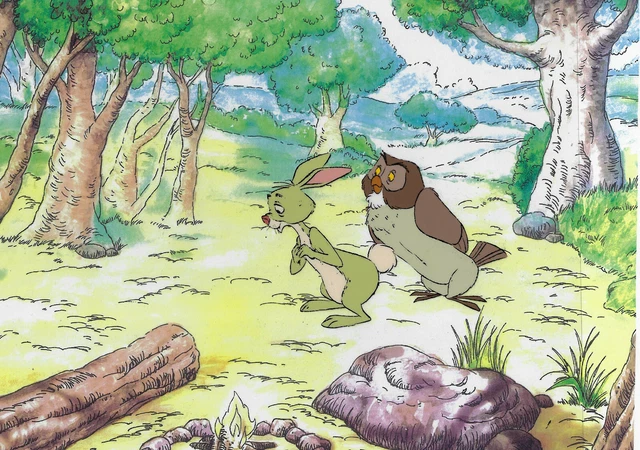
Owl and Rabbit present a harder problem.
That difficulty is itself revealing.
Unlike Pooh, Piglet, and Eeyore, neither Owl nor Rabbit feels like a philosophical ideal. If anything, they often resemble philosophical warnings. They are not embodiments of wisdom so much as embodiments of common mistakes in the pursuit of wisdom. They want understanding. They want order. They want competence. They want to be right.
Who among us does not?
And that is where things become interesting.
Owl and the Philosophy of Knowing
Owl believes he understands more than everyone else.
To be fair, compared with Pooh, that is often true.
He can spell. Or at least something close to spelling. He knows large words. He possesses stories, theories, explanations, and credentials of a sort. The others frequently seek him out when they face a puzzle because Owl projects the appearance of expertise (Milne, Winnie-the-Pooh, 1926).
Yet Milne consistently undermines Owl’s authority.
His stories wander away from their point. His spelling is famously unreliable. His explanations often create confusion rather than clarity. He knows many things, yet seems unable to recognize the limits of what he knows (Milne, Winnie-the-Pooh, 1926; Milne, The House at Pooh Corner, 1928).
This places Owl within a long philosophical tradition stretching back at least to Socrates. The truly wise person understands the extent of their ignorance. The merely knowledgeable person mistakes information for wisdom (Plato, Apology).
Imagine Owl explaining the weather.
He delivers a twenty-minute lecture concerning atmospheric tendencies, regional patterns, historical precedents, migratory observations, and technical terminology.
Pooh looks out the window.
“It seems to be raining.”
Pooh’s answer is better.
What Owl represents is not knowledge itself. Knowledge matters. Civilization depends on it. Rather, Owl represents the temptation to substitute abstraction for direct experience.
If Pooh lives inside reality, Owl often lives inside commentary about reality.
There is a difference.
I have met Owls.
Most universities contain entire flocks of them. So do social media platforms, conferences, and hobby groups. Sometimes I catch traces of Owl in myself. I spend ten minutes constructing an explanation when two minutes of observation would have sufficed. The modern world rewards analysis so heavily that analysis easily becomes detached from its object.
The forest disappears behind the map.
The philosophy suggested by Owl’s failures might therefore be called epistemic humility. Not because Owl himself possesses humility, but because his shortcomings illuminate its necessity.
One repeatedly encounters this pattern throughout the Milne books. Owl’s advice is sought because it sounds authoritative. The actual solution arrives through simpler means, accidental discovery, or straightforward observation by someone less concerned with appearing knowledgeable (Milne, Winnie-the-Pooh, 1926).
How often does that happen outside fiction?
More often than experts like to admit.
Yet I am not entirely convinced Owl represents a philosophy in the same way Pooh, Piglet, or even Eeyore do. A philosophy usually offers a way of living. Owl seems closer to a way of knowing. His concerns are less ethical than epistemological. He is interested in what counts as knowledge, who possesses it, and how it should be communicated. If Pooh asks, “How should one move through the world?” Owl asks, “How can one understand it?”
That distinction matters because the history of thought contains more than philosophies of life. It also contains philosophies of inquiry. Empiricism, rationalism, skepticism, and related traditions are not chiefly concerned with happiness, virtue, or meaning. They are concerned with the acquisition and justification of knowledge. Owl often stumbles as a thinker, but his stumbles orbit the same territory. He gathers information, categorizes experience, constructs explanations, and attempts to translate observation into understanding. Even when he gets things wrong, he is pursuing knowledge rather than contentment.
In that sense, Owl may represent not wisdom itself but the human pursuit of wisdom. He resembles the scholar more than the sage. Pooh simply notices the forest. Owl tries to explain the forest. The explanation may be flawed, incomplete, or unnecessarily complicated, but the impulse behind it is recognizable. It is the impulse that fills libraries, laboratories, and lecture halls. Before Rabbit appears with his plans and procedures, Owl occupies a different corner of human experience altogether: the desire to know what is true and to organize that truth into a coherent picture of the world.
Or, for a slightly more whimsical and idiosyncratic version that better matches the Eeyore essay:
Perhaps I have been looking for the wrong sort of philosophy.
Owl may not represent a philosophy of living at all. He may represent a philosophy of looking. The distinction sounds small until one trips over it. Pooh navigates the world. Piglet develops character within it. Eeyore endures it. Owl studies it. His attention is directed not toward purpose or virtue but toward knowledge itself, toward the strange human habit of wanting explanations.
From that perspective, Owl begins to resemble the descendants of empiricism and epistemology more than the heirs of Taoism or Stoicism. He is forever gathering facts, arranging concepts, constructing narratives, and making sense of events. Whether his conclusions are correct is almost secondary. The defining feature is the pursuit. He wants the world to be intelligible. He wants observations to become understanding.
There is something charmingly human about that. Long before anyone built a university, published a journal, or argued over methodology, somebody looked at the world and wondered what was really going on. Owl lives in that impulse. He is not the embodiment of wisdom. He is the embodiment of the search for wisdom. And as with many searches, the journey is often more revealing than the destination.
Rabbit and the Philosophy of Control
If Owl is obsessed with understanding, Rabbit is obsessed with management.
Everything about Rabbit points toward organization.
He creates plans. He coordinates activities. He worries about procedures. He attempts to shape events into predictable outcomes. Unlike Pooh, who flows with circumstances, Rabbit continually tries to improve them.
Or correct them.
Or regulate them.
Or prevent them from happening incorrectly in the first place.
His struggles with Tigger are especially revealing. Tigger represents spontaneity, unpredictability, and exuberant disruption. Rabbit responds by attempting elaborate schemes to manage, reform, or redirect him. The result is usually frustration (Milne, The House at Pooh Corner, 1928).
Why?
Because reality refuses administrative supervision.
Rabbit’s philosophy resembles a very old human hope. If enough intelligence, discipline, planning, and effort are applied, perhaps uncertainty can be eliminated.
The forest repeatedly rejects this proposal.
A recreation feels easy to imagine.
Rabbit develops a detailed schedule for a woodland celebration. Arrival times are assigned. Activities are organized. Contingencies are prepared.
Then Tigger arrives early.
Pooh forgets.
Eeyore wanders elsewhere.
Piglet becomes nervous.
Rain starts.
The schedule survives approximately seven minutes.
Rabbit’s experience echoes themes explored by thinkers ranging from the Stoics to modern complexity theorists. Human beings possess influence over events but rarely possess command over them. Much suffering arises from confusing the two (Epictetus, Enchiridion; Taleb, The Black Swan, 2007).
Rabbit is not wrong to plan.
He is wrong to expect obedience from the universe.
That distinction defines his character.
Yet Rabbit too, may not represent a philosophy in the same sense that Pooh represents Taoist naturalness or Eeyore represents acceptance. Rabbit seems closer to a philosophy of agency. His attention is fixed on the boundary between what can be influenced and what cannot. Unfortunately, he keeps placing the boundary in the wrong location.
Rabbit is often effective when dealing with things that genuinely fall within his reach. He can organize an event, coordinate neighbors, tend a garden, or make practical arrangements. Problems arise when competence quietly expands into expectation. The forest does not cooperate simply because a plan is well designed. Tigger refuses to behave according to procedure. Friends forget instructions. Circumstances change. Rabbit repeatedly confuses influence with control, and the distinction proves decisive.
In that sense, Rabbit’s recurring lesson resembles a practical form of epistemological humility. He does not merely overestimate his ability to direct events. He overestimates his ability to know which events are amenable to direction in the first place. The problem is not planning. The problem is assuming that reality has entered into an agreement with the planner. Neil deGrasse Tyson captured the broader principle succinctly: “The Universe is under no obligation to make sense to you.” (Tyson, The Mystery of Existence, 2014). Rabbit’s world suggests a companion truth. The universe is under no obligation to obey you, either.
Seen this way, Rabbit becomes less a champion of order than a representative of a very human temptation. We continually encounter domains where effort matters, and we gradually begin acting as though effort is all that matters. Rabbit’s frustrations arise from discovering that reality contains independent variables. The weather, other people, chance, and simple unpredictability retain a vote. Every failed scheme becomes a reminder that control is not a thing one possesses. It is a narrow and temporary relationship between intention and circumstance.
Owl, Rabbit, and the Problem of Civilization
What makes Owl and Rabbit harder to map onto a philosophy than Pooh, Piglet, or Eeyore is that they represent functions rather than virtues.
The Hundred Acre Wood genuinely needs Owl.
It genuinely needs Rabbit.
Someone must preserve knowledge. Someone must coordinate activity. Communities cannot run entirely on honey, friendship, and quiet acceptance.
Yet Milne refuses to idealize either role.
Owl’s learning becomes pretension.
Rabbit’s organization becomes rigidity.
The moral pattern appears repeatedly. Knowledge detached from humility becomes folly. Planning detached from flexibility becomes frustration (Milne, Winnie-the-Pooh, 1926; Milne, The House at Pooh Corner, 1928).
Pooh succeeds because he remains connected to immediate reality.
Owl and Rabbit often struggle because they become disconnected from it in opposite directions.
Owl drifts upward into abstractions.
Rabbit charges forward into management.
Pooh notices a cloud.
The Missing Philosophies
Which philosophy does Owl represent?
Not wisdom.
The pursuit of wisdom.
More specifically, the danger that the pursuit may become confused with possession.
Which philosophy does Rabbit represent?
Not order.
The pursuit of order.
More specifically, the danger that order may become an attempt to dominate uncertainty.
That is why neither character fits as neatly into a philosophical framework as Pooh, Piglet, or even Eeyore. They are less like completed insights and more like ongoing human predicaments.
And perhaps that is their value.
Most of us are not Pooh.
Most of us do not navigate life with effortless simplicity. We gather information. We make plans. We construct explanations. We organize schedules. We seek certainty. We seek control.
Then a donkey loses his tail.
A tiger bounces through the garden.
A bear gets distracted by honey.
The forest continues being itself.
Owl and Rabbit spend much of their lives discovering that reality is larger than their theories and less orderly than their plans. That discovery never entirely cures them. Maybe it should not. Their striving gives the Wood texture. Their mistakes give it humor. Their limitations give it humanity.
Pooh may reveal how to live.
Owl and Rabbit reveal why living that way is so difficult.
References
- Epictetus. Enchiridion. c. 125 CE.
- Hoff, Benjamin. The Tao of Pooh. Dutton, 1982.
- Hoff, Benjamin. The Te of Piglet. Dutton, 1992.
- Milne, A. A. Winnie-the-Pooh. Methuen, 1926.
- Milne, A. A. The House at Pooh Corner. Methuen, 1928.
- Plato. Apology. c. 399 BCE.
- Taleb, Nassim Nicholas. The Black Swan: The Impact of the Highly Improbable. Random House, 2007.

Leave a Reply