
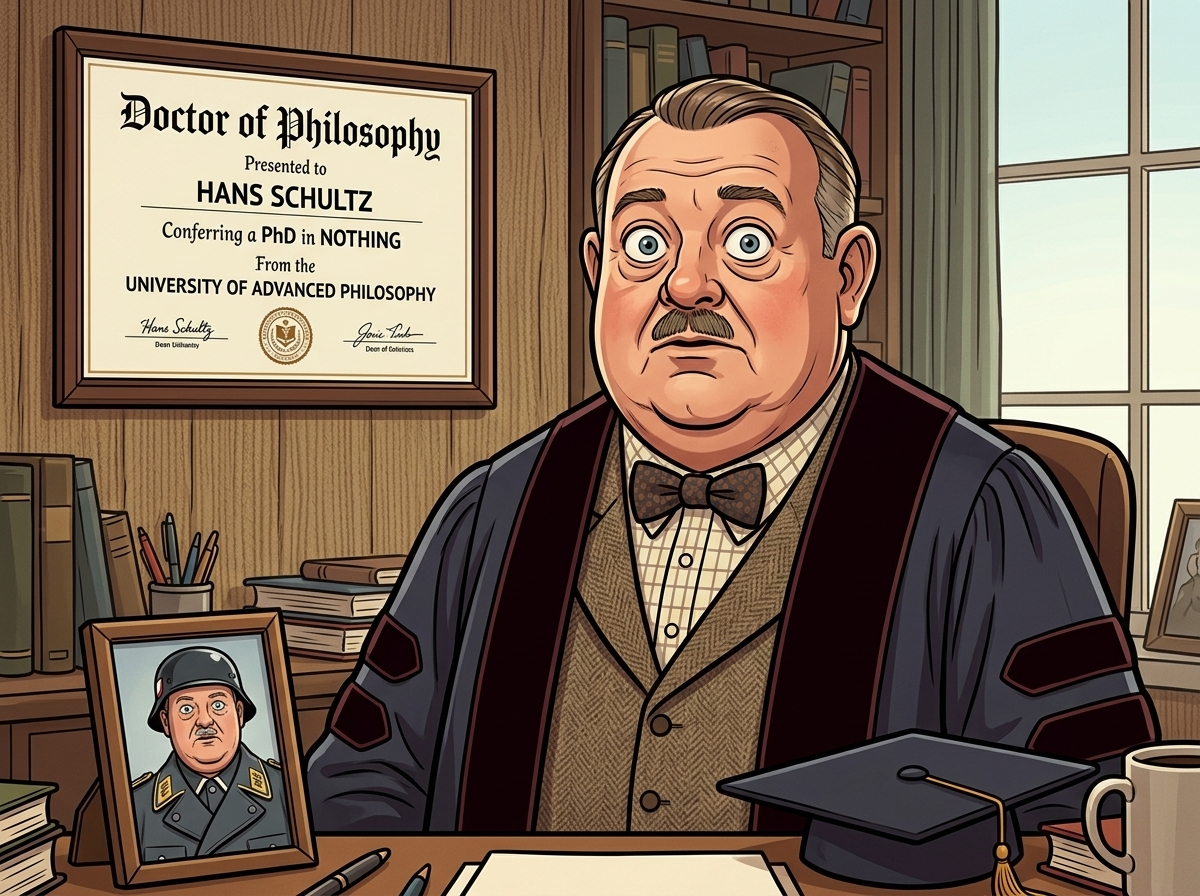
This latest philosophical problem arrived on a cloudy Pacific Northwest afternoon, which is to say it arrived on a normal afternoon. I was staring out the window, watching certainty dissolve into mist over a stand of fir trees, when a thought presented itself with the confidence of a tenure committee and the evidence of a squirrel’s economic forecast: if I know that I know nothing, can I earn a certificate for that?
My first instinct was yes. My second instinct was also yes. My third instinct wondered whether having three instincts on the matter already disqualified me from knowing nothing.
Knowledge has always enjoyed good publicity. Ignorance, meanwhile, has built an impressive career from not showing up. Yet the history of nothing suggests that nothing is rarely content to remain nothing. Ancient philosophers debated absence. Mathematicians eventually gave nothing a symbol. Entire traditions devoted themselves to describing what could not be described. Nothing accumulated departments, journals, conferences, and reputations. A remarkable achievement for a concept that allegedly contains no achievements.
This creates an educational opportunity.
If nothing has a history, surely it has prerequisites. If it has prerequisites, it needs coursework. If it needs coursework, someone can charge tuition.
I find this persuasive mainly because it sounds organized.
The central challenge is proving that I know nothing. Unfortunately, knowledge of my ignorance appears to be knowledge. The certificate evaporates the moment I qualify for it. Suppose an examination asks whether I know nothing. If I answer yes, I demonstrate awareness. If I answer no, I claim knowledge of having knowledge. If I leave the page blank, perhaps I pass with distinction. Or perhaps I have merely forgotten the exam date. The administrative record cannot tell the difference, and that ambiguity feels surprisingly academic.
Studying nothing presents additional difficulties. Traditional education measures growth. Yet if I begin with nothing and end with nothing, have I succeeded perfectly or failed completely? Consider the student who spends four years mastering ignorance. At graduation, the faculty announces that the candidate learned absolutely nothing. The room erupts in applause. Why? Because the outcome precisely matches the program objectives.
Or does it?
The more seriously I consider the matter, the less evidence I require. In fact, evidence becomes suspicious. Evidence frequently interferes with elegant conclusions. Without evidence, almost any assertion develops a kind of majestic freedom. I can declare that nothing is the foundation of all learning because every subject begins with not knowing it. I can also declare the opposite, namely that nothing is the final stage of learning because every answer reveals additional questions. Neither claim needs proof. They merely need confidence and a slightly elevated tone of voice.
Universities have already assembled much of the necessary infrastructure. Philosophy PhD programs at institutions such as Stanford, Harvard, MIT, Columbia, and the University of Washington support advanced study in epistemology, the branch of philosophy concerned with knowledge and its limits. A determined scholar could spend years investigating what it means to know, how knowledge fails, and why certainty behaves like a cat that appears only when ignored. Whether this leads to a Certificate in Knowing Nothing is unclear. That uncertainty may itself count toward program requirements.
Teaching nothing is where the enterprise truly shines. The ideal lecture begins with the professor announcing, “Nobody knows what we are discussing today.” Students take notes immediately. Questions follow.
“What is nothing?”
“We do not know.”
“How do we know?”
“We do not know that either.”
“Will this be on the final?”
“Especially that.”
An educational miracle has occurred. Nothing has generated a curriculum.
The instructor’s authority depends entirely on the absence of supporting evidence. Were evidence introduced, the topic might accidentally become something. Instead, the classroom rests upon unfalsifiable assertions. Perhaps nothing is everywhere. Perhaps nothing is nowhere. Perhaps nothing exists only when unobserved. Perhaps nothing grades papers at midnight. None of these claims can be comfortably cornered. They wander freely across intellectual landscapes like deer crossing a trail exactly where nobody expected them.
I encountered a practical version of this problem in college. In philosophy courses, entire weeks disappeared into debates over whether knowledge required justification, whether certainty existed, and whether anyone could legitimately claim to know much of anything at all (Plato, Apology, c. 399 BCE). In sociology courses, we examined institutions, norms, and categories that seemed permanent until someone pointed out they were collectively maintained agreements. In psychology courses, we learned that memory is reconstructive, perception is selective, and confidence frequently exceeds accuracy. By the end of the semester, every department had contributed generously to my growing expertise in uncertainty. The philosophy faculty questioned what could be known. The sociology faculty questioned who benefited from claiming knowledge. The psychology faculty questioned whether the person doing the knowing could be trusted in the first place.
The remarkable part was that all three disciplines issued grades. I could write ten pages explaining why certainty was elusive, social facts were contingent, and human judgment was vulnerable to distortion, then receive a letter affirming the correctness of those conclusions. The transcript functioned as a bureaucratic miracle. After months of studying the limits of knowledge, I was officially certified to understand that understanding was limited. If that is not preparation for a Certificate in Knowing Nothing, I am unsure what additional qualifications would be required. Perhaps a comprehensive examination in doubt. Perhaps a dissertation entitled Toward a More Rigorous Lack of Conclusion. Perhaps a committee meeting in which the successful defense consists entirely of unanswered questions. (Aristotle, Rhetoric, c. 330 BCE; Frankfurt, On Bullshit, 2005).
But was it all for nothing?
I admit a personal attraction to this field. Part of me wants the certificate. Not because it would prove anything, but because it would prove nothing with official letterhead. I imagine framing it above my desk. Visitors would ask what it certifies. I would tell them it confirms my successful completion of advanced studies in not knowing. They would laugh. I would laugh. The certificate would remain silent, secure in its authority.
Then again, authority itself may be the greatest nothing of all. We trust titles, credentials, seals, signatures, and embossed paper because everyone else appears to trust them first. Somewhere along the way, collective confidence becomes reality. A document transforms ignorance into accomplishment through administrative alchemy.
So can I earn a certificate for knowing that I know nothing?
Obviously yes.
Obviously no.
The real puzzle is why those answers feel equally satisfying. We know enough to recognize the contradiction and not enough to resolve it. Somewhere between learning nothing, teaching nothing, studying nothing, and certifying nothing, the nothing grows unexpectedly substantial. It acquires campuses, dissertations, committee meetings, and perhaps even a graduation ceremony.
Which leaves me with one final concern. If all this nothing is something, then the certificate may be invalid.
On the other hand, if the certificate is invalid, that seems like the most authentic possible credential in the field.
References
- Aristotle. Metaphysics. Translated editions various. Originally composed c. 350 BCE.
- Aristotle. Rhetoric. Translated editions various. Originally composed c. 330 BCE.
- Frankfurt, Harry G. On Bullshit. Princeton University Press, 2005.
- Kerr, Clark. The Uses of the University. Harvard University Press, 1963.
- Plato. Apology. In The Last Days of Socrates. Originally composed c. 399 BCE.
- Seife, Charles. Zero: The Biography of a Dangerous Idea. Viking, 2000.
- Stanford Department of Philosophy. Doctoral Program. Stanford University, 2026. https://philosophy.stanford.edu/academics/graduate-program-philosophy/doctoral-program
- University of Washington Department of Philosophy. Graduate Programs. University of Washington, 2026. https://phil.washington.edu/graduate-programs
- Barnes, Jonathan, ed. The Complete Works of Aristotle: The Revised Oxford Translation. Princeton University Press, 1984. (Contains Aristotle’s discussions of Parmenides and earlier Greek philosophy.)
- Curd, Patricia. A Presocratics Reader: Selected Fragments and Testimonia. 2nd ed. Hackett Publishing, 2010.
- Democritus. Fragments collected in: Taylor, C. C. W. The Atomists: Leucippus and Democritus, Fragments. University of Toronto Press, 1999.
- Kirk, G. S., J. E. Raven, and M. Schofield. The Presocratic Philosophers. 2nd ed. Cambridge University Press, 1983.
- Leucippus. Fragments collected in: Taylor, C. C. W. The Atomists: Leucippus and Democritus, Fragments. University of Toronto Press, 1999.
- Parmenides. On Nature. Fragments and testimonia in: Curd, Patricia. A Presocratics Reader: Selected Fragments and Testimonia. 2nd ed. Hackett Publishing, 2010.
- Parmenides. In: Kirk, G. S., J. E. Raven, and M. Schofield. The Presocratic Philosophers. 2nd ed. Cambridge University Press, 1983.
- Plato. Apology. Translated by G. M. A. Grube, revised by John M. Cooper. In Complete Works, edited by John M. Cooper. Hackett Publishing, 1997.
- Plato. Parmenides. Translated by Mary Louise Gill and Paul Ryan. Hackett Publishing, 1996.

Leave a Reply