
When “intelligent design” starts to look like a series of workarounds
I end up in conversations with creationists more often than you might expect, usually in the margins of other topics, where the assumptions are already baked in. Life, the universe, and everything is designed. Not just designed, but intelligently designed, because the designer is presumed to be intelligent in the way a craftsman is intelligent, or a planner, or at least someone who prefers symmetry over chaos. The logic feels self-sealing. If something looks complex, that complexity is evidence of intent. If something looks weird, the weirdness is either our misunderstanding or a test of faith. I’ve learned to listen for the tone more than the argument.
But I cannot get comfortable with that framing, not because I think it is wrong in a simple way, but because I keep running into examples that refuse to behave like the output of a coherent plan. There are too many cases where the design, if that is what it is, looks improvised, even adversarial, as if the system were built by someone willing to accept collateral damage as a design feature. I find myself asking, sometimes out loud, how can that be designed? And if it is, what kind of designer would choose this route instead of a cleaner one? The answer that comes back, implicitly, is always the same. An intelligent one. I’m not sure that resolves anything. It might just relocate the strangest part of the question.
So, the question arrives like weather does here, not announced, just present. How is any of this designed? I keep thinking about it the way you think about a bridge you’ve driven over a hundred times. You don’t first ask who drew the plans. You ask why it holds at all, and what happens when it doesn’t.
Syphilis comes in with a historical swagger that feels almost theatrical. It moves through Europe in the late 1400s like a rumor that learned to replicate itself. The earliest reliable European documentation places it in the 1490s, though its origin stretches back farther and less politely than that (Quétel, History of Syphilis, 1990). I picture it less as a “disease” in the abstract and more like an opportunist that shows up right when social systems are already fraying. War, trade, crowded cities. It does not need design. It needs proximity.
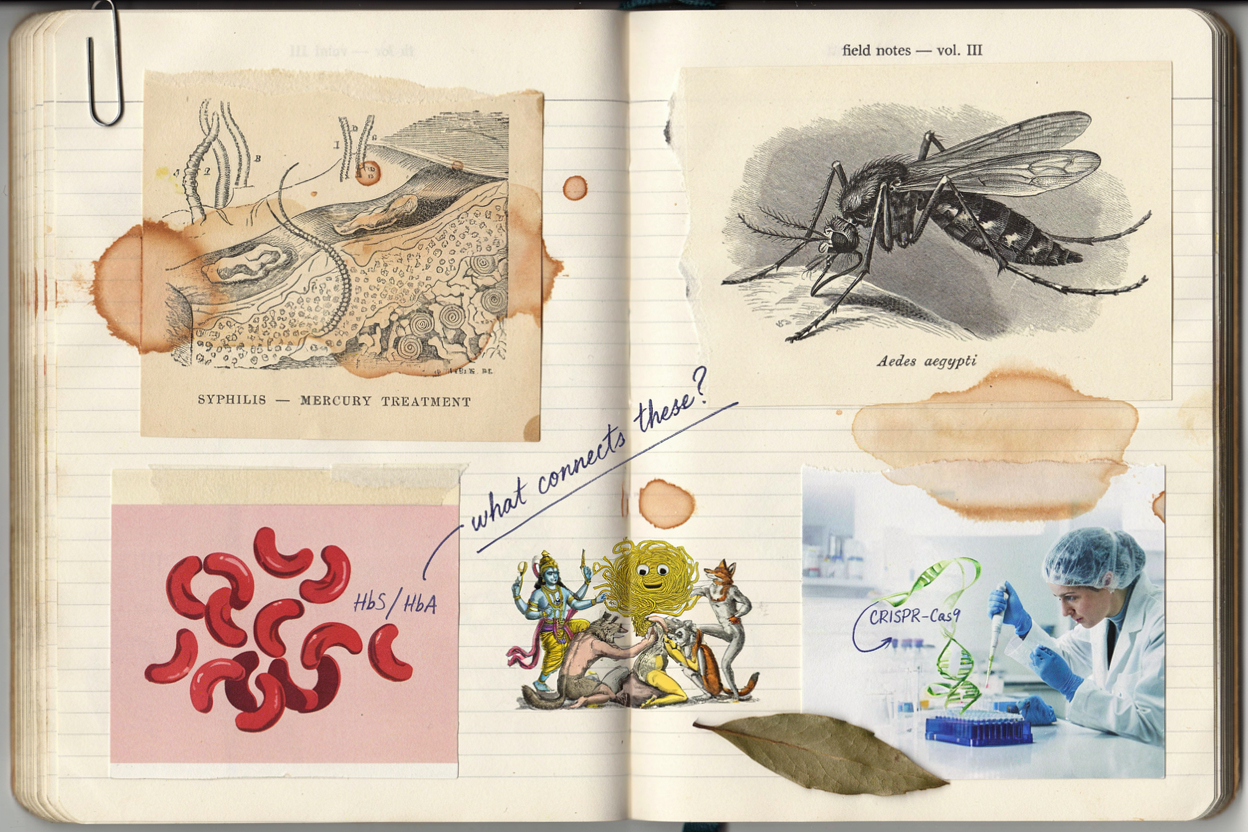
The treatment that follows is somehow more bizarre than the infection. In the early twentieth century, before antibiotics could do the heavy lifting, physicians experimented with malaria as a controlled infection to treat neurosyphilis. Julius Wagner-Jauregg’s malariotherapy involved deliberately infecting patients with Plasmodium to induce fevers high enough to damage Treponema pallidum (Wagner-Jauregg, Nobel Lecture, 1927). The logic is almost comically grim. Use one parasite’s heat to cook another. If you step back far enough, it looks like an argument that resolution requires escalation. I have to admit, I find this both ingenious and slightly unhinged. Like curing a house fire by setting a smaller, more manageable fire in the kitchen.
Ok, maybe not that unhinged, we do this to stop forest fires.
Malaria itself is not new. It has shaped human evolution for millennia, especially in regions where Plasmodium falciparum thrived under the right ecological conditions (Carter and Mendis, “Evolutionary and Historical Aspects of Malaria,” 2002). The parasite is less a single entity than a system of timing and adaptation, cycling through mosquito and human hosts with a precision that feels indifferent but not random. You can almost imagine it as a recurring visitor that never learns your address, yet always finds its way back.
And then there’s sickle-cell, which reads like malaria’s counterproposal. The mutation in the beta-globin gene produces hemoglobin that distorts red blood cells under low oxygen conditions, but in heterozygous carriers it confers a survival advantage against severe malaria (Allison, “Protection Afforded by Sickle-Cell Trait,” 1954). It is one of those evolutionary tradeoffs that refuses to be tidy. The body carries a condition that can become lethal in one configuration and protective in another. I remember the first time I really sat with that fact. It felt less like adaptation and more like a negotiation that never fully resolves. Why preserve a trait that hurts some people so much? Because in a different environment it keeps them alive. The logic is not moral. It is situational.
I live in a place where people talk about systems as if they can be tuned. But biology does not tune easily. It accretes. It compensates. It keeps the receipt for every trade.
Modern genetics enters this sequence like a late arrival who refuses to acknowledge how strange the room already is. Gene editing tools, especially CRISPR-Cas9, have been used to reactivate fetal hemoglobin production or correct the underlying mutation in hematopoietic stem cells, offering durable treatment for sickle-cell disease (Frangoul et al., “CRISPR-Cas9 Gene Editing for Sickle Cell Disease,” NEJM, 2021). The first time I read about these therapies, I had that familiar Pacific Northwest reaction. Not amazement exactly. Something closer to a quiet, uneasy appreciation. We are now writing edits into the code, as if the genome were a document that could be revised with enough precision and patience.
I keep circling back to the question. How is any of this designed? Not in the sense of a designer you can point to, but in the sense of coherence. The malaria parasite “designs” a lifecycle that depends on mosquitoes. The human genome “designs” a mutation that partially defeats that lifecycle, but at a cost. Physicians “design” a treatment by strategically introducing another disease. And now scientists “design” interventions that target the machinery of inheritance itself.
It feels like a chain of interventions that are less like progress and more like a series of workarounds stacked on top of each other. Each solution borrows from something adjacent, sometimes something hostile, sometimes something already breaking. Is that what design looks like when you are close enough to see the seams?
I find myself thinking about this while walking through wet streets, the kind that reflect too much sky. I am not neutral about any of it. I am slightly amused, slightly unsettled. There is something absurd about the idea that a parasite can be both a killer and a cure, that a mutation can be both burden and shield, that a therapy can rely on inducing another illness. The system does not resolve into simplicity. It refuses to behave.
At some point you stop looking for a clean answer and start noticing the pattern of improvisation. Even the latest genetic work, with all its precision, feels like it is negotiating with older constraints, not replacing them. We are not stepping outside the system. We are tightening screws on a machine we did not assemble and only partially understand.
So how is any of this designed? I don’t know. But I do know that if it is, the design is not the kind that prefers clarity. It looks more like adaptation that kept going long after anyone was in charge. And that thought, strangely enough, does not bother me as much as it should.
Maybe that’s the weirdest part. It works anyway.
References
- Allison, A. C. “Protection Afforded by Sickle-Cell Trait Against Subtertian Malaria Infection.” British Medical Journal, 1954.
- Carter, R., and K. N. Mendis. “Evolutionary and Historical Aspects of Malaria.” Parasitology Today, 2002.
- Frangoul, H. et al. “CRISPR-Cas9 Gene Editing for Sickle Cell Disease and β-Thalassemia.” New England Journal of Medicine, 2021.
- Quétel, Claude. History of Syphilis. Johns Hopkins University Press, 1990.
- Wagner-Jauregg, Julius. Nobel Lecture, 1927.

Leave a Reply