
On Proptaku’s “Temperature” shirt, measurement, and the quiet comedy of 27 degrees
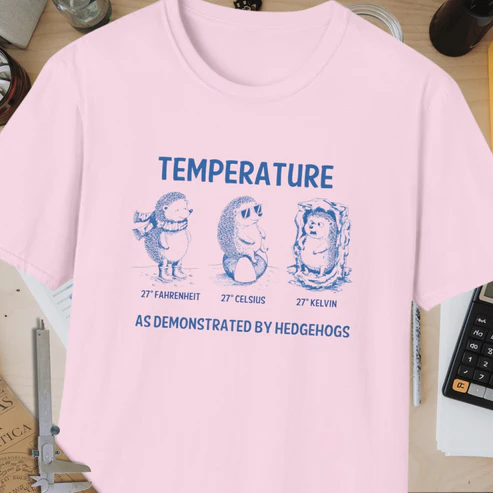
We were not in a coffee shop this time. We were on a bus headed toward Mount Rainier, the kind of trip where the scenery does most of the talking and the passengers default to silence or nervous commentary about elevation. Proptaku sat by the window, their “Temperature” shirt visible under a jacket they refused to fully zip. The shirt showed three hedgehogs, all at the same 27 degrees, each one behaving differently depending on the scale. Fahrenheit hedgehog, comfortable and wrapped in a scarf. Celsius hedgehog, stretched out on a beachball like it had decided to take the day off. Kelvin hedgehog, trapped in a block of frozen gas, which I am still not entirely sure is a metaphor or a warning.
I said, “They’re all the same temperature.”
Proptaku nodded. “They are. That is the point.”
There is a particular kind of precision in that answer. Not explanatory, but final. The kind of precision that assumes you will either understand it or not, and both outcomes are acceptable.
Temperature, in the technical sense, is not about heat itself. It is about the average kinetic energy of particles in a system (Atkins and de Paula, Physical Chemistry, 2014). It is a statistical property, not a sensory one. The shirt, however, renders it as something immediately legible, which is where the humor begins to do double duty. It is not just a joke about hedgehogs. It is a visual argument about how measurement systems shape perception.
The first hedgehog, Fahrenheit, is clearly the most relaxed. The scarf is doing a lot of work, which makes sense given that 27 degrees Fahrenheit is a little below freezing, but not yet catastrophic. It is the temperature of sidewalks that might betray you if you are not careful, and mornings that require negotiation with your own willingness to leave the house. In the shirt’s interpretation, Fahrenheit hedgehog appears stable, almost domesticated. It is the measurement system that still feels slightly human, calibrated around lived experience rather than absolute reference points (Celsius, Hotom et Coldom, 1742). I have lived long enough in the Pacific Northwest to understand that this is the scale people default to when they are trying to describe weather in a way that sounds personal.
Celsius hedgehog, by contrast, is at 27 degrees and essentially thriving. The beachball is an odd choice until you realize that 27 degrees Celsius is roughly room temperature plus a bit of optimism. It is the point at which water is no longer indifferent to your presence, and your body stops actively resisting the environment. The hedgehog’s posture suggests ease, not because the number is different, but because the scale is. Celsius is the system that treats freezing and boiling as clean reference points, which makes 27 feel comfortably midrange, even if the actual physical conditions are identical to the other hedgehogs (Bolton, The Nature of Temperature Scales, 2008). The shirt is quietly pointing out that comfort is sometimes just a matter of framing.
Then there is Kelvin hedgehog, which is where the whole thing tips into something slightly uncomfortable. At 27 Kelvin, everything is cold enough that molecular motion is dramatically reduced, and the idea of a beachball would be absurd even if it were not already occupied. The shirt depicts this hedgehog in a block of frozen gas, a detail that Proptaku, with the kind of understated certainty I have come to expect, described as “probably from its own outgassing.”
I paused at that. “Its own?”
“Every system has to go somewhere,” they said. “Even if it is just into itself.”
That is the sort of statement that sounds like a joke until you think about it for too long.
Kelvin, unlike Fahrenheit and Celsius, is an absolute scale. It starts at zero, which is not arbitrary but defined by the absence of thermal motion (Thomson, On the Absolute Scale of Temperature, 1848). There is no negative Kelvin. The scale refuses to go below its own baseline, which is part of why the shirt calls attention to it. The hedgehog is not just cold. It is constrained by the structure of the system itself.
I have been thinking about that constraint more than I expected to. Not in a dramatic way, but in the way you notice that certain frameworks do not allow for easy exceptions. The Kelvin hedgehog is funny because it is trapped, but also because it is correct. You cannot go below zero. You can only approach it.
The bus rattled slightly as we climbed, and the air outside shifted in a way that felt like a subtle recalibration of everything inside. Proptaku watched the trees blur past and said, “It is interesting that all three are the same temperature, and none of them are experiencing it the same way.”
I asked, “Is that the point?”
They shrugged. “It is one of them.”
That answer, again, was not helpful in the conventional sense. But it was accurate. The shirt is not just about thermodynamics. It is about interpretation. Measurement systems are not neutral. They encode assumptions about what is normal, what is extreme, and what counts as a reference point. The hedgehogs make this visible by anchoring abstract numbers to physical comedy.
I have to admit, I keep returning to the Kelvin hedgehog. Not because it is the most interesting, but because it is the most honest. It shows what happens when a system is taken to its logical endpoint. No wiggle room. No scarf.
We got off the bus near a viewpoint where the mountain was partially visible, its presence asserting itself through shifting cloud cover. The temperature up there was different in a way that did not require conversion. Proptaku adjusted their jacket and said, almost casually, “You know, 27 degrees is just a number. It only means something because we agree on what it means.”
I looked at the shirt again. Three hedgehogs, same number, three entirely different realities.
“Even the gas one?” I asked.
Proptaku smirked. “Especially the gas one.”
And I thought about that too, as the wind picked up and the air felt like it was moving through more than just space. Temperature, after all, is not a thing you can hold. It is a condition you infer from behavior. From motion. From the way hedgehogs choose to arrange themselves, or refuse to.
The shirt, in its quiet way, makes that clear. It does not argue. It demonstrates. And like most good demonstrations, it leaves you wondering whether you understood the concept, or just the hedgehogs.
References
• Atkins, Peter, and Julio de Paula. Physical Chemistry. Oxford University Press, 2014.
• Bolton, William. The Nature of Temperature Scales. Springer, 2008.
• Celsius, Anders. Hotom et Coldom. 1742.
• Proptaku. “Temperature Unisex Softstyle T-Shirt.” https://proptaku.com/products/temperature-unisex-softstyle-t-shirt
• Thomson, William (Lord Kelvin). “On the Absolute Scale of Temperature.” 1848.

Leave a Reply