
Threads Theology and the Long Life of an Adversary
Threads is a remarkable engine for half-formed metaphysics. A question flashes by, unburdened by footnotes or patience, and suddenly you are ankle-deep in Augustine without noticing. This one landed with that same casual audacity:
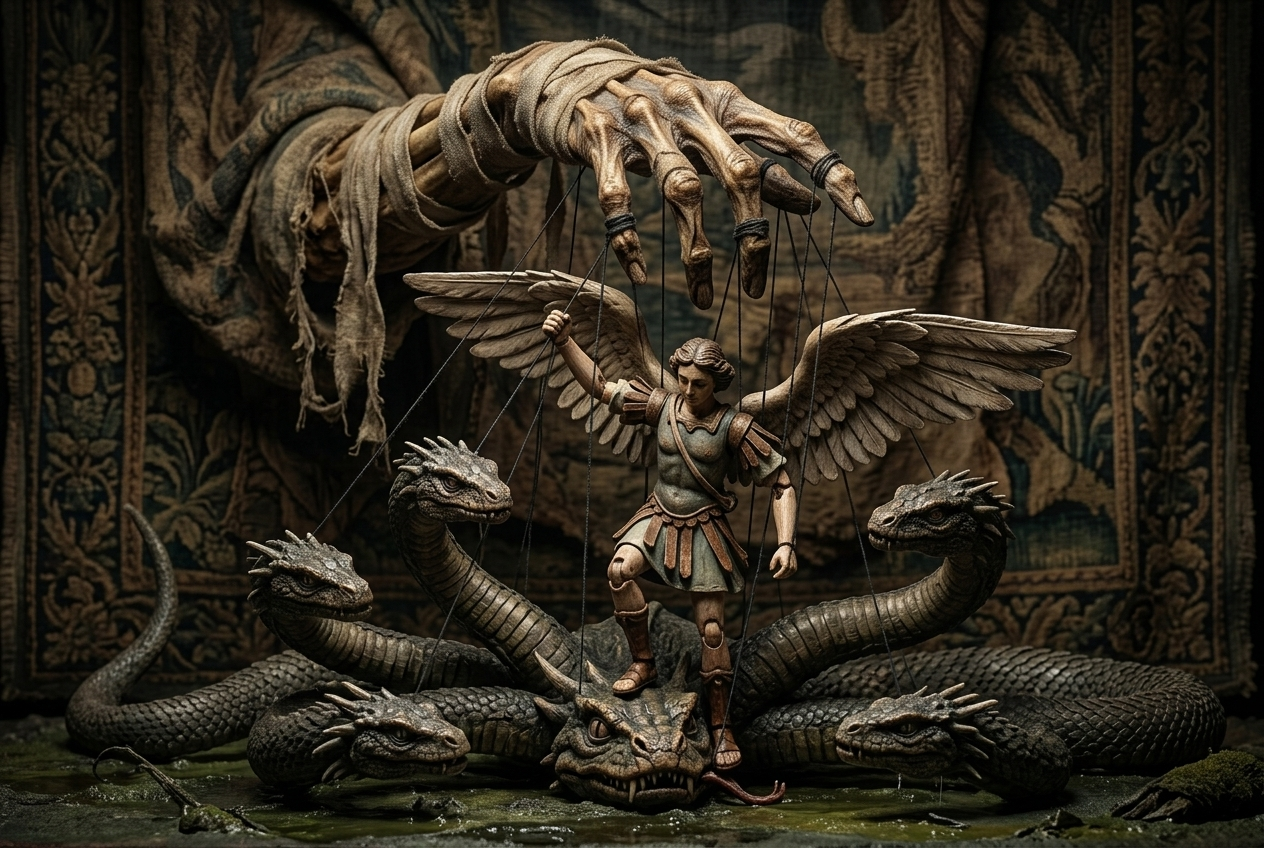
“If the serpent was in fact Satan, why does he still exist after his head was crushed under Michael’s heel?”
A tidy puzzle, almost smug in its phrasing. It assumes a narrative continuity that the texts themselves never quite agree on, and it imagines a decisive moment that settles the problem of evil with a single act of divine orthopedic violence.
Let’s sit with the quotation as it stands. The “serpent” belongs to Genesis 3, where the creature is described simply as “more crafty than any other wild animal” (Genesis, NRSV). No horns, no wings, no résumé as cosmic prosecutor. The crushing of the head is a line directed at the serpent in that same chapter, often read retrospectively as a proto-prophecy of a final victory over evil. Michael, meanwhile, enters from Revelation, locked in apocalyptic combat with “that ancient serpent, who is called the Devil and Satan” (Revelation 12). The question stitches these texts into a single timeline, as if the Bible were less a library and more a screenplay (Pagels, The Origin of Satan, 1995). You can hear the intent behind it. The question is not really asking about philology or redaction history. It is probing coherence. If evil was crushed, why does it still walk around Seattle in a Patagonia jacket, ordering oat milk and cutting in line?
My response
“Several possible answers:
1. It was just a physical manifestation of spirit
2. Ha-satan just means adversary, and Yahweh creates them as needed.
3. It’s just a story”
My first answer was blunt, maybe even a little Jesuit in its clinical detachment: “It was just a physical manifestation of spirit.” This treats the serpent as an instrument rather than an identity. Augustine would recognize the move, even if he might prefer more metaphysical scaffolding. Evil, in this view, lacks independent substance and borrows form when necessary (Augustine, City of God, 426). The serpent becomes a costume, one episode in a longer drama of spiritual opposition. I remember a Jesuit teacher sketching something like this on a whiteboard, speaking with that careful precision that made everything sound both provisional and absolute. The implication was that crushing a head does not eliminate the principle behind it. You can break the mask without ending the play.
What kind of world does that answer assume? A layered one. Reality is not exhausted by what can be seen or struck. You could step on the snake and still miss the problem. Does that satisfy the question, or does it shift it upward a level? If spirit persists, what does “crushed” even mean? Is it victory, or is it a metaphor we cling to because it feels final?
The second answer carries a different flavor, something I picked up from my Baptist phase. I was there less for doctrine and more for the quiet approval of a girlfriend’s father, which is its own kind of theology. The answer goes like this: “Ha-satan just means adversary, and Yahweh creates them as needed.” In the Hebrew Bible, “the satan” appears not as a rebel angel but as a role in the divine court, a tester or accuser (Job 1–2). The word is less a name than a job description. Scholars have been pointing this out for decades, often to the discomfort of readers who prefer a single, continuous villain (Day, God’s Conflict with the Dragon, 1985).
This answer reframes the question entirely. If “satan” is a function, then asking why he still exists is like asking why prosecutors keep showing up in court. The system generates them. I can still see the fluorescent-lit fellowship hall where someone explained this to me with surprising calm, as if it were obvious that God might appoint an adversary for the sake of testing human fidelity. It landed oddly then, and it still does. What does it say about a worldview if opposition is built into the structure of reality? Does it comfort you to think that the adversary is authorized, even necessary, or does it make the whole drama feel staged?
Between those two positions sits a long, uneven evolution. The Hebrew ha-satan begins as a role within a monotheistic court, an agent who tests, obstructs, or prosecutes under divine permission. By the Second Temple period, that role starts to harden. Texts like 1 Enoch and Jubilees thicken the character, giving the adversary a sharper edge and a narrative arc that looks less like function and more like opposition (Nickelsburg, 1 Enoch, 2001). This is the stretch of history where Israelite thought brushes against Persian Zoroastrianism during and after the exile, where a clearer dualism between good and evil is not only imaginable but ambient. You do not have to posit direct borrowing to see the conversation happening. The cultural air shifts. Cosmic opposition becomes narratively legible. Suddenly, the adversary can feel less like an employee and more like a contender (Boyce, Zoroastrians, 1979).
What follows is not a clean transition but a series of creative tensions. Early Jewish and then Christian writers begin to speak as if the adversary has a will that resists God, even while insisting on God’s ultimate sovereignty. By the time you reach the New Testament, “Satan” looks far more like a personal force of evil, yet still one that can be bound, cast down, or otherwise handled within a divine plan (Pagels, The Origin of Satan, 1995). The result is a figure who flickers between roles, sometimes a necessary accuser, sometimes a rogue opponent. That flicker says as much about developing ideas of evil as it does about any single character. When you imagine the serpent’s head being crushed, which version are you picturing. The court official whose task is complete, or the rebel whose defeat is always just ahead of us. And if those images blur, what does that do to the certainty the question is trying to claim.
And then there is the third answer, the one that probably belongs most fully to who I am now: “It’s just a story.” Not “just” in the sense of trivial, but “just” in the sense of crafted narrative. The serpent is a literary character, shaped by the concerns of ancient authors trying to explain why things feel broken (Alter, The Art of Biblical Narrative, 1981). The crushing of the head is an image, vivid and satisfying, meant to gesture toward resolution without pretending to deliver it in historical time.
I came to this slowly, and not without friction. Letting the story be a story does not empty it of meaning. It relocates the meaning. The question then becomes less about reconciling timelines and more about understanding why the image persists. Why do we keep returning to the idea that evil can be dealt with decisively, once and for all? Why does that promise keep slipping, like rain off a cedar branch?
Each of these answers carries a worldview in its pocket. The first trusts in unseen structures. The second sees roles and functions where others see personalities. The third leans into narrative and symbolism. None of them fully closes the loop that Threads opened in a sentence. Maybe that is the point. The question itself is a small act of theological compression, a desire to tidy up a sprawling set of texts into a clean resolution.
But here’s what nags. When you hear “crushed under Michael’s heel,” what do you imagine actually happening? A battle in time, with a clear before and after? Or a promise that refuses to sit still, shifting as you look at it? And why does the persistence of “the serpent,” whatever we take that to mean, feel like a problem that needs solving rather than a condition that needs understanding?
I can’t quite shake the image of that Threads post, bright and fleeting, asking for closure in a medium designed for fragments. Maybe the real answer lives in that tension. We want endings that behave like physics. The texts tend to offer something closer to weather.
References
- Alter, Robert. The Art of Biblical Narrative. 1981.
- Augustine. City of God. 426.
- Day, John. God’s Conflict with the Dragon and the Sea. 1985.
- Genesis, New Revised Standard Version (NRSV).
- Pagels, Elaine. The Origin of Satan. 1995.
- Revelation, New Revised Standard Version (NRSV).

Leave a Reply