
From Autocatalytic Circles to Protocells, and Why the “First Cell” Gotcha Misses the Story
There it was again, the Facebook Thursday that keeps on giving. A post from the account styling itself “The Intelligent Design”, declaring with satisfied brevity:
“According to mainstream evolutionary biology, natural selection did not form the first self-replicating cell.”
It lands like a trap that expects applause, a clean statement that seems to close a door.
I read it, and I get the appeal they are after. It feels like catching someone in a contradiction. Evolution explains complexity, but here is the beginning of complexity, and evolution is not allowed to speak. Case closed.
But that framing depends on a silent, stealthy, comic ninja move, one that takes a messy continuum and draws a hard line through it, then demands an explanation for the line itself. Evolutionary biology, as a discipline, begins where replication with variation is already in play. It never claimed to build the first replicator. That has been explicit for decades. The boundary is definitional, not evidentiary (Maynard Smith, The Origins of Life, 2000).
As usual with posts by The Intelligent Design, it treats that boundary as a failure. It is not. It is more like the edge of a map someone refuses to extend.
The history of that extension is long and strange and, to me, more interesting than the argument. Early thinkers like Oparin and Haldane imagined a prebiotic Earth rich with simple organic molecules, a “soup” that was less a broth and more a shifting chemical landscape. Not life. Not even close. But not inert, either. I find that middle ground compelling. We tend to think in binaries, alive or not, but the evidence keeps pointing toward gradients.
As an aside, I always notice how figures like Stephen C. Meyer lean hard on that older “primordial soup” phrasing in talks and videos. It is rhetorically useful. It sounds vaguely dated and a little unappealing, which helps set the tone before any actual argument is made. But it also flattens the history. The Miller–Urey experiment becomes the stand‑in for all abiogenesis work, as if nothing meaningful has happened since the 1950s. That is not just incomplete, it is misleading. The field moved on decades ago into far more nuanced models like hydrothermal vent chemistry, surface catalysis, and autocatalytic networks. Reducing it back to a bubbling flask is less about accuracy and more about framing the problem in a way that already feels exhausted.
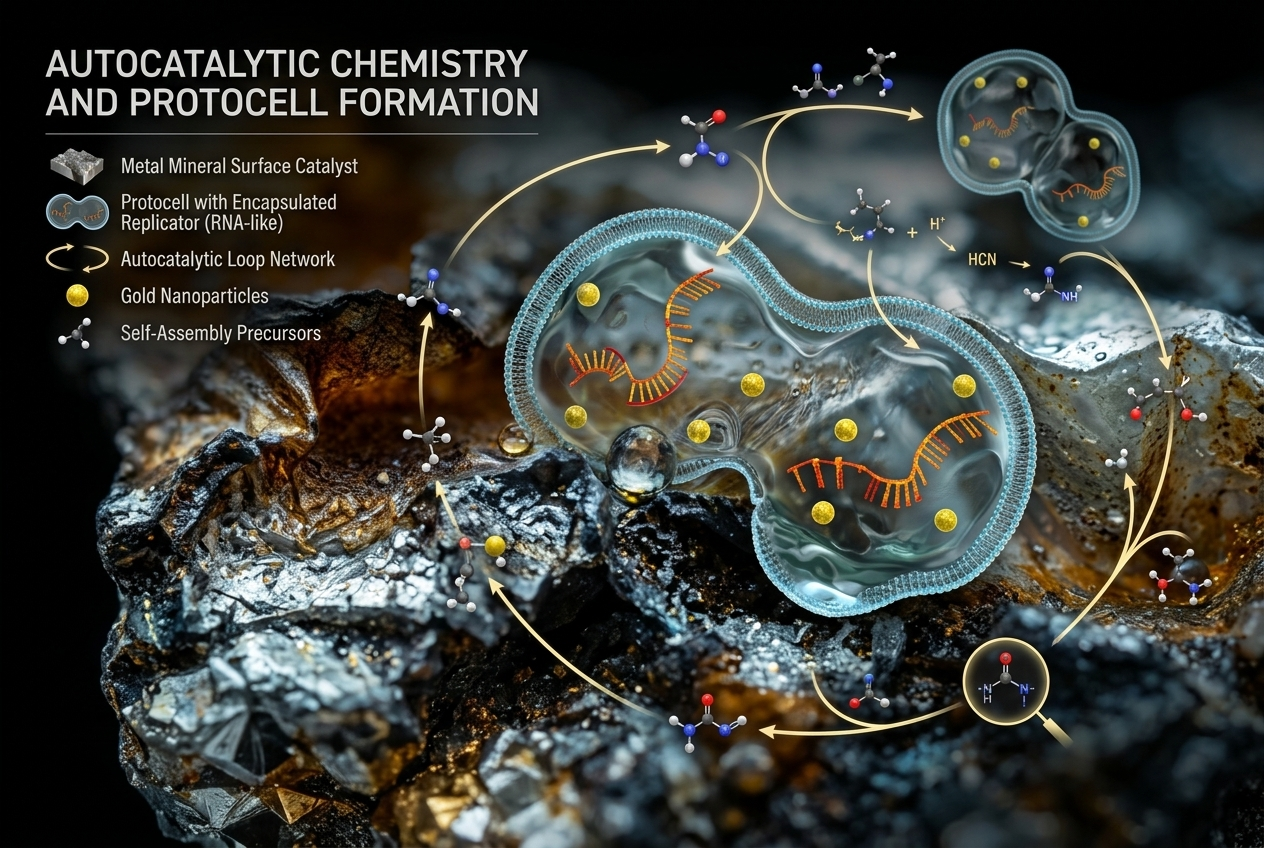
By the late twentieth century, the conversation had shifted toward dynamics. Stuart Kauffman’s idea of autocatalytic sets suggested that networks of molecules could collectively enhance their own formation (Kauffman, At Home in the Universe, 1995). No genes, no DNA, nothing we would recognize as biology. Just chemistry that, under the right conditions, organizes into loops of reinforcement. One reaction produces a molecule that speeds up another reaction, which in turn feeds back into the first. A circle forms, not by design, but by compatibility.
I’d like to linger there a bit, take another sip from my americano first, because this is where the Intelligent Design “gotcha” starts to dissolve. If some molecular arrangements persist longer because they reinforce themselves, then persistence is not random in any deep sense. It is biased by structure. Differential persistence creates patterns over time. Some configurations become more common simply because they last and replicate their conditions. Others vanish because they cannot maintain themselves. That is not yet Darwinian selection, but it carries a family resemblance.
I picture early Earth not as a laboratory but as a shoreline in constant rearrangement. Tidal pools filling and draining, mineral surfaces catalyzing reactions, temperature fluctuations stressing and stabilizing different compounds. It is chaotic, but not featureless. In one shallow pool, a set of reactions happens faster than elsewhere. In another, molecules degrade quickly under UV radiation. Over time, the chemical “immigrants” that arrive and remain are the ones whose structures and interactions fit the local conditions.
I can picture another setting, too, one that feels less like a shoreline and more like a furnace. Hydrothermal vents, mineral chimneys rising from the ocean floor, steep gradients of heat and chemistry pressing against one another. It is a different kind of order. Iron-sulfur surfaces acting as catalysts, tiny pores providing compartments before membranes ever stabilize. Some researchers think early metabolism may have taken shape there, cycling through reactions driven by those gradients (Russell, Hydrothermal vents and the origin of life, 2003). I’m not committed to one scene over the other. It never felt like a single doorway anyway. More like several plausible entrances, each offering slightly different constraints and opportunities, with chemistry testing them all in parallel.
I keep coming back to that immigrant frame. There is movement, failure, adaptation without intent. A chain forms, breaks, returns altered. Another chain happens to catalyze its own formation. It grows more common, not because it is better in any moral sense, but because it is faster or more stable. It occupies more of the available space simply by persisting. What else would you call that, if not a prelude to selection?
Then replication appears, tentative and unreliable. RNA or RNA-like molecules that can act both as information carriers and catalysts. Experiments have shown that RNA can copy sequences, albeit imperfectly (Joyce, “RNA Evolution,” 2002). Imperfection is not a bug here. It is the source of variation. If every copy were perfect, nothing new would emerge. Errors introduce alternatives, most of which fail, a few of which persist.
I find this stage particularly vivid. Imagine strands forming and pairing, then separating again, some sequences holding together longer, others fragmenting. Thermal cycles drive the process. Wet-dry cycles on mineral surfaces concentrate reactants, then dilute them again. Each iteration is an opportunity for slight change. Over many cycles, certain sequences become more common because they survive the conditions better or catalyze their own replication more efficiently.
At this point, the language starts to tilt. We are still in chemistry, technically, but we are edging toward behavior. The system has memory in the form of sequences that recur. It has variation. It has differential success. The ingredients of evolution are assembling, even though we are not yet dealing with cells.
I keep thinking of some of the newer materials research you see coming out, where simple systems start exhibiting lifelike behavior without being alive in any formal sense. Reactive droplets that move, divide, or maintain gradients. Mineral substrates that bias reactions in consistent ways. It echoes that gray zone where chemistry begins to organize into something that looks suspiciously like agency, even though it isn’t. That literature complicates the boundary even further. If materials can already “act” in patterned, persistent ways, then the jump to protocells feels less like a leap and more like a continuation.
And then, somewhat quietly, boundaries emerge.
Fatty acids and other amphiphilic molecules have a tendency to form bilayer structures in aqueous environments. They organize into vesicles, little spherical enclosures that trap whatever is inside them (Chen and Szostak, “Protocell Growth and Division,” 2004). This is not an invention so much as a property of the molecules themselves. Under the right conditions, membranes happen.
Once membranes exist, new dynamics appear. A vesicle enclosing a productive set of reactions can grow by incorporating more lipids from its surroundings. Physical forces can cause it to divide, creating two daughter vesicles, each inheriting some of the internal chemistry. If the internal chemistry includes replicating polymers, then replication and containment become linked. The vesicle protects the replicators, and the replicators, in some cases, stabilize or enhance the vesicle.
To me, this is where the story shifts from a scattered journey to something like settlement. Not settled in the human sense. More like a fragile camp that can survive a few cycles of the environment. A protocell is not yet a modern cell with complex machinery and tightly regulated processes. It is a loose association of boundary and chemistry, but it is enough to make persistence more likely.
The Intelligent Design argument looks for a single inflection point, the moment the first true cell appears, and asks who or what built it. But the evidence points in the other direction. There is no clear moment. There is a sequence of thresholds. Replication becomes reliable enough to matter. Variation becomes stable enough to accumulate. Membranes become robust enough to persist through environmental stress. Each step is incremental, and each step is supported by mechanisms that do not require external direction.
I notice something else when I read these “gotcha” posts. They often rely on intuition about what counts as an explanation. If you cannot point to a single mechanism that constructs the entire system, then the system remains unexplained. But that intuition fits engineered systems, not emergent ones. In emergent systems, explanations are distributed. They live in the interaction of parts over time.
Kauffman’s autocatalytic sets do not “build” cells in the way a blueprint builds a house. They create conditions under which certain structures are favored. RNA replication does not design a genome in one step. It generates variants, some of which persist. Lipid vesicles do not decide to encapsulate useful chemistry. They encapsulate whatever is present, and some combinations happen to be more stable. The process is cumulative, not directive.
I find that perspective less tidy but more faithful to what the models and experiments suggest. It also shifts the question. Instead of asking what built the first self-replicating cell, we ask how systems capable of replication and persistence emerged from simpler chemistry. That question has partial answers, not a single solution.
There is also a temporal aspect that tends to get flattened in these debates. The early Earth had hundreds of millions of years for these processes to unfold. Chemical systems had time to explore a vast space of possibilities. Most paths led nowhere. Some led to increasingly stable and self-reinforcing arrangements. Time acts as a filter, not just a background parameter.
I think about that shoreline again (or the vent, let’s be fair), over deep time. Pools forming, drying, reforming. Molecules assembling and disassembling. Occasional feedback loops giving rise to temporary order. Over time, temporary becomes less temporary. Persistence extends from minutes to hours, from hours to cycles, from cycles to what we would recognize, eventually, as generations.
At no point does a boundary appear that cleanly separates non-life from life. There is a zone of ambiguity where definitions start to strain. That is where the post’s confidence feels misplaced. It assumes a clarity that the evidence does not support.
Why does the “natural selection did not form the first cell” line resonate? Partly because it sounds like a concession. It sounds like scientists admitting a gap. But the gap is only there if you insist that “natural selection” must refer strictly to the process as it operates in modern organisms. If you broaden the lens to include differential persistence, amplification of certain molecular networks, and the gradual coupling of replication with containment, then selection-like dynamics are present well before cells.
I catch myself wanting to tidy this up into a neat conclusion, but that would mimic the same impulse I am pushing against. The story is uneven because the process is uneven. There are starts and stalls, dead ends and breakthroughs that are only visible in retrospect.
So when I see that Facebook post, I do not see a decisive argument. I see a snapshot of one boundary being mistaken for the whole landscape. Evolutionary biology does not build the first cell, no. But the processes that make evolution possible are already at work in the chemistry that precedes it. The transition is not a single leap across a gap. It is more like wading through a long, shallow gradient where, eventually, you realize you are swimming.
And once you notice that, the question changes. Not who built the first self-replicating cell, but how a world of simple reactions became a world where replication, variation, and persistence were enough to begin the long, still unfinished experiment we call life.
References
Maynard Smith, J. The Origins of Life: From the Birth of Life to the Origin of Language. 2000.
Kauffman, S. At Home in the Universe. 1995.
Joyce, G. F. “The antiquity of RNA-based evolution.” 2002.
Chen, I. A., Szostak, J. W. “A kinetic study of the growth of fatty acid vesicles.” 2004.
Russell, M. J. “The alkaline solution to the emergence of life: Energy, entropy and early evolution.” 2003.
CeleryKills. “When Materials Start Acting Like Organisms”. 2026

Leave a Reply