
Modeling Noah’s Ark, Avoiding the Poop Math, and Other Questionable Decisions
I’ll admit this one started the way most bad ideas do. Lost World Museum on Facebook says, “Instead of asking in skepticism “How did ALL the animals fit in Noah’s Ark?”
See if IT IS possible.” and suddenly I’m standing there with a coffee, a calculator, and just enough curiosity to make things weird.
So I did the math.
Not because I thought it would prove anything. Not because I had a theological axe to grind. Mostly because I wanted to see what happens when you treat an ancient narrative like a warehouse logistics problem. That shift alone is worth the price of admission.
The text gives us dimensions, and they’re oddly specific.
“The length of the ark shall be three hundred cubits, its breadth fifty cubits, and its height thirty cubits” (Genesis 6:15).
Translate that into something you can actually imagine and you get:
Length ≈ 300 cubits × 1.5 ft = 450 ft
Width ≈ 50 cubits × 1.5 ft = 75 ft
Height ≈ 30 cubits × 1.5 ft = 45 ft
Spread across three decks, that’s about:
Total floor area ≈ 450 × 75 × 3 = 101,250 sq ft
Which sounds enormous until you remember you’re about to fill it with animals that do not respect personal space.
So we trim it down. You need room to move, and Noah presumably didn’t want to spend a year pressed flat against a wall by confused livestock. Call it a 20 percent deduction for movement, plus a very generous 2 percent for human beings who presumably would like to sit down at some point.
Usable space ≈ 101,250 × 0.78 ≈ 78,000 sq ft
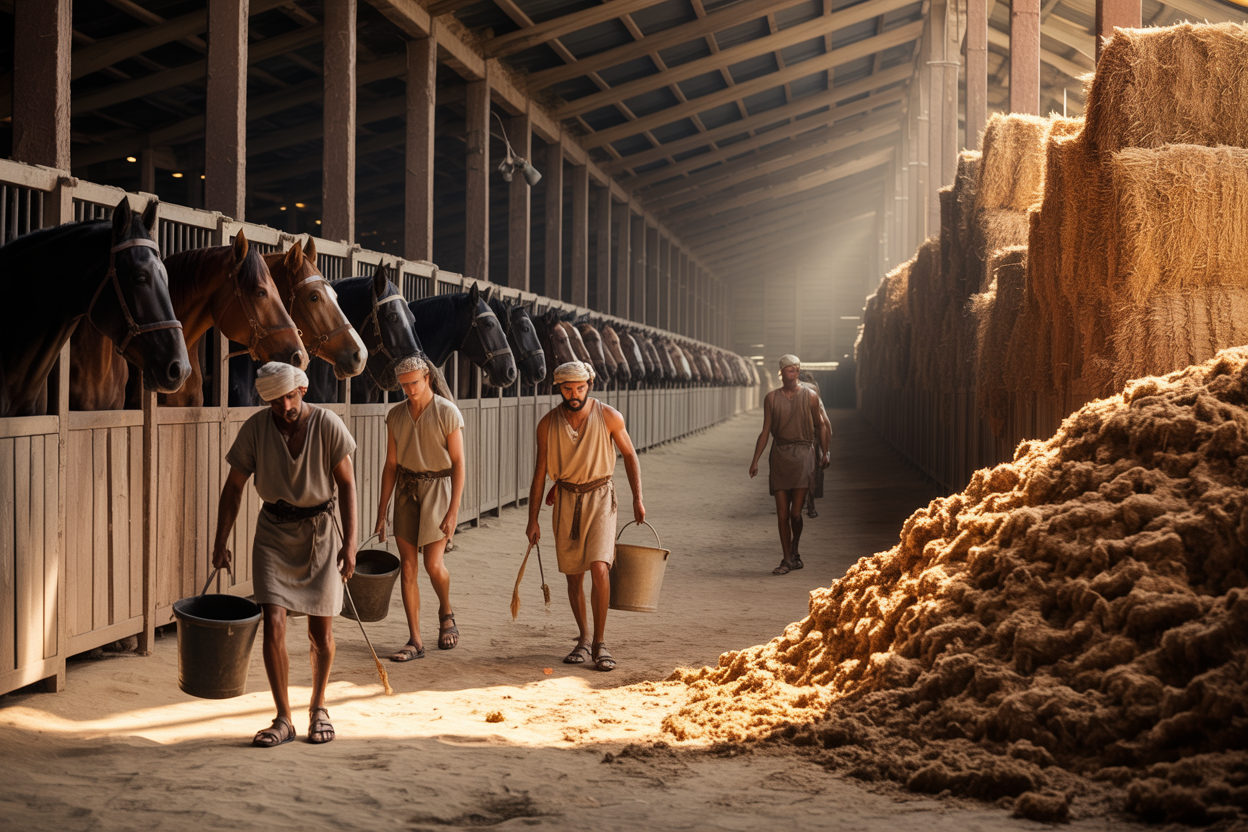
Now comes my favorite part. The Standard Unit of Animal Storage: the horse.
A horse gives us a convenient anchor. Roughly:
Horse stall ≈ 250 sq ft
Food and water storage ≈ 240 sq ft
Total ≈ 490 sq ft per horse
Which means the Ark can hold about:
78,000 / 490 ≈ 159 “horse units”
If we just use horse feed, that ~180 bales per horse (~7500 lbs), stacked 5 bales high, ~60 sq ft per horse. Then fresh water, ~15 gal per day, or 5,475 for 365 days, ~110 x 50 gal barrels, or ~180 sq ft stacked 2 high.
At this point, the argument either collapses or gets interesting. Fortunately for everyone involved, it gets interesting.
Instead of counting horses, we scale by weight. A horse weighs about 1,000 pounds. The “average” named animal, once you wipe away intuition and just let the math run, comes out to something like 4 pounds.
Yes, that feels wrong. Stay with me.
1 horse ≈ 1,000 lbs
Average animal ≈ 4 lbs
Scaling factor ≈ 250 animals per horse
Multiply that back through:
159 horse-units × 250 ≈ 39,750 animals
≈ 19,875 pairs
And now we have a number that refuses to behave. It doesn’t immediately explode. It doesn’t politely disprove anything. It just sits there, looking… plausible enough to keep going.
This is where I surprised myself.
Because at that point, my honest reaction wasn’t “see, impossible.” It was “well… now I kind of want to actually try it.”
Seriously. The Ark Encounter already exists. The proportions are right. The materials are modern enough to avoid immediate catastrophe. If the claim is that this is feasible, then let’s lean into it. Two of every “kind,” scaled however they like, plus food and water for a year, plus a crew of eight managing what is effectively the world’s least organized zoo.
I would absolutely visit that exhibit.
Of course, the moment you stop doing ratios and start doing reality, things get… lively.
Diet, for example, has been quietly behaving itself up to this point. Everything is eating generic “horse feed” in tidy rectangular bales, which is convenient if you don’t think too hard about lions, vultures, or animals whose dietary requirements would file formal complaints.
Water is even more entertaining. At about 15 gallons per animal per day, you get:
15 × 365 ≈ 5,475 gallons per animal annually
Stacked into barrels, you’re devoting massive chunks of space to something that animals will immediately turn into… less useful forms.
Which brings us to waste management. I was briefly tempted to model this. I even opened a spreadsheet. Then I closed it again, because there are calculations that add clarity, and there are calculations that completely foul up the conversation.
This is one of those.
Let’s just say the Ark is less a vessel at this point and more an emerging ecosystem with strong opinions about sanitation.
Then there’s the weight problem, which is doing the quiet heavy lifting. We’ve treated animals as points in space with proportional mass, but wood doesn’t negotiate with math that way. A 450‑foot wooden ship carrying tens of thousands of animals, plus food, plus water, plus dynamic load shifts from moving animals, is less a boat and more a philosophical question about tensile strength.
Ancient shipbuilders were good. They were not “floating multi-deck wildlife preserve through catastrophic flood conditions” good.
Of course, the Ark Encounter doesn’t have to float. And that’s the part that makes this whole exercise strangely fun. It removes the hardest variable while leaving the rest intact. You can test density, logistics, feeding cycles, and crowding behavior without worrying about hydrodynamics or structural failure turning the whole thing into an aquatic parable.
Which brings me back to the thing I didn’t expect to say at the start.
I think they should do it.
Not as proof. Not as disproof. But as a demonstration of what happens when a simplified model meets the full texture of reality. Load the animals. Run the year. See what breaks first. My money’s on something small, inconvenient, and completely ignored in the original calculation.
Because that’s how these things usually go.
The math gets you in the door. Reality rearranges the furniture.
References
- The Bible. Genesis 6–7.
Primary source for Ark dimensions, duration of the flood, and animal loading instructions. - Lost World Museum. Facebook post on Ark feasibility.
Prompt for turning theology into a warehouse logistics problem. - Anonymous (me, with coffee). Ark Animal Space Calculations. 2026.
Back‑of‑the‑envelope modeling using horse‑equivalent scaling, aggressively simplified assumptions, and mild regret. - Steinkraus, R. F. Ship Design and Construction. Society of Naval Architects and Marine Engineers, 1988.
Baseline reference for why very large wooden ships tend to have strong opinions about staying in one piece. - McGrail, Sean. Ancient Boats and Ships. Oxford University Press, 2004.
Context for Bronze Age shipbuilding limits and why 450‑foot floating zoos were not standard practice. - USDA. Livestock Feed Requirements. Various publications.
Source for approximate bale counts and why the animals would like to speak with management. - National Academies of Sciences. Nutrient Requirements of Domestic Animals.
Confirmation that “everything can eat horse feed” is a bold and deeply incorrect assumption. - Ark Encounter (Kentucky, USA).
Full‑scale modern reconstruction demonstrating that one key advantage of this version is that it does not have to float. - Unpublished Spreadsheet (mercifully abandoned).
Waste output estimates for thousands of animals over 365 days. Results omitted in the interest of public morale.

Leave a Reply