
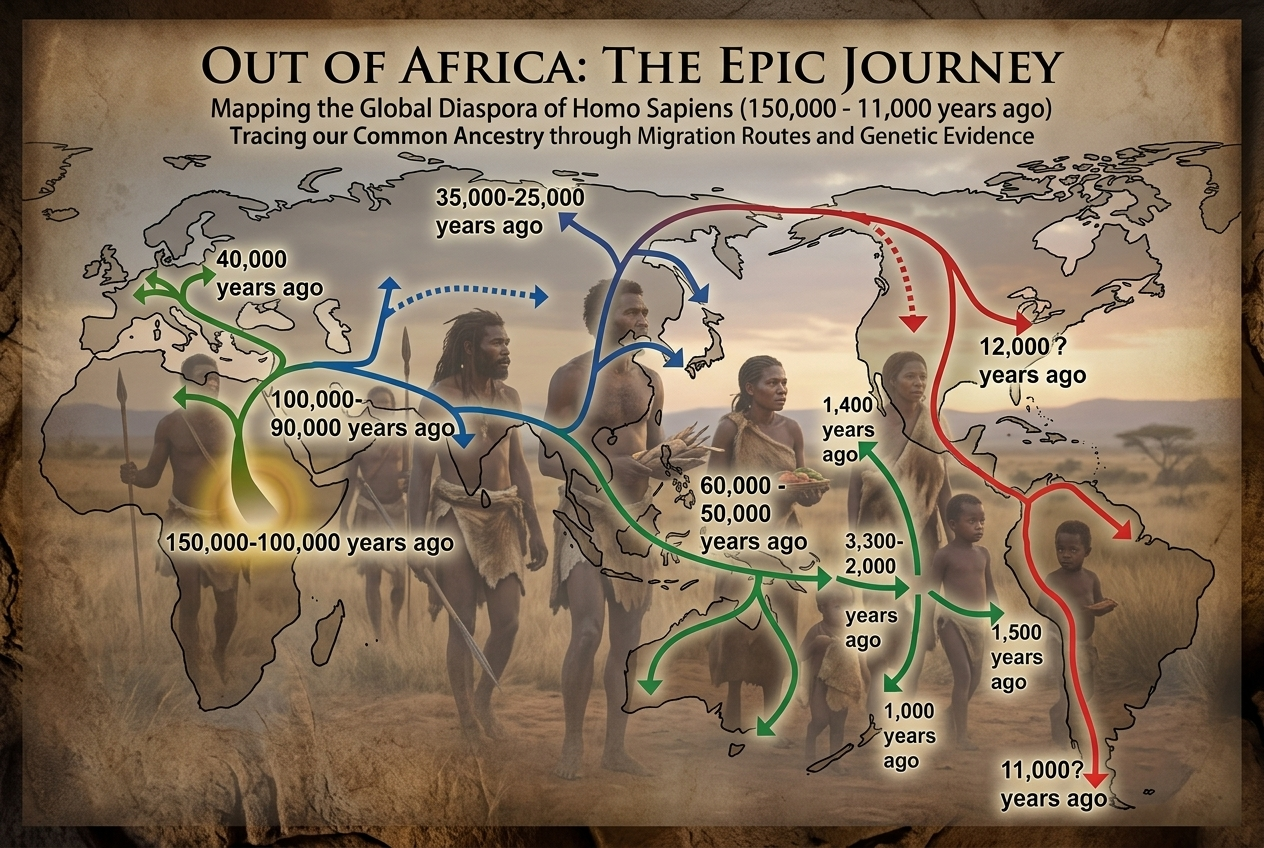
The thread that kicked this off had that familiar shape. A sharp claim, some intuition folded into evolution, and then the leap: “Homo sapiens… passed through a genetic bottleneck of fewer than 15,000 individuals.” From there it builds into something bigger. “In order to survive… some truly extraordinary adaptations developed.” You can feel the narrative forming as you read it.
It doesn’t stop at population genetics. It moves outward. “This is why individual work is so critical… not because any of this is inherently wrong… but because they are completely unsustainable in a closed system.” Then the pivot, the one I keep seeing in these conversations: “The thinking, planning, scarcity recursion mind is a tool we evolved to survive an apocalypse.” A clean arc. Crisis produces traits. Traits produce culture. Culture produces the mess we’re in.
I get the appeal. It reads like an origin story. Like we’re all carrying around some ancient survival algorithm that no longer fits the world we’ve built. And maybe there’s a sliver of truth buried in there. But the way it’s framed compresses a very long, very uneven evolutionary history into something cinematic. A single bottleneck. A single turning point. A single explanation.
That’s where I start to get uneasy. Because when the story gets that tidy, it usually means we’ve smoothed over the parts that actually matter.
And that’s exactly what’s happening here.
I’ve seen that “15,000 humans” idea more times than I can count, and every time I hear it, I have the same reaction. It sounds clean. Too clean. Evolution almost never hands you clean numbers. When it does, you should get suspicious.
The claim usually goes like this. Humanity nearly went extinct. We dropped to a tiny population, learned to survive, and everything we are now comes from that narrow escape. It’s a compelling story. It feels like a myth you could tell around a fire. The problem is that it’s not what the data actually say.
What people are pulling from is effective population size, not census population. These are not the same thing. Effective population size is a modeling construct. It tells you how genetic diversity behaves, not how many bodies were on the landscape (Charlesworth, Effective Population Size, 2009). When geneticists say humans have an effective population size around 10,000 to 20,000 over long periods, they are not saying there were only that many humans alive. They are saying the genetic signal looks as if that many individuals were consistently contributing to future generations.
That difference matters more than most people realize. It dissolves the entire “almost wiped out” narrative.
The real story is messier, and I think more interesting. Human populations have always been structured and regional, not singular and unified. Groups spread, split, recombined, adapted locally, and occasionally merged back together. Climate shifts affected different regions differently. Some populations contracted. Others expanded. There was no single moment where all of humanity was squeezed through one narrow funnel.
The event people gesture toward most often is the Out of Africa dispersal around 60,000 to 70,000 years ago. This did involve a bottleneck, but not in the dramatic sense being claimed. A subset of humans left Africa, carrying with them only a fraction of the genetic diversity present in the larger African population. That’s a founder effect, not a near-extinction (Henn et al., Genetic History of Africans and African Americans, 2012). Meanwhile, populations within Africa remained large and genetically diverse.
So when someone says “humanity passed through 15,000 individuals,” what they are often describing is a model artifact combined with a migration event, filtered through a desire for narrative simplicity. It becomes a story of survival against apocalypse instead of what it actually is, which is population structure over time.
You can see this pattern clearly if you follow the recent literature around regional dispersals. Take the post–Last Glacial Maximum expansion into Europe, often tied to populations moving out of refugia around the Black Sea and southern Europe. Genetic studies show shifts in ancestry components, population replacement, and admixture over time, but those shifts get retold as bottlenecks or “resets” when in reality they are waves of migration layered on top of existing populations (Brace et al., Population Replacement in Early European Farmers, 2019). No collapse. Just turnover.
The same thing happens with the settlement of Sahul, when humans moved into what is now Australia and New Guinea roughly 50,000 years ago. Yes, there was a founder effect. A relatively small population crossed into a new ecological zone and expanded. But genetic evidence shows that once established, these populations diversified locally and remained structured for tens of thousands of years (Malaspinas et al., Genomic History of Aboriginal Australia, 2016). What gets flattened into “a small founding group” is actually a branching pattern.
East Asia tells a similar story. Population histories in China show repeated cycles of expansion, contraction, and mixture tied to climate, agriculture, and migration. Genetic data reveal complex substructure and long-term continuity alongside periodic influxes of new lineages (Yang et al., Ancient DNA in East Asia, 2020). Again, the pattern is not a choke point but a shifting network.
And then there’s the peopling of the Americas, which gets turned into a bottleneck narrative almost by default. Yes, there was a strong founder effect associated with a Beringian population that persisted in isolation before moving south. But even here, the “Beringian standstill” represents a regionally isolated population, not the entirety of humanity reduced to a handful of individuals (Moreno-Mayar et al., Beringian Standstill and Native American Origins, 2018). Once movement begins, you see rapid diversification and adaptation across the continent.
What ties all of these together is not collapse but filtering. Populations move, some genes pass through, others don’t. Diversity shifts. But at no point does the species as a whole get compressed into the kind of narrow bottleneck the popular narrative implies. What we keep calling bottlenecks are often just snapshots of movement seen through a genetic lens that exaggerates simplicity.
And once you see that, the pattern becomes hard to unsee.
And this isn’t unique to humans. Bottlenecks are common across species, but they rarely look like the stories we tell about them. Cheetahs, for example, show extremely low genetic diversity, likely due to past bottlenecks, yet they were never reduced to a single handful of animals in a dramatic scene of survival (O’Brien et al., Genetic Basis for Species Vulnerability, 1985). Northern elephant seals dropped to very low numbers due to human hunting, then rebounded. Wolves in isolated regions show founder effects. Each case is different, and none of them follow the clean arc we retroactively impose.
The reason the human bottleneck story sticks is not scientific. It’s psychological and, frankly, ideological.
There is a long habit of using simplified genetic narratives to make larger claims about human nature. Sometimes it leans into fatalism. “We evolved in scarcity, so hoarding and dominance are natural.” Sometimes it drifts into regionalism or worse, attempts to ground modern inequality in deep history. I’ve seen it weaponized in discussions that quietly slide from population genetics into arguments about capability, hierarchy, or destiny. That move is never explicit, but the direction is clear.
Then there’s the theological pull. A narrow bottleneck starts to look suspiciously like a creation story. A small founding group. A reset. A shared origin. People want that symmetry. It’s familiar. It feels meaningful. But it is imposed after the fact, not derived from the data.
From an anthropological perspective, what we actually see is not a species shaped by a single crisis, but a species that is continuously adapting across fragmented environments. Our behaviors, including the ones being called out in that thread, are not relics of one extreme moment. They are products of long-term social living, competition, cooperation, and symbolic cognition.
Which brings me back to the part of the thread that I found interesting. The idea that we over-model the world. That we turn everything into symbols, predictions, abstractions, sometimes to our own detriment. There’s something there. But tying that directly to a supposed bottleneck misses the scale of the process.
Humans didn’t learn to think that way in a single event. We built that capacity gradually, across hundreds of thousands of years, in shifting social groups that demanded it. Language, planning, deception, cooperation. These are not emergency adaptations. They are accumulations.
So I’d ask a different question. When you hear these bottleneck stories, what are they doing for you? Not what do they explain, but what do they simplify? What narratives are they allowing you to tell about human behavior, about inequality, about inevitability?
And maybe more importantly, where did you first hear it? Was it a paper, or a post? A dataset, or a story dressed like one?
Because once you start looking for the seams, you see them everywhere.
References
- Brace, S., et al. Population Replacement in Early European Farmers. 2019.
- Charlesworth, B. “Effective Population Size and Patterns of Genetic Diversity.” 2009.
- Henn, B. M., et al. “The Genetic History of Africans and African Americans.” 2012.
- Malaspinas, A.-S., et al. A Genomic History of Aboriginal Australia. 2016.
- Moreno-Mayar, J. V., et al. Terminal Pleistocene Alaskan Genome Reveals First Founding Population of Native Americans (Beringian Standstill). 2018.
- O’Brien, S. J., et al. “Genetic Basis for Species Vulnerability in the Cheetah.” 1985.
- Yang, M. A., et al. Ancient DNA Reveals Human Population Shifts and Admixture in East Asia. 2020.

Leave a Reply