
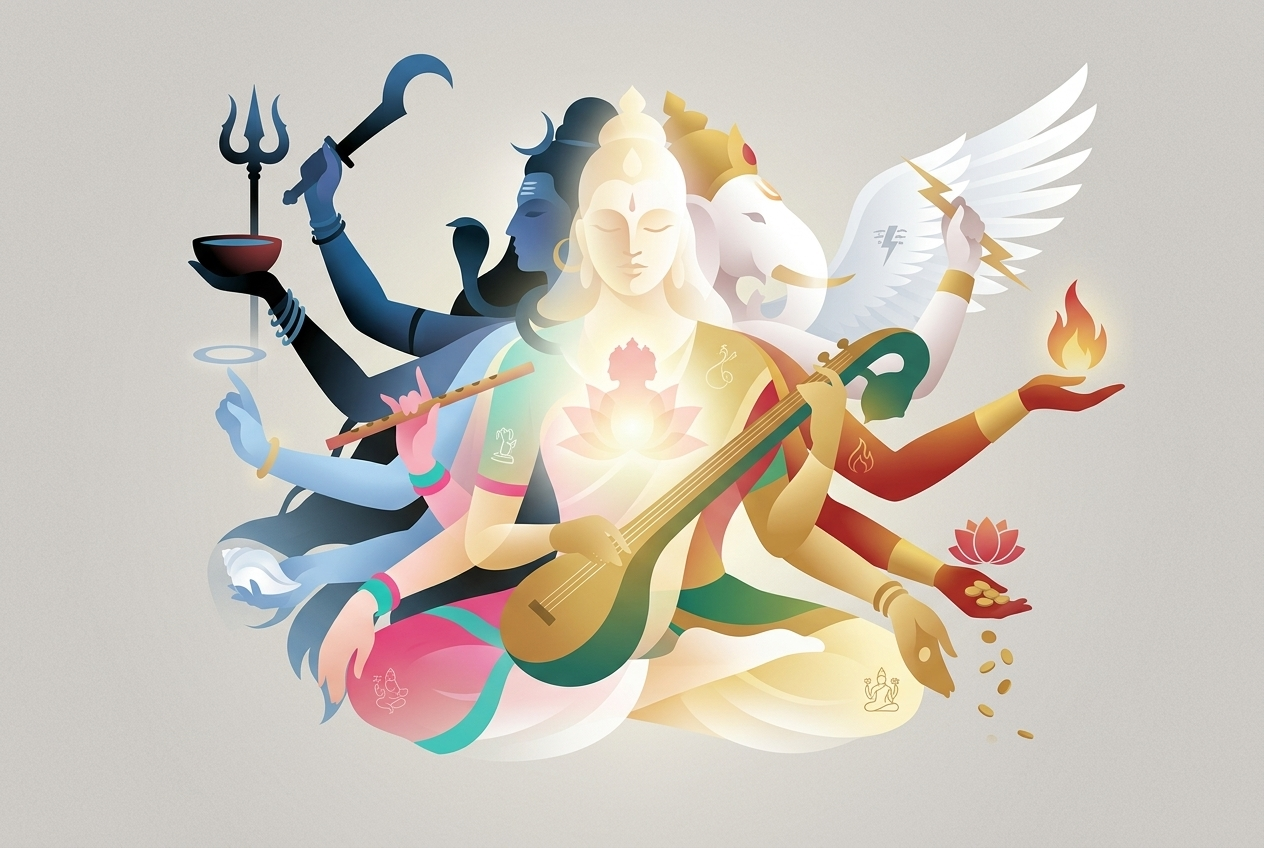
Is Hinduism Monotheistic, or Is That the Wrong Question?
I remember the first time I noticed the tension clearly. Not in a temple, not in a theology text, but in a comparative religion class that was trying a little too hard to be neutral. The instructor said something like, “Hinduism believes in many gods, but also one.” And then moved on, as if that settled anything. I sat there thinking, which is it? And more importantly, why does it keep getting explained as both without anyone slowing down long enough to admit the contradiction might be structural rather than accidental.
The first time I encountered Hinduism in any structured way was in a comparative religion class that tried to smooth everything out before it ever had a chance to be difficult. Diagrams, clean categories, a few memorized phrases about “many gods, one reality,” and then we moved on. I remember thinking it sounded plausible in the way tidy explanations usually do. No rough edges. No disagreement. Just a conceptual shortcut handed out as understanding.
That held until it didn’t. Later, with more reading, more time, and less patience for clean summaries, the picture started to fracture. Different schools saying incompatible things with equal confidence. Texts that didn’t align as neatly as the classroom implied. I could feel something off, but I couldn’t quite locate it. It wasn’t just that the categories were inadequate. It was that they were doing too much work too quietly.
The shift came in pieces, mostly outside of anything formal. A few trips to India that weren’t organized around study so much as proximity. Long conversations with friends who didn’t agree with each other about what their own tradition meant. One person explaining Brahman as something close to an absolute unity, another pushing back and insisting on a personal God who actually acts. A temple visit one day, a philosophical argument over tea the next (gosh fresh Indian tea spoils you), and none of it quite resolving into the “one behind the many” framework I had been handed earlier.
At a certain point I stopped asking which version was correct and started asking why I assumed there had to be one. That assumption felt imported. It wasn’t coming from the material itself. It was something I brought with me, a preference for coherence dressed up as analysis. Once that cracked, the question shifted. Not what Hinduism “is,” but what kind of system produces this range of claims without collapsing under them.
The argument that Hinduism is monotheistic, or at least not pantheistic, begins with a historical move. Early Vedic religion looks much closer to what anthropologists would call polymorphic animism fused with ritual hierarchy, a landscape of deities tied to forces, places, and functions. Indra storms, Agni burns, Varuna governs cosmic order. These are not masks of a unified reality at the outset. They are differentiated powers in a ritual economy (Flood, An Introduction to Hinduism, 1996).
But systems evolve under pressure. Internal reflection. External comparison. The Upanishadic turn compresses plurality into abstraction. Brahman emerges as the underlying ground, not one god among others but the condition that makes gods possible. A sentence appears, repeated endlessly since, “truth is one, the wise call it by many names” (Rig Veda, cited in Radhakrishnan, The Principal Upanishads, 1953). That line does a lot of work. It doesn’t erase the gods. It reinterprets them.
Anthropologically, this looks familiar. Localized spirit systems, once stable, begin to centralize as political and philosophical pressures grow. Empire does this. Trade does this. Contact with Islam does this. You see similar compression in late Egyptian theology, in Neoplatonism, even in strands of Christianity as it absorbs Greek metaphysics. Many become one. Or at least one becomes the official explanation for many.
But the story doesn’t end there. It splinters. Advaita Vedanta leans into nondualism, collapsing distinctions until Brahman is the only real thing, the world rendered provisional, almost a perceptual artifact (Shankara, Brahma Sutra Bhashya). Vishishtadvaita resists, holding the world inside God but not identical to God. Dvaita splits decisively, insisting on real difference between God and creation. So what is Hinduism here. Monotheism. Panentheism. Qualified dualism. All of them. None of them. A taxonomy problem masquerading as a doctrinal one.
I find it useful to compare this directly to classical monotheism. Judaism, Christianity, and Islam do not tolerate this level of ontological fluidity. God is singular, personal, and ontologically distinct from creation. Even when mystical traditions blur that line, they are usually corrected or marginalized. There is one God. Not one expressed as many. Not one appearing as many. One, and not the world.
You can see the contrast sharpen if you follow how classical monotheisms change under pressure. Early Israelite religion, before it stabilizes, still carries traces of plurality. Yahweh is elevated, but not initially alone in any strict metaphysical sense. Over time, especially during and after the Babylonian exile, the system tightens. Competing deities are not reinterpreted as expressions of one reality. They are denied, demoted, or erased. One God becomes not just central but exclusive, and that exclusivity becomes part of the identity of the system itself (Smith, The Early History of God, 2002). Christianity inherits that structure and then complicates it internally through the Trinity. One God, three persons, a formulation that preserves unity while absorbing multiplicity, though it does so by defining strict boundaries around what counts as legitimate interpretation. Islam reacts by simplifying again. Absolute unity, no internal division, no participation by creation. The pattern is not static belief. It is repeated compression and re‑articulation under theological constraint.
That movement has more in common with Hindu developments than it first appears. In both cases, plurality exists early. In both cases, pressures build toward unity. The divergence is in how the systems handle what refuses to collapse. Hindu traditions tend to absorb plurality into layered interpretations, allowing contradiction to persist under a wider metaphysical umbrella. Classical monotheisms tend to resolve contradiction by exclusion, defining orthodoxy through what cannot be said as much as what can. That instinct produces dogma. Not necessarily as distortion, but as a mechanism. A way to stabilize meaning across time. You see councils, creeds, doctrinal boundaries forming as responses to competing interpretations. The same basic human problem. Too many meanings, too much variation, and a need to decide which ones count.
Once you recognize that, the categories start to feel less like descriptions of reality and more like strategies for managing it. Monotheism, pantheism, panentheism. None of them appear fully formed. They emerge, shift, harden, loosen again. What looks like doctrine from a distance often reads, up close, like a series of decisions about how much difference a system is willing to tolerate before it starts calling that difference error.
Spinoza offers something else entirely. God is identical with nature. No separation. No transcendence. This is pantheism in its cleanest philosophical form (Spinoza, Ethics, 1677). Compared to that, most Hindu systems do not collapse God fully into the world. They maintain an asymmetry. The world participates in Brahman but does not exhaust it. That makes them closer to panentheism, though even that label feels like a rough translation.
There are voices within the tradition that push back against this compression, and they sound closer to Spinoza than most people expect. Early Buddhist critiques, emerging in the same intellectual climate, rejected the entire move toward a permanent underlying reality. No Brahman, no stable self, no metaphysical anchor beneath appearance. What you have instead is conditioned arising. Processes all the way down. That critique doesn’t deny experience. It denies the need to unify it under a single explanatory substrate (Rahula, What the Buddha Taught, 1959). Later Hindu thinkers respond by refining Brahman into something less vulnerable to that critique, shifting toward more abstract formulations that cannot be easily disproven because they no longer make concrete claims.
Even within Hindu philosophy, dissent isn’t hard to find. The Carvaka school drops the entire metaphysical project. No unseen reality, no afterlife, no hidden ground behind experience. Perception is enough. Anything beyond it is speculation dressed as knowledge (Chattopadhyaya, Lokayata, 1959). That position rarely survives institutionally, but it lingers as a counterpoint. A reminder that the move from multiplicity to unity is not inevitable. It’s chosen. And once you notice that, Brahman starts to look less like discovery and more like resolution. A way to quiet the system, to collapse difference into something stable enough to live with.
From an atheist frame, the pattern looks less like revelation and more like compression under conceptual strain. Humans encounter multiplicity. They build systems to manage it. At some point, the multiplicity becomes unwieldy. A unifying principle is introduced. Not because the universe demands it, but because cognition does. One reduces complexity. One stabilizes explanation. One becomes necessary.
There are strengths here. The ability to hold multiple representations without collapsing them prematurely. The willingness to treat ultimate reality as something that exceeds categorical language. These are philosophically durable moves. They resist the brittle certainty of strict monotheism, where contradiction must be eliminated rather than absorbed.
But there are flaws, and they are not subtle. The claim that all gods are expressions of one reality often functions as a retroactive unification, not an original insight. It explains away contradiction instead of accounting for it. It turns plurality into symbolism without demonstrating that transformation. If every difference can be reinterpreted as unity, what would count as genuine difference?
Scientifically, none of this holds. There is no empirical evidence for Brahman, no measurable substrate behind consciousness or matter that behaves as described. The claims operate entirely within metaphysical assertion. That is not unusual. It is what metaphysics does. But when metaphysical language substitutes for explanation, it risks becoming indistinguishable from absence.
And yet it persists. That should mean something. Not as proof, but as data. People return to these frameworks because they offer a way to think about reality that resists fragmentation. One and many, held together. Not resolved, not eliminated.
So what do you call that. Monotheism. Pantheism. Something else entirely.
Or maybe the better question is simpler. If the categories keep failing, why are we so committed to them?
References
Chattopadhyaya, Debiprasad. Lokayata: A Study in Ancient Indian Materialism. 1959.
Flood, Gavin. An Introduction to Hinduism. 1996.
Rahula, Walpola. What the Buddha Taught. 1959.
Radhakrishnan, Sarvepalli. The Principal Upanishads. 1953.
Shankara. Brahma Sutra Bhashya.
Smith, Mark S. The Early History of God: Yahweh and the Other Deities in Ancient Israel. 2002.
Spinoza, Baruch. Ethics. 1677.

Leave a Reply