
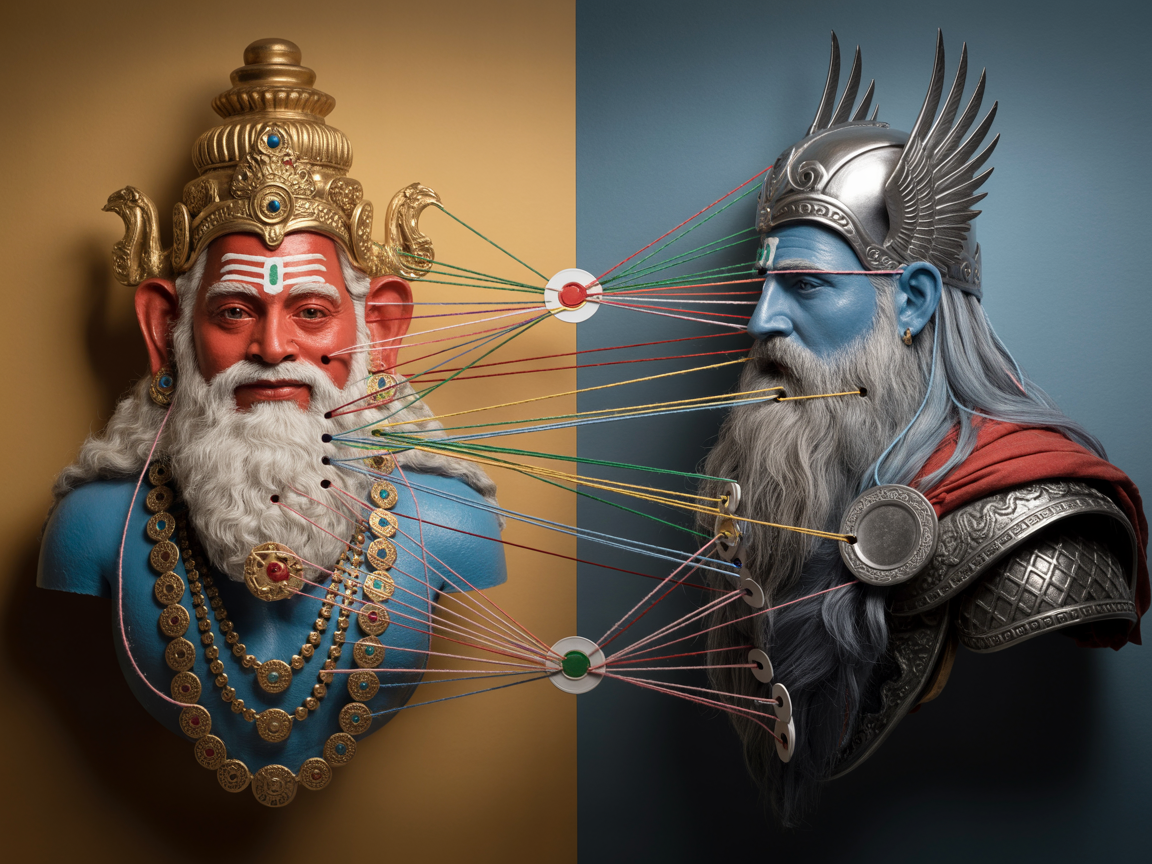
On False Syncretism and Narrative Absorption
I started this whole line of thought from a Threads exchange that went sideways in about three sentences.
Someone confidently asserted that Yahweh is Geb in Egypt, Anu in Mesopotamia, Brahma in Hindu tradition. I pushed back. Not politely, probably. Another person chimed in, frustrated, and I followed with the obvious example. Zeus, Odin, Ra. Same “slot,” different systems. Then the line that kept sticking with me. Real syncretism requires historical borrowing. Without that, it’s just mapping.
And I kept thinking. Why is this so common? Why does it keep happening in Christian and Muslim discourse in particular?
Syncretism, properly understood, is not just similarity. It is historical contact producing fusion, reinterpretation, or identification between traditions. Romans equating Zeus with Jupiter is syncretism because there is a traceable path of borrowing, translation, and institutional adoption (Beard, Religions of Rome, 1998). Greco‑Egyptian Serapis is syncretism because political and cultural forces deliberately fused religious identities (Frankfurter, Religion in Roman Egypt, 1998).
That’s the bar.
Everything else is projection.
False syncretism starts earlier than most people realize. I remember being in 5th grade, sitting in a dim classroom while a teacher tried to make world religions “relatable.” Zeus was “like God but Greek.” Thor was “like God but Norse.” Even then something felt off. But what made it sharper for me, and honestly a little disorienting, was that I had already read more than the framework being presented to us. I’d been working through Robert Graves’ The Greek Myths, those dense, sometimes contradictory retellings that refused to simplify anything, and the Sullivan Programmed Readers from McGraw‑Hill, where mythology wasn’t flattened but unfolded in layers. I had even cracked open Bulfinch’s Mythology early, not fully grasping all of it, but recognizing that these stories were not interchangeable parts.
So when the teacher reduced Zeus to “basically the same as God,” I didn’t just feel that something was missing. I felt a mismatch. Zeus wasn’t a singular, morally absolute creator. He was inconsistent, political, embedded in a divine family that behaved more like a dynastic court than a unified metaphysical principle. Thor wasn’t a creator in any sense that matched a monotheistic framework. He was a protector, a force within a system that already assumed multiple centers of power. These weren’t trivial differences. They were the structure.
And I remember sitting there, maybe eleven, thinking not in formal terms but in instinct. Why are we compressing this. Why are we pretending these are the same thing so they’re easier to digest. It felt like watching someone take a map with distinct continents and redraw it into a single landmass because it was simpler to explain. Technically smoother, cognitively easier, but obviously wrong.
There was a kind of quiet frustration to it. Not confrontational, not even fully conscious yet, but present. Because I wasn’t learning something new about these traditions. I was watching them get diluted in real time. All the specificity, all the internal logic, shaved down into a vague equivalence that didn’t survive even basic comparison. Zeus doesn’t function like a monotheistic deity. Thor doesn’t occupy anything like the same ontological position. These were not variations on a theme. They were entirely different compositions.
And what stayed with me, looking back, is how early the habit forms. That impulse to make things line up even when they don’t. To collapse difference into familiarity instead of sitting with the tension. I had already seen enough to know it didn’t hold, even if I didn’t have the language for why. It wasn’t about defending one system or another. It was about recognizing that each system had its own internal gravity, and flattening them wasn’t understanding. It was avoidance.
The habit sticks.
By high school and then college, it mutates into something more deliberate, almost strategic. What was once a classroom simplification hardens into a claim about reality itself. I started seeing it in apologetics, not as a teaching shortcut but as a framework for absorbing everything into itself. Christian writers would argue that pagan traditions were distorted survivals of an original monotheism, fragments of Genesis refracted through time and culture. Islamic authors would take a different route and argue that earlier revelations had been progressively corrupted, leaving partial truths scattered across traditions. Different theological engines, same destination. Everything gets pulled inward.
And by then, I had enough background to see the scaffolding.
I had been working through Greek classics, not just myth summaries but actual texts. Hesiod, Homer, fragments of the tragedians. There’s a density to those systems that resists casual translation. The gods are not abstract principles waiting to be identified with something else. They are embedded in a cosmos with its own logic, its own tensions, its own contradictions that are not bugs but features. Zeus is not a degraded version of a monotheistic God. He is the center of a polytheistic structure that assumes multiplicity at the root. You can’t strip that away and still claim you’re describing the same thing.
Then I shifted into biological anthropology, and that changed how I looked at it again. Now I wasn’t just reading texts. I was looking at patterns across cultures, how ideas emerge under similar environmental and psychological pressures. Flood stories, sky deities, fertility cycles, sacrificial systems. These recur because humans share constraints. Bodies, ecosystems, mortality, social hierarchy. Not because they all derive from a single, historically traceable revelation. Convergence doesn’t imply transmission. That distinction settled in pretty quickly.
So when I came back to comparative religion from that angle, the apologetic move started to look less like explanation and more like appropriation with a theoretical gloss. If you assume in advance that one framework is the original and authoritative one, then everything else becomes derivative by definition. Any similarity gets claimed as evidence of shared origin. Any difference gets explained as corruption. It’s a closed loop. Nothing escapes because the system is designed so nothing can.
That’s not syncretism. That’s narrative absorption.
And it has a certain feel to it once you recognize it. It doesn’t examine other systems on their own terms. It doesn’t ask how they function internally or historically. It asks how they can be reinterpreted to fit a prior conclusion. The comparison is never symmetrical. One side is stable and authoritative. The other is provisional, distorted, waiting to be corrected.
I remember sitting in a seminar where someone confidently mapped Greek myth onto biblical narrative, point by point, as if the parallels were decisive. I asked, maybe too bluntly, whether similarity under shared human conditions might explain the overlap without requiring a single origin. The room paused, not because the idea was new, but because it broke the expected direction of the argument. It shifted the question from “how do these fit together” to “why do we assume they must.”
And that’s where the difference shows itself.
Syncretism, done properly, traces contact, influence, adaptation. It follows the path of ideas moving across languages, trade routes, political systems. It leaves evidence. Narrative absorption skips that step. It replaces history with inference, then treats the inference as explanatory.
Once you’ve seen both side by side, it’s hard to mistake one for the other.
And I get the impulse. If you believe your framework is universal, you are going to look for echoes. But echoes are cheap. They show up everywhere. Human cultures reuse motifs because human cognition is not infinitely creative. It is patterned. We recur to sky gods, creator figures, flood myths, cycles of destruction and renewal because we are dealing with the same environment and the same existential pressures (Boyer, Religion Explained, 2001).
The problem is what happens next.
False syncretism takes that shared human patterning and turns it into identity claims. Not “these traditions share structural similarities,” but “these are actually the same deity under different names.” That leap is rarely argued. It’s asserted. It feels intuitive, so it passes.
Why? Psychology does a lot of the work. There’s a deep cognitive bias toward category compression. We prefer simpler maps. One God, many names. Clean. Elegant. But elegant is not the same thing as accurate. Anthropological complexity resists that kind of compression, and forcing it creates distortion (Asad, Genealogies of Religion, 1993).
Then there’s motivation. Sometimes it’s lazy mapping. You see two creator figures and stop there. Sometimes it’s apologetic. You want continuity, validation, legitimacy. Sometimes it’s appropriation. You take another culture’s symbols and fold them into your own system, not because history supports it, but because it strengthens your narrative position.
I’ve seen this most aggressively in certain corners of online Christian apologetics and also in some Islamic popular discourse, where the claim becomes totalizing. All gods are either corrupted memories of the “true God” or misinterpretations of an earlier revelation. It’s a neat story. It’s also historically unsupportable in most cases.
Take Yahweh and Brahma. Different metaphysics entirely. One is part of a cyclical, polycentric system where creation, preservation, and destruction are distributed functions. The other develops within a monotheistic tradition that resists that distribution. No historical chain links them. No shared doctrinal evolution connects them. You don’t get to call that syncretism just because both are “creator figures.”
That’s not comparison. That’s substitution.
The philosophical issue underneath this is whether similarity implies identity. It doesn’t. Systems are defined not just by their roles, but by their internal logic, their relationships, their constraints. Remove those, and you are no longer describing the system. You are sketching a silhouette.
And silhouettes are easy to match.
What bothers me most, and I’m probably a little too blunt about this, is how this process erases difference. It’s not just sloppy reasoning. It’s a quiet kind of intellectual colonization. Everything gets pulled into one framework whether it fits or not. That’s not respect for other traditions. It’s overwrite.
I saw a better approach in college. A professor who refused to let us merge things prematurely. When we studied Greco‑Roman religion, we traced how gods were identified across cultures, but only when there was evidence. Trade routes. Political conquest. Textual alignment. That’s how syncretism works. It leaves a record. It has a mechanism.
I watched that process unfold most clearly in how the Romans handled Zeus and Jupiter. They did not simply notice that both were “sky gods” and declare them identical. The identification came through sustained contact with Greek culture during the early centuries of Roman expansion into Magna Graecia and later the Hellenistic world. Greek colonies in southern Italy brought language, ritual forms, and mythic frameworks into direct contact with Roman religious practice. Over time, Roman writers began to explicitly equate Zeus with Jupiter, not as a guess, but as a translation. You see it in Latin literature where Zeus simply becomes “Jupiter” when Greek texts are rendered into Roman terms. Cicero does this. So do later historians and poets. The mapping is textual, repeated, and conscious. It’s not inferred from similarity. It is asserted within a bilingual, bicultural environment that required equivalence to function.
And it didn’t stop at language. There is archaeological continuity that tracks alongside it. The Temple of Jupiter Optimus Maximus on the Capitoline Hill becomes the focal point of Roman state religion, mirroring Zeus’s centrality in Greek civic cults, but developing its own distinctly Roman character tied to law, authority, and empire. Inscriptions, votive offerings, and ritual practices show adaptation, not duplication. Greek iconography influences Roman depictions of Jupiter, but you can trace how those forms were reworked over time. The Romans were not flattening Zeus into Jupiter. They were absorbing, reinterpreting, and institutionalizing that identification through governance, literature, and public religion. There is a chain there. Trade, conquest, education, translation, architecture. Each step leaves evidence.
That’s what I mean by mechanism. You can follow it. You can point to where the ideas meet, where they shift, where they stabilize into something new. It doesn’t rely on surface resemblance to make the case. It relies on continuity that can be documented. That’s why it holds.
That discipline matters.
Because there is such a thing as good syncretism. Thoughtful, documented, accountable. It happens when traditions actually meet, exchange, transform. Early Christianity interacting with Hellenistic philosophy. Islamic scholarship absorbing and reworking Greek thought. Those are not accidents. They are historical processes with observable pathways (Gutas, Greek Thought, Arabic Culture, 1998).
That’s what people mean when they use the word correctly.
So when someone says Yahweh is Geb or Anu or Brahma, I don’t hear insight. I hear the absence of mechanism. No transmission, no development, no continuity. Just resemblance pressed into identity.
Which raises the question I actually care about.
When you see two traditions that look similar, what do you do with that resemblance? Do you assume unity, or do you ask how that resemblance arose. Cognitive patterns, environmental pressures, cultural exchange, independent development. Which path explains it.
I’ve learned, maybe the long way around, to distrust the answer that arrives too fast.
If syncretism is going to mean anything, it has to be anchored in history, not in convenience. Otherwise it’s just a rhetorical tool. A way to claim without showing.
So I’m curious where others land on this. Where have you actually seen syncretism done well, with evidence, with care. And where do you see it abused, flattened, weaponized, turned into an all‑purpose explanation.
Because at some point the question isn’t whether traditions overlap.
It’s whether we’re willing to let them stay different.
References
Beard, Mary. Religions of Rome. 1998.
Frankfurter, David. Religion in Roman Egypt. 1998.
Boyer, Pascal. Religion Explained. 2001.
Asad, Talal. Genealogies of Religion. 1993.
Gutas, Dimitri. Greek Thought, Arabic Culture. 1998.

Leave a Reply