
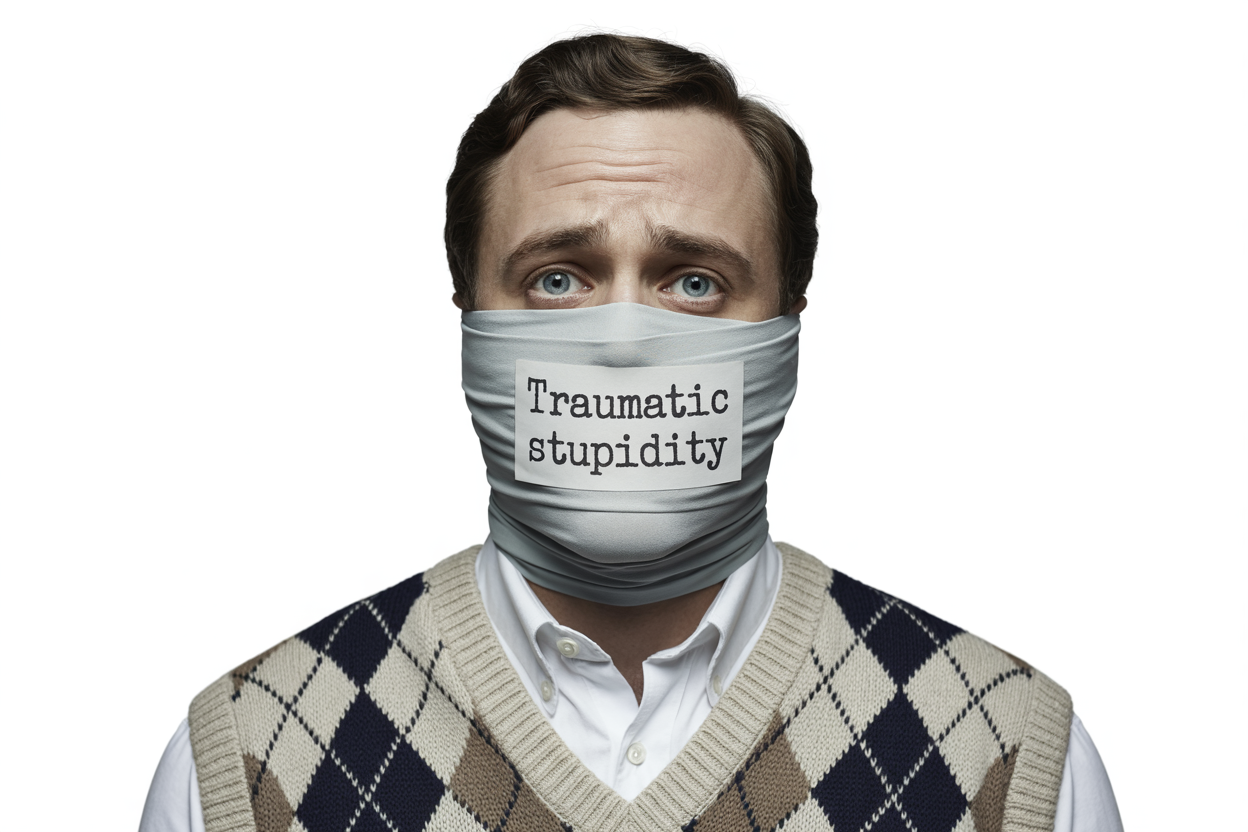
Medical textbooks are very calm about traumatic bleeding. They do not scold the chainsaw. They do not ask why the foot was there. They say things like uncontrolled hemorrhage leads to rapid loss of function and possibly death, apply pressure immediately, stop the bleeding before you worry about dignity. I have always admired that tone. Direct. Prioritized. Ruthlessly practical. Which is why I’ve come to think traumatic stupidity deserves the same treatment.
Traumatic stupidity is not chronic stupidity. Chronic stupidity is a lifestyle. Traumatic stupidity is acute. It happens fast. One moment someone is fine, the next they have placed their entire foot directly into their mouth at highway speed. A meeting. A microphone. A comment that should never have left the brain. You can almost hear the arterial spray of consequences hitting the walls.
It happened at a work gathering that was supposed to be harmless. Folding chairs, bad coffee, the soft hum of people pretending to listen while waiting for their turn to speak. Evan had been quiet most of the meeting, scrolling articles earlier, skimming headlines, collecting just enough fragments to feel fluent. Gases, pressure, ignition points. Nothing too complex. He had a container, a seal, and a mental model of how systems behaved when you nudged them. He wanted to see it. Controlled, he thought.
When the moment came, he leaned forward, confident in the way people get when they mistake familiarity for understanding. He started explaining. Not loudly. Calmly. Authority without credentials. He framed it as a clarification, which is often how traumatic stupidity announces itself. The room shifted. Heads tilted. A few people stopped typing. Someone across the table inhaled sharply, the way you do when you see a chainsaw swing a little too close to a leg.
The mistake wasn’t speaking. The mistake was assuming the system would stay within the boundaries he imagined. Social pressure doesn’t negotiate. It accumulates, then resolves instantly. One sentence crossed a line. Another doubled down. The assertion detonated. Not figuratively. Practically. You could feel it. Reputations recoil the way bodies do when something goes very wrong very fast.
No one applied pressure.
That was the fatal pause. Everyone froze, waiting for someone else to intervene. Evan kept talking, filling the silence he had created with more explanation, more certainty, more exposure. This is the bleed. Rapid. Uncontrolled. Each word carrying more consequence than the last. Someone could have stepped in. A cough. A redirect. A firm “let’s pause there.” That was the tourniquet. Silence. Immediate and external. But no one wanted to be rude. So the bleeding continued.
Afterward, the damage assessment was grim. Apologies followed, but those are dressings, not interventions. The outcome wasn’t catastrophic, but it was permanent in small ways. Trust lost. Credibility reduced. A cautionary tale quietly archived by everyone who witnessed it.
Traumatic stupidity isn’t about being unintelligent. Evan wasn’t. It’s about timing, confidence, and failure to stop the flow when the situation demands it. The lesson wasn’t “don’t speak.” It was “know when to shut it down.” The tourniquet would have hurt for a moment. It would have saved a lot more in the long run.
Historically, humans have always tried to treat stupidity after the fact. Apologies. Backpedaling. Elaborate rationalizations that function like applying a bandage to a severed limb. Medieval courts called it heresy. Modern workplaces call it “an email clarification.” Same problem. Wrong tool. By the time you’re explaining, the bleeding has already happened (Gawande, The Checklist Manifesto, 2009).
Emergency medicine learned something important in the last few decades, and it learned it the hard way. You don’t wait. You don’t debate. You don’t workshop feelings while the floor gets slippery. You apply a tourniquet. Firm. Immediate. Unapologetic. Traumatic stupidity works the same way, and the tourniquet has a recognizable shape once you’ve seen it used correctly.
In the field, the traumatic stupidity tourniquet is rarely subtle. Sometimes it looks like a hand gently but decisively placed over a mouth, the social equivalent of direct pressure. Sometimes it’s a cone of silence, an old Cold War fantasy device I remain convinced we should bring back for meetings. In extreme cases, it’s the removal of the microphone, the laptop lid snapped shut, the Slack permissions quietly revoked for twenty minutes. I’ve seen people fantasize about gags or stun guns, but those are for cartoons and lawsuits. The real device is simpler and more humane. Silence imposed from the outside before the patient insists on explaining the injury further.
There are times, of course, when a full tourniquet is overkill. Minor stupidity bleeds happen. A clumsy sentence. A poorly phrased joke that lands wrong but not fatally. That’s when you pack the wound. Clarification. Redirection. A quick, controlled “let’s rephrase that.” Trauma training helps here. Knowing when to escalate is the skill. You don’t slap a tourniquet on a paper cut, but you also don’t apologize your way through arterial spray.
The danger with the tourniquet is always the same. Leave it on too long and you risk losing something you wanted to save. Voice. Trust. Sometimes a career. But those are later concerns. In the moment, the only goal is to stop the damage from spreading. Traumatic stupidity thrives on adrenaline and certainty. The tourniquet buys time. Time for oxygen to metaphorically return to the brain. Time for the swelling certainty to subside. Reflection, regret, learning, if the patient is lucky and the intervention was fast enough.
Social media turned traumatic stupidity from a localized injury into a mass‑casualty event. What used to happen in a room now happens in public, archived, searchable, and algorithmically amplified. The bleed rate increases because the system rewards velocity. Hot takes outrun reflection. Certainty travels faster than correction. By the time someone realizes what they’ve said, the comment has been screenshotted, reposted, and metabolized into someone else’s outrage. This is not a moral failure. It’s a platform design problem colliding with human stress responses.
Detection is easier than people pretend. Early signs look familiar. Rapid posting. Escalating confidence. Replies getting sharper while content gets thinner. The person stops responding to questions and starts responding to imagined enemies. That’s arterial spray. At that point, the correct protocol is not engagement. It’s containment. Mute, pause, log out, remove the device from reach. Friends don’t debate friends who are bleeding. They take the phone away and say “we’ll talk later.”
The best protocols are boring, which is why they work. Delay before posting. Drafts that never publish. Trusted people with permission to say “stop.” Temporary locks that feel humiliating in the moment and lifesaving afterward. Packing the wound works here too. A simple clarification pinned early can prevent escalation. But once the flow accelerates, packing fails. You need a tourniquet. Silence imposed externally. Not as punishment. As care.
Trauma training changes how you see timelines. The window is short. Miss it and you’re doing cleanup instead of treatment. Social media convinces people they can explain their way out after the fact. They can’t. The only winning move is stopping the bleed early, even if it feels dramatic. Especially then.
Trauma care emphasizes protocols over personality for a reason. In crisis, people cannot self-regulate. That’s not a moral failure. It’s physiology. The same holds socially. When someone is bleeding stupidity all over the room, the kindest thing you can do is stop it decisively. You can always explain later why the cone came down. You can’t explain your way out of the mess if you let it keep flowing.
I challenge you to think of moments where this would have helped. The meeting that derailed. The post that went viral for all the wrong reasons. The argument that escalated because no one cut the flow early. How many reputations could have been saved with thirty seconds of enforced quiet?
Medicine doesn’t moralize bleeding. It treats it. Maybe it’s time we did the same with stupidity. Not as a character flaw, but as an injury. Acute. Manageable. And very often survivable if someone nearby knows when to apply pressure.
References
Gawande, Atul. The Checklist Manifesto. 2009.
Stop the Bleed Coalition. Bleeding Control Basics. 2016.

Leave a Reply