
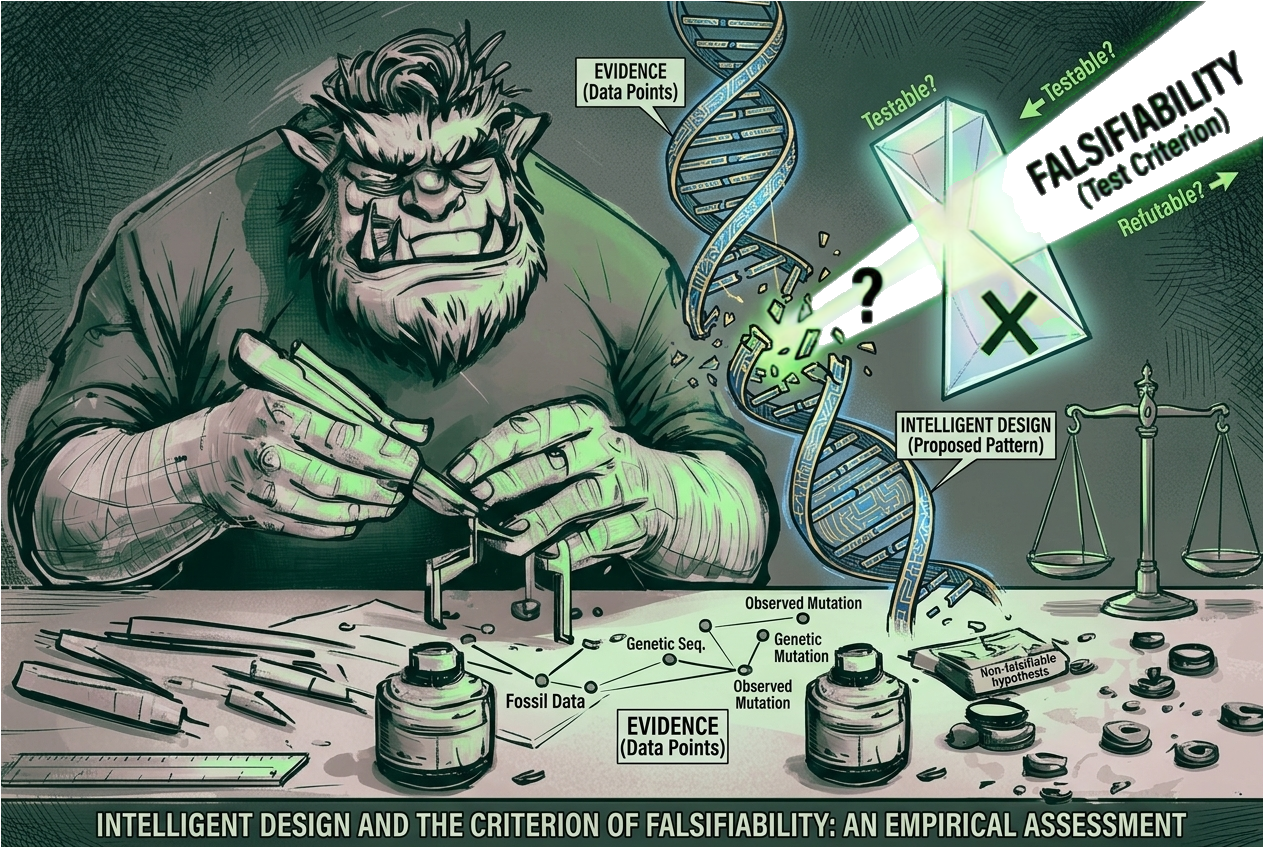
Use these prompts alongside “Five Falsifiable Tests for Intelligent Design: An Introductory Guide for Theology 101.” The goal is to help first‑year students practice careful reasoning at the science–theology boundary without collapsing one domain into the other.
A. Framing the Conversation
- Terms and Boundaries:
In your own words, distinguish methodological naturalism (a rule of scientific method) from metaphysical naturalism (a worldview claim). Where might a theology student accept the first while rejecting the second? What practical consequences follow in classroom and church settings? - What Counts as “Design”?
List three meanings of the word “design” you’ve encountered (e.g., teleology in philosophy, engineering design, divine providence). For each, say whether it makes a testable prediction in the lab. If not, how might it still be theologically meaningful? - Falsifiability as Intellectual Virtue:
Explain why scientists insist on risky predictions that could fail. Give an example from any discipline where a bold, preregistered prediction changed minds. How might this intellectual habit serve theology as a discipline concerned with truthfulness?
B. Working With the Five Tests
- Irreducible Complexity:
The claim is “no selectable intermediates exist” for a given system. What specific kind of evidence would weaken your confidence in that claim? What would strengthen it? Sketch a fair experimental design you would accept from either side. - Complex Specified Information (CSI):
Before running experiments, how would you operationalize CSI in a way that a skeptical biologist could sign off on? Propose a threshold, a measurement procedure, and a rule for calling the test for or against ID without changing definitions afterward. - Fossils and “Abrupt Appearance”:
Imagine two future discoveries: A) a cache of clear transitional forms; B) a large, persistently empty interval (“gap”) after intensive sampling. Explain how each would update your view. What degree of absence counts as evidence, and when is it just incomplete search? - Hard Ceilings on Innovation:
If ID proposes specific ceilings, what are the virtues and risks of naming them publicly in advance? Design a simple, preregistered “ceiling” test using either protein evolution, gene regulatory networks, or developmental modules. - Design Signature Classifier:
Draft the outline of a blinded classification challenge. What datasets count as “designed”? What counts as “evolved”? How will you prevent overfitting? State beforehand what accuracy would persuade you that a signature exists.
C. Philosophy-of-Science Skills
- Explaining vs. Re‑labeling:
When does “the designer intended it” function as an explanation, and when does it merely re‑label what we don’t yet understand? Offer criteria for telling the difference in real cases. - Inference to the Best Explanation (IBE):
Choose a biological case study. Compare three competing explanations and rank them using IBE criteria: scope, simplicity, consilience, predictive success, and independent testability. Which explanation wins and why? - Burden of Proof and Asymmetry:
Discuss how the burden of proof works in science. Does a critique of evolution automatically count as evidence for design, or do design claims bear their own positive evidential load? Give reasons.
D. Theology in Good Faith
- Theology Without Overreach:
Write a short paragraph articulating a theologically rich account of creation, providence, or meaning that does not ask the lab to certify metaphysical conclusions. What makes your paragraph responsibly theological rather than pseudo‑scientific? - Intellectual Hospitality:
Select one ID claim and one mainstream evolutionary claim. For each, state the strongest version and the key test that could change your mind. Why is being explicit about “what would change my mind” a virtue in both theology and science? - Pastoral and Pedagogical Stakes:
If you were mentoring high‑school students, how would you help them appreciate both rigorous science and serious theology without turning either into a caricature? Draft three sentences you would actually say.
E. Practice Exercises
- Preregistration Drill:
Take one of the five tests and write a one‑page preregistration: mechanism, conditions, predicted outcome, pass/fail criteria, and how you will handle ambiguous results. Bring it to seminar and trade for peer review. - Blind Review Thought Experiment:
Imagine you are given two papers, one ID‑leaning and one evolution‑leaning, with author names removed. What features of method, data, and risk would you use to judge quality without knowing the author’s stance? - Map the Dialogue:
Create a one‑page map showing where science properly speaks, where theology properly speaks, and where philosophical mediation is needed. Place common claims from the ID debate onto that map and justify each placement.
F. Reflection
- Humility Statement:
Write a brief statement (150–200 words) acknowledging one aspect of this topic you understand better now and one open question you’ll keep. How will you seek better sources and fair‑minded interlocutors? - Public Communication:
Draft a short, jargon‑free paragraph you would post for a general audience explaining why falsifiability matters and why theology still has profound work to do even when it isn’t running lab experiments. - Your Best Next Question:
End with one concrete, testable question you would pose to either an ID researcher or an evolutionary biologist. What result would move you most, and how would you update your view accordingly?
Instructor Tips
- Encourage students to commit to specific pre‑class positions on one question, then revisit those positions after discussion to model intellectual growth.
- Use structured debate with role‑reversal: ask ID‑sympathetic students to defend a mainstream test design and vice versa, to cultivate charity and rigor.
- Assess not by which “side” students prefer but by clarity of definitions, testability of proposals, and fairness to opposing evidence.

Leave a Reply