
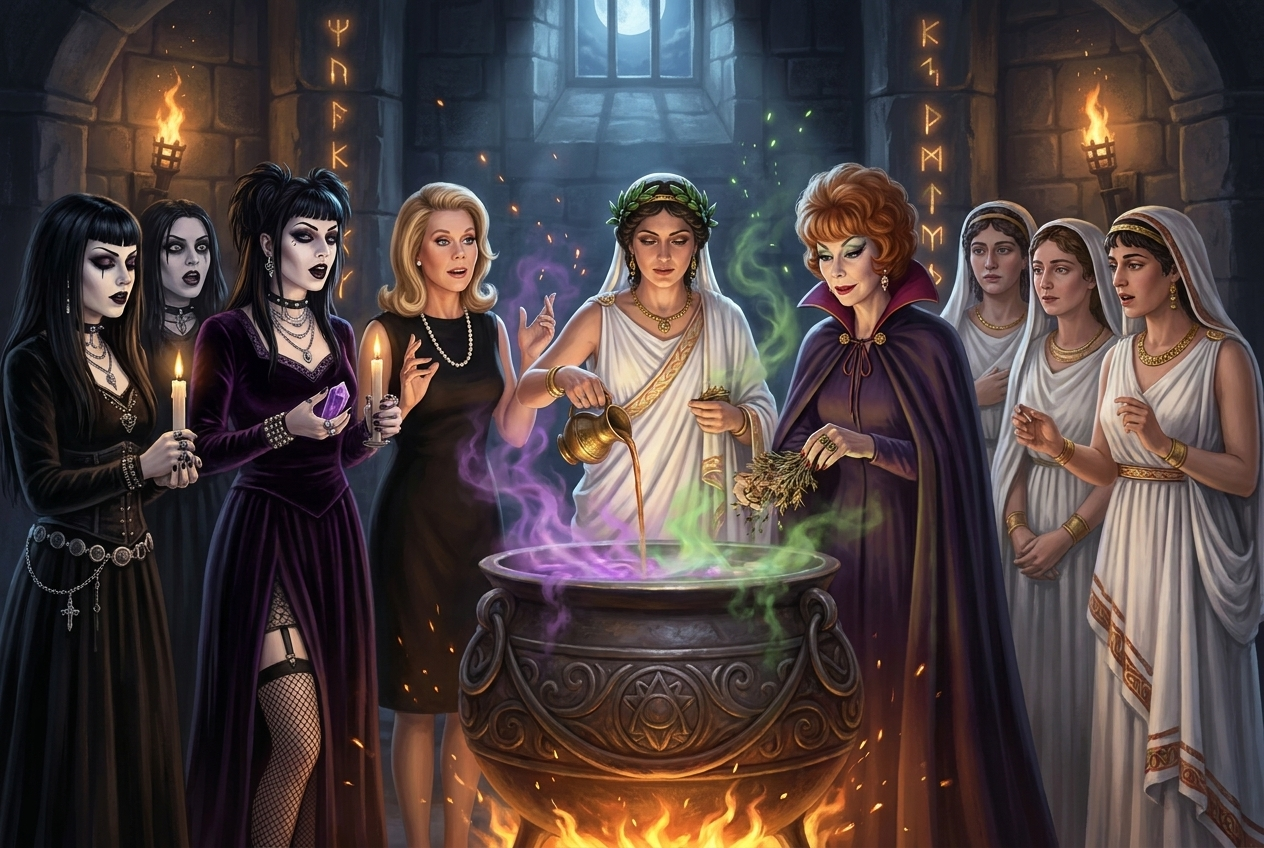
From Bronze Age Spells to Modern Revival
I live in a region where moss grows over everything, including ideas, and that feels like the right place to think about witchcraft, magic, and Christianity. These are not cleanly separated traditions. They are layered practices, arguments, and anxieties that have been talking to each other for thousands of years. In Western culture, magic does not begin as rebellion against religion. It begins as technique, survival, and negotiation with a world that refuses to explain itself.
The earliest evidence for what we now call witchcraft appears in Bronze Age societies as written action rather than belief. Mesopotamian tablets record spells for protection, healing, and curse removal alongside legal codes and hymns (Bottéro, Religion in Ancient Mesopotamia, 2001). These texts treat magic as practical knowledge. Curse tablets, ritual instructions, and incantations were tools used by specialists and laypeople alike, not marks of heresy.
Across the eastern Mediterranean, similar practices appear in Canaanite and early Israelite contexts. Biblical texts themselves preserve traces of this world. The Hebrew Bible condemns sorcery, necromancy, and divination, yet those prohibitions only make sense in cultures where such practices were common (Deuteronomy 18). Archaeology confirms this overlap. Amulets, household figurines, and inscriptions suggest everyday ritual practice operating alongside formal Yahwism (Keel, Goddesses and Images of God, 1998).
Iron Age Anatolia and Greece expand the picture. Hittite ritual texts describe elaborate magical procedures for healing and state protection. Greek culture systematizes magic through curse tablets, love spells, and theurgical writings preserved in the Greek Magical Papyri (Betz, The Greek Magical Papyri in Translation, 1986). These spells often invoke gods, daemons, and cosmic forces without any sense of contradiction. Religion and magic are not opposites here. They are adjacent technologies.
Roman culture inherits and normalizes this adjacency. Latin curse tablets appear in courts, bathhouses, and temples. Magic is regulated rather than eradicated, policed when it threatens state power rather than cosmology (Graf, Magic in the Ancient World, 1997). This is the world early Christianity emerges into, and it matters. Christianity does not arrive to a blank slate. It arrives to a crowded ritual marketplace.
Early Christianity draws a sharp rhetorical line between legitimate divine power and illicit magic, but the practices blur on the ground. Healing, exorcism, relic veneration, and prayer for intervention mirror earlier magical aims while rebranding authority (Aune, Apocalypticism, Prophecy, and Magic, 2006). The Acts of the Apostles condemns sorcerers even as it presents miraculous acts that look indistinguishable to outsiders. The distinction is not functional. It is jurisdictional.
By the medieval period, this jurisdiction hardens. Christian ritual becomes institutional magic with paperwork. Blessings, sacraments, holy water, and sanctioned miracles coexist with fierce condemnation of unsanctioned spellwork. Witchcraft becomes less about practice and more about control, especially where social anxiety, gender, and authority intersect (Levack, The Witch-Hunt in Early Modern Europe, 2016). The irony is that much of what is condemned mirrors church ritual stripped of approval.
Early industrial Europe intensifies the split. Science claims explanatory territory. Christianity retreats to moral authority. Witchcraft is recast as superstition, fraud, or pathology. Yet folk magic persists quietly in charms, healers, and household rituals, especially among the poor and marginalized. Suppression does not eliminate practice. It drives it underground.
The modern resurgence of witchcraft is not a return to antiquity but a remix. Contemporary paganism, Wicca, and occult revival draw selectively from ancient sources, medieval folklore, and non-Western traditions filtered through colonial contact. African, Indigenous American, and Asian practices influence Western magic through diaspora and reinterpretation, though this essay stays grounded in Western trajectories (Hutton, The Triumph of the Moon, 1999).
What fascinates me is not whether magic works, but why it keeps reappearing. Magic thrives where institutions fail to address uncertainty, injustice, or agency. Christianity’s long battle with witchcraft reveals less about truth than about power. The same tension persists today, as ritual, belief, and identity are renegotiated in digital spaces.
Looking forward, the question is not whether magic or religion will disappear. It is how authority will be negotiated when meaning fragments further. Algorithms already perform divination. Data functions as prophecy. The old questions remain, just wearing better interfaces. Western culture will keep arguing about magic because it keeps arguing about who gets to name reality.
References
- Bottéro, Jean. Religion in Ancient Mesopotamia. University of Chicago Press, 2001.
- Keel, Othmar. Goddesses and Images of God in Ancient Israel. Fortress Press, 1998.
- Betz, Hans Dieter (ed.). The Greek Magical Papyri in Translation. University of Chicago Press, 1986.
- Graf, Fritz. Magic in the Ancient World. Harvard University Press, 1997.
- Aune, David. Apocalypticism, Prophecy, and Magic in Early Christianity. Baker Academic, 2006.
- Levack, Brian P. The Witch-Hunt in Early Modern Europe. Routledge, 2016.
- Hutton, Ronald. The Triumph of the Moon. Oxford University Press, 1999.

Leave a Reply