
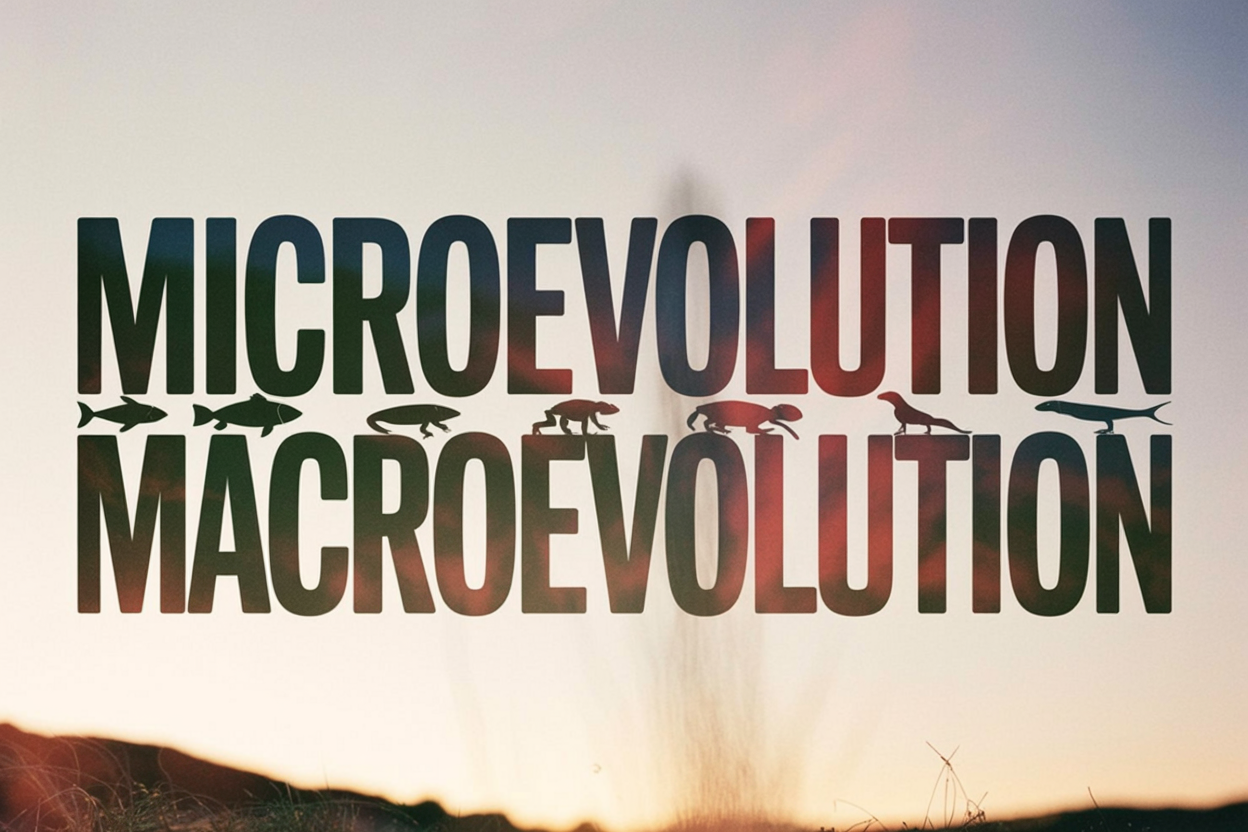
Ok, something short today, something I see all the time, and something I’ve seen a lot more frequently… like someone put out a trendy YouTube video to which the gullible flocked.
The first time someone tried to explain microevolution and macroevolution to me, they drew a line in the air with their hand. Below the line, change was real, observable, respectable. Above the line, things got suspicious. New species, new forms, big changes. The hand hesitated. Something different was supposed to happen up there. Something extra. I remember thinking the line looked flimsy, like tape holding together a broken explanation.
Here’s the quiet part most people never hear in that conversation. Biologists do not use the terms microevolution and macroevolution the way they’re usually presented. Not as two mechanisms. Not as two tiers of reality. The language comes not from evolutionary biology, but from creationist apologetics in the early twentieth century, especially as a way to concede small changes while denying large ones (Numbers, The Creationists, 2006). It was a rhetorical move, not a scientific discovery.
The history of the split is less scientific genealogy and more rhetorical repurposing. The words microevolution and macroevolution did exist earlier, but not in the way they’re used now. Early evolutionary biologists like Dobzhansky used “microevolution” descriptively to talk about population-level change, and Simpson used “macroevolution” to describe large-scale patterns across deep time, not different mechanisms, not different rules, just scale and tempo (Dobzhansky, Genetics and the Origin of Species, 1937; Simpson, Tempo and Mode in Evolution, 1944). Those terms were never meant to be separable domains. They were bookkeeping shorthand. Creationist apologetics lifted the vocabulary and stripped it of context.
That repurposing solidified in the mid‑twentieth century with figures like George McCready Price and later Henry Morris, who needed a way to concede observable change while walling off common ancestry. The move becomes explicit with Whitcomb and Morris’s The Genesis Flood, which popularized the idea that “microevolution” was real and acceptable while “macroevolution” was speculative and unproven (Whitcomb and Morris, The Genesis Flood, 1961). From there it spread institutionally. The Institute for Creation Research and later Answers in Genesis adopted the language wholesale, teaching generations that evolution comes in two kinds and only one counts (Numbers, The Creationists, 2006; Scott, Evolution vs. Creationism, 2009). The distinction stuck not because it explained biology better, but because it offered a stable rhetorical compromise.
What’s striking is how little agreement exists even within that framework. One organization will label speciation as microevolution, another will quietly reclassify it as macroevolution when it becomes inconvenient. Ring species slide back and forth across the boundary. Polyploidy in plants gets waved through one door and slammed shut at another. The criteria shift because the goal isn’t consistency. It’s containment. The split survives by being flexible enough to protect a conclusion, not rigid enough to describe a process. And that’s the tell. When a distinction has to keep moving to stay intact, it isn’t tracking nature. It’s tracking anxiety.
The goal was simple. Divide evolution into a harmless version you can see and a dangerous version you can’t. Accept finches changing beak size. Reject common ancestry. Accept antibiotic resistance. Reject speciation. The problem is that even proponents of the split can’t agree where the boundary lies. Is speciation micro or macro. What about ring species. What about polyploidy in plants. What about chromosomal rearrangements. The line keeps moving because it was never anchored to a mechanism in the first place.
Actual evolutionary biology doesn’t recognize two kinds of evolution because there is only one process operating across time. Mutation introduces variation. Selection filters it. Drift shuffles it. Gene flow redistributes it. Given enough generations, small changes accumulate into large ones. Not by crossing a threshold, but by continuing (Futuyma, Evolution, 2013). There is no moment where microevolution turns into macroevolution like a caterpillar into a butterfly. That metaphor belongs to misunderstanding, not biology.
The analogy I keep coming back to is walking. No one argues that walking across your living room is real movement, but walking from Seattle to Portland requires a different force called macromotion. It’s the same act repeated. Distance is not a mechanism. Time is not a switch. Scale doesn’t add magic.
Historically, the terms gain traction because they sound scientific while doing theological work. They allow someone to say “I accept evolution” while quietly redefining it into something evolution no longer is. That’s not skepticism. That’s boundary maintenance (Scott, Evolution vs. Creationism, 2009). The distinction survives because it feels intuitive. Small changes feel safe. Big changes feel threatening. Biology does not care how safe a conclusion feels.
There’s also a philosophical weakness baked into the split. It assumes that qualitative difference requires qualitative causes. That new forms require new rules. But this is exactly the mistake science has spent centuries unlearning. Heat is molecular motion. Pressure is particle collisions. Weather is fluid dynamics scaled up. No extra ingredient appears when clouds form. Complexity emerges because systems persist, not because laws change (Mayr, What Evolution Is, 2001).
Here’s the humorous rebuttal I usually offer. If microevolution is real but macroevolution isn’t, then erosion can make pebbles but not mountains. Rain can wear grooves but never carve a canyon. You can save pennies but never have a dollar. At some point the argument starts sounding like someone insisting that stairs are real but floors are a conspiracy.
And here’s the clean one. There is no proposed mechanism in biology that operates at the micro level and shuts off at the macro level. Every documented large-scale evolutionary pattern is composed of the same small-scale processes observed directly. Denying that accumulation is not scientific caution. It’s arithmetic denial.
What’s fascinating to me is how durable the language is, even after it’s been dismantled repeatedly. That durability has nothing to do with evidence. It has everything to do with how people want the world arranged. Two tiers feel manageable. One continuous process doesn’t offer a stopping point.
But evolution doesn’t stop where comfort begins. It doesn’t recognize hand-drawn lines in the air. It just keeps walking.
References
- Futuyma, Douglas J. Evolution. 2013.
- Mayr, Ernst. What Evolution Is. 2001.
- Numbers, Ronald L. The Creationists. 2006.
- Scott, Eugenie C. Evolution vs. Creationism. 2009.
- Dobzhansky, Theodosius. Genetics and the Origin of Species. 1937.
- Simpson, George Gaylord. Tempo and Mode in Evolution. 1944.

Leave a Reply