
These two papers landed in my feed a few days apart. One from Nature Geoscience, one from SciTechDaily summarizing it. That’s usually how it happens. I keep a running feed across disciplines because cross‑pollination is where the real work happens. You don’t go looking for ocean dynamics or neural operators or satellite telemetry in isolation. You let them collide. I learned that the hard way years ago when I was pulled into a NOAA study looking at Pacific wave structures, back before we called it AI. We were using early distributed systems, map‑reduce pipelines stitched together to process satellite and buoy data, trying to extract pattern from noise without the luxury of models that could infer structure. It was brute force pattern recognition. Useful, but blunt.
So when I read the GOFLOW work, it clicked immediately. Same problem. Completely different toolset.
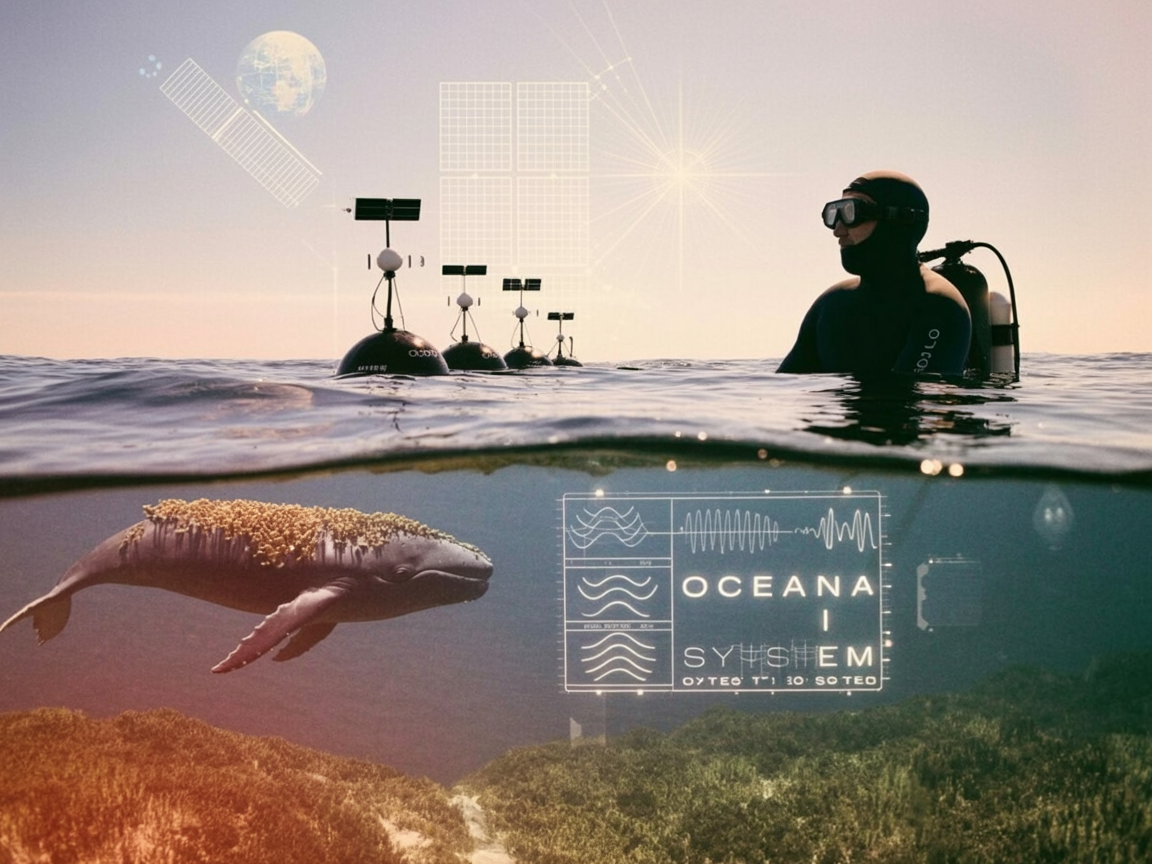
The starting point is deceptively simple. Ocean currents matter at scales we can’t observe cleanly. The small, fast, submesoscale structures where vertical mixing happens have been effectively invisible, either smeared out over ten‑day satellite cycles or captured locally by ships. That left a gap in the actual machinery of climate, carbon exchange, and ecosystem dynamics (Lenain et al., An unprecedented view of ocean currents, 2026). The GOFLOW system closes that gap not by launching new instruments, but by reinterpreting what we already have. It takes continuous thermal imagery from geostationary weather satellites and uses deep learning to reconstruct surface velocity fields at hourly resolution (Lenain et al., An unprecedented view of ocean currents, 2026; SciTechDaily, Hidden Ocean Currents Revealed, 2026).
That shift is not cosmetic. It’s ontological. We go from inference to observation. From fragments to flow.
The method itself is worth sitting with for a minute. Instead of relying on simplified physical balances, like geostrophy, the model learns how temperature gradients evolve over time. It watches how patterns bend, shear, stretch. The structure is embedded in the time series, not in a predefined equation. You train against known measurements, validate with shipboard data, and then let the model reconstruct what you could not directly measure (Technology Networks, New AI Approach, 2026). It is less a prediction engine than a reconstruction instrument.
That distinction matters because this is not the same AI most people interact with. Commercial AI is optimized for engagement, completion, and plausibility. It operates in a regime where being useful often means being convincing. Scientific AI works under a different constraint. It must match physical reality, or it is discarded. The architecture reflects that. You see deep learning systems anchored to observational ground truth, hybrid models that embed physical constraints, neural operators that approximate governing equations rather than bypass them. The goal is not to generate. It is to reveal.
I’ve noticed, thinking back to that NOAA work, how much of our effort went into managing limitations. Sparse data. Slow revisit times. Incomplete coverage. The GOFLOW approach doesn’t eliminate those constraints. It reinterprets them. Instead of waiting for a measurement, it reconstructs motion from continuity. Instead of treating missing data as absence, it treats it as latent structure. There is something almost uncomfortable about that. It feels like cheating, until you realize it is closer to recovering information that was always there but inaccessible.
And the applications stack quickly. Climate modeling gets tighter because vertical mixing is no longer a blind parameter. Carbon transport estimates become less speculative. Marine ecosystems can be monitored at the scale where nutrients actually move. Even operational tasks like oil spill tracking or search and rescue shift from probabilistic drift models to something closer to real‑time mapping (ScienceDaily, AI Just Revealed Ocean Currents, 2026). Each of those is a reduction in uncertainty, and uncertainty is where bad decisions hide.
But there’s a cost buried here that people keep circling and not quite naming. It’s not just compute or energy or data pipelines. It’s epistemic dependence. When the model becomes the way you see the system, what happens when it’s wrong in ways you don’t recognize? These systems are validated against known data, but they are most valuable exactly where data is sparse. That’s the trade. You gain visibility where you had none, but you rely on a reconstruction you cannot fully interrogate.
We’ve seen this pattern elsewhere. AlphaFold compresses protein folding into something tractable. Climate emulators reduce massive simulations into fast approximations. Neural ocean models can run orders of magnitude faster than traditional numerical solvers. Each time, you gain speed and coverage. Each time, you risk hiding assumptions inside the model itself.
I keep thinking about how often science fiction got this almost right. Not the loud versions with rogue AI, but the quieter ones where systems reveal patterns humans couldn’t see and the problem becomes interpretation. The alien language in Arrival. The probabilistic modeling in Foundation. Even the systems in The Three‑Body Problem that translate chaos into something navigable. These aren’t fantasies about intelligence. They’re about access to structure.
So the real question isn’t whether this use of AI is beneficial. It clearly is. The question is sharper. What happens if we don’t use it?
The ocean doesn’t pause while we debate architectures. Carbon still moves. Systems still destabilize. Decisions still get made with incomplete information. The cost of building and running these models is measurable. The cost of not seeing what they reveal is harder to quantify, but it’s not zero.
I think back to those early NOAA pipelines, the frustration of knowing there was structure in the data we couldn’t extract. We were limited by the tools we had. That limitation felt natural at the time. It wasn’t. It was contingent.
So now the choice isn’t between clean, classical science and messy AI augmentation. That choice already collapsed. The choice is whether we accept a new class of instrument, with all its opacity and power, or pretend the blind spots are acceptable.
I don’t think they are.
But I also don’t think we get this for free.
References
- Lenain, L., Srinivasan, K., Barkan, R., & Pizzo, N. An unprecedented view of ocean currents from geostationary satellites. Nature Geoscience, 2026.
- SciTechDaily. Hidden Ocean Currents Revealed in Stunning Detail by AI, 2026.
- ScienceDaily. AI Just Revealed Ocean Currents We’ve Never Been Able to See, 2026.
- Technology Networks. New AI Approach Reveals Ocean Currents in Unprecedented Detail, 2026.

Leave a Reply