
Why Hybrid Energy Harvesting Thrives on Clouds, Rain, and Leftover Motion
I came across the SciTechDaily piece the way I come across a lot of energy news now: scrolling on my phone while my car was charging in the driveway, rain tapping the roof, inverter quietly doing its thing. The headline about a solar panel that generates power from both sunlight and raindrops felt almost tailored to my latitude and my mood (SciTechDaily, This Breakthrough Solar Panel, 2025). If you live somewhere dry and bright, rain is a nuisance. If you live where I do, rain is just another ambient condition, like moss. The idea that it might be doing useful work instead of just darkening the sky is hard not to like.
The article frames the work as a kind of weather‑proof upgrade to solar, a panel that refuses to go idle just because clouds roll in. That framing isn’t wrong, but it glosses over what the researchers actually built and why it matters. The underlying paper is far more careful, and far more interesting, precisely because it does not pretend this is a replacement for conventional generation (Núñez‑Gálvez et al., Nano Energy, 2026).
What’s being demonstrated is a hybrid energy harvester that layers two fundamentally different mechanisms on the same physical platform. One is a perovskite solar cell, efficient under diffuse and low‑intensity light, which already makes it attractive for cloudy regions. The other is a drop‑driven triboelectric nanogenerator that converts the mechanical interaction between raindrops and a fluorinated surface into electrical pulses. The clever part is the interface. A thin CFₓ plasma polymer layer acts simultaneously as a moisture barrier for the perovskite and as the active triboelectric surface. That dual role is the real breakthrough.
When you compare this approach to wind‑solar hybrids, the contrast is instructive. Wind‑solar systems work because their production profiles are anticorrelated at large scales. Wind often peaks at night or during storms when solar is low. Solar peaks during calm, clear days when wind may slacken. The hybridization happens at the system level, through shared inverters, grid connections, and storage assets. The devices remain separate, and the gains come from statistical smoothing.
Rain‑solar hybrids operate at the opposite extreme. The energy contribution from rain is tiny compared to solar. No one serious thinks raindrops are going to meaningfully boost household kilowatt‑hours. What they do offer is temporal continuity and functional resilience. The system keeps doing something when solar output drops, even if that something is modest. It’s the difference between a system going dark and one staying alive.
That difference matters most for energy storage. Large wind‑solar hybrids rely heavily on batteries, pumped hydro, or grid‑scale balancing to manage variability. They produce lots of energy when conditions are right and then store or export it. Rain‑solar hybrids shift the emphasis. The triboelectric output is high voltage, low current, intermittent. It is poorly suited to bulk storage but well suited to trickle charging, waking systems up, topping off capacitors, or powering sensors that would otherwise need oversized batteries. In the paper, this shows up in the ability to charge capacitors and run LEDs using simple boost converters, even under half‑sun illumination and periodic dripping (Núñez‑Gálvez et al., Nano Energy, 2026).
From a systems perspective, that means hybrid harvesting like this reduces storage demands at the margins. It does not replace batteries, but it can shrink them. Devices can survive longer between charge cycles. Sensors can remain deployed without maintenance. In places where sending a technician is expensive or dangerous, that matters more than raw efficiency.
There are limits, and they’re worth stating plainly. Triboelectric generators produce spiky, location‑dependent output. The power depends on droplet size, impact position, surface charge saturation, and water chemistry. Scaling them up introduces uniformity problems. The perovskite cells, while far more stable here than in older designs, still degrade under combined heat, oxygen, and humidity over long timescales. Even with encapsulation, this is not yet a twenty‑year rooftop technology. The authors themselves describe the system as a proof of concept and outline the remaining materials and circuit challenges without hedging (Núñez‑Gálvez et al., Nano Energy, 2026).
This is where the comparison to wind‑solar hybrids clarifies expectations. Wind‑solar hybrids are infrastructure solutions. They change how grids operate. Rain‑solar hybrids are device‑level solutions. They change how individual systems survive and adapt. Confusing the two leads to disappointment. Understanding the difference opens up better questions.
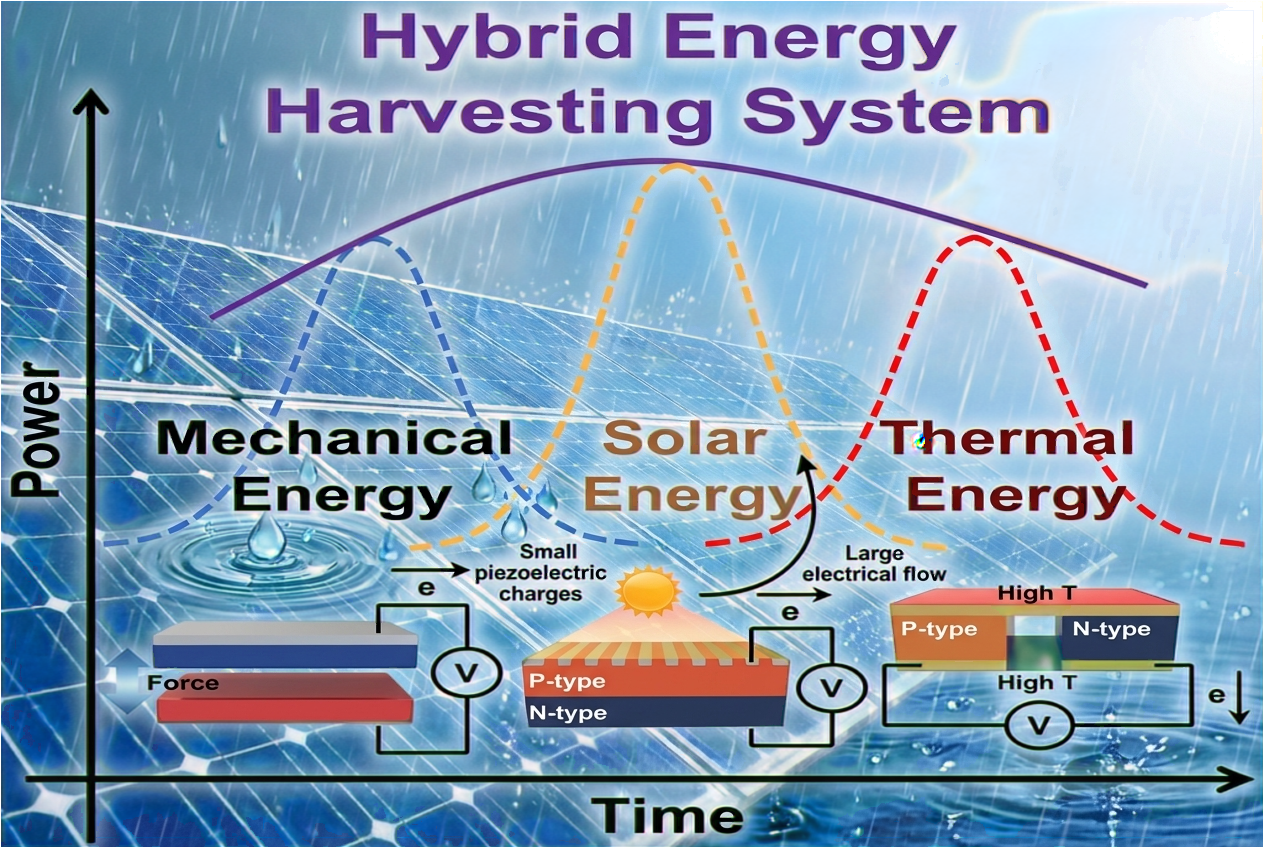
Hybrid energy harvesting, more broadly, is moving in this direction. Solar paired with thermoelectrics to scavenge waste heat. Solar paired with vibration harvesters on bridges and rail lines. Even biological hybrids where microbial fuel cells complement photovoltaics in wastewater treatment. None of these systems win on watts alone. They win on availability and persistence (Wang et al., Matter, 2021).
Thermoelectrics are a good example of this quieter kind of hybrid thinking. They don’t generate power from heat in the dramatic way people imagine turbines and steam. They scavenge temperature differences. A thermoelectric device produces electricity when one side is warmer than the other, even if that difference is small. Waste heat leaking from industrial equipment, the back side of a solar panel warming in the sun, a pipeline running through cold air. None of that heat is useful enough to justify a power plant, but it is useful enough to refuse being wasted.
That matters because heat gradients are everywhere and almost always ignored. In a hybrid system, thermoelectrics don’t compete with solar. They parasitize its inefficiencies. Every photon that turns into heat instead of electricity becomes another input. The power is modest, often measured in microwatts or milliwatts, but it is steady, predictable, and silent. In places where maintenance is expensive or failure is unacceptable, that steadiness carries weight.
Vibration harvesters follow a similar logic, but their source is motion rather than heat. Any structure that flexes, rattles, or hums can be persuaded to give up a little energy. Bridges under traffic. Rail lines. Industrial machinery. Even fences that sway in wind or shudder when a truck passes. Piezoelectric and electromagnetic vibration harvesters convert that mechanical stress into electrical charge, again at low power but high reliability.
I find fence slats especially telling. They’re mundane, overlooked, and everywhere. A fence alongside a highway vibrates constantly, not violently, but persistently. A row of vibration harvesters embedded along that fence could power environmental sensors, cameras, or communication relays indefinitely. Roadside collectors harvesting vibration and pressure from passing vehicles operate on the same principle. No one notices them working. That’s the point.
What ties thermoelectrics and vibration harvesters to rain‑solar hybrids is not output. It’s posture. These technologies assume the environment is already doing useful work and ask how little engineering is required to listen in. They don’t demand ideal conditions. They thrive on leftovers. Hybrid energy harvesting stops treating inefficiency as loss and starts treating it as opportunity.
As a solar advocate who now lives with panels overhead and an EV in the driveway, I’ve learned that the future of energy isn’t just about making more power. It’s about wasting less opportunity. Clouds, rain, vibration, heat. These are not failures of solar. They’re inputs we haven’t fully learned to listen to yet.
As a solar advocate who now lives with panels overhead and an EV in the driveway, I’ve learned that the future of energy isn’t just about making more power. It’s about wasting less opportunity. Clouds, rain, vibration, heat. These are not failures of solar. They’re inputs we haven’t fully learned to listen to yet.
The SciTechDaily headline caught my attention because it spoke the language of where I live. The paper earned my respect because it didn’t oversell the idea. Hybrid energy harvesting like this won’t replace wind farms or solar arrays. But it will quietly make systems tougher, smarter, and harder to kill. In a wet, gray world, that’s not a bad direction to head.
References
- SciTechDaily. This Breakthrough Solar Panel Generates Power From Both Sunlight and Raindrops. 2025.
- Anton, Steven R.; Sodano, Henry A. A review of power harvesting using piezoelectric materials. Smart Materials and Structures, 2007.
- Beeby, Steve P.; Tudor, Mike J.; White, Neil M. Energy harvesting vibration sources for microsystems applications. Measurement Science and Technology, 2006.
- Bell, Lon E. Cooling, Heating, Generating Power, and Recovering Waste Heat with Thermoelectric Systems. Science, 2008.
- Champier, Daniel. Thermoelectric generators: A review of applications. Energy Conversion and Management, 2017.
- Erturk, Alper; Inman, Daniel J. Piezoelectric Energy Harvesting. Wiley, 2011.
- Núñez‑Gálvez, F. et al. Water‑Resistant Hybrid Perovskite Solar Cell–Drop Triboelectric Energy Harvester. Nano Energy, 2026.
- Paradiso, Joseph A.; Starner, Thad. Energy scavenging for mobile and wireless electronics.
IEEE Pervasive Computing, 2005. - Priya, Shashank; Inman, Daniel J. (eds.) Energy Harvesting Technologies. Springer, 2009.
- Roundy, Shad; Wright, Paul K.; Rabaey, Jan. A study of low level vibrations as a power source for wireless sensor nodes. Computer Communications, 2003.
- Rowe, D. M. (ed.) Thermoelectrics Handbook: Macro to Nano. CRC Press, 2005.
- Snyder, G. Jeffrey; Toberer, Eric S. Complex thermoelectric materials. Nature Materials, 2008.
- Wang, Z. L. et al. Hybrid Energy‑Harvesting Systems Based on Triboelectric Nanogenerators. Matter, 2021.

Leave a Reply