
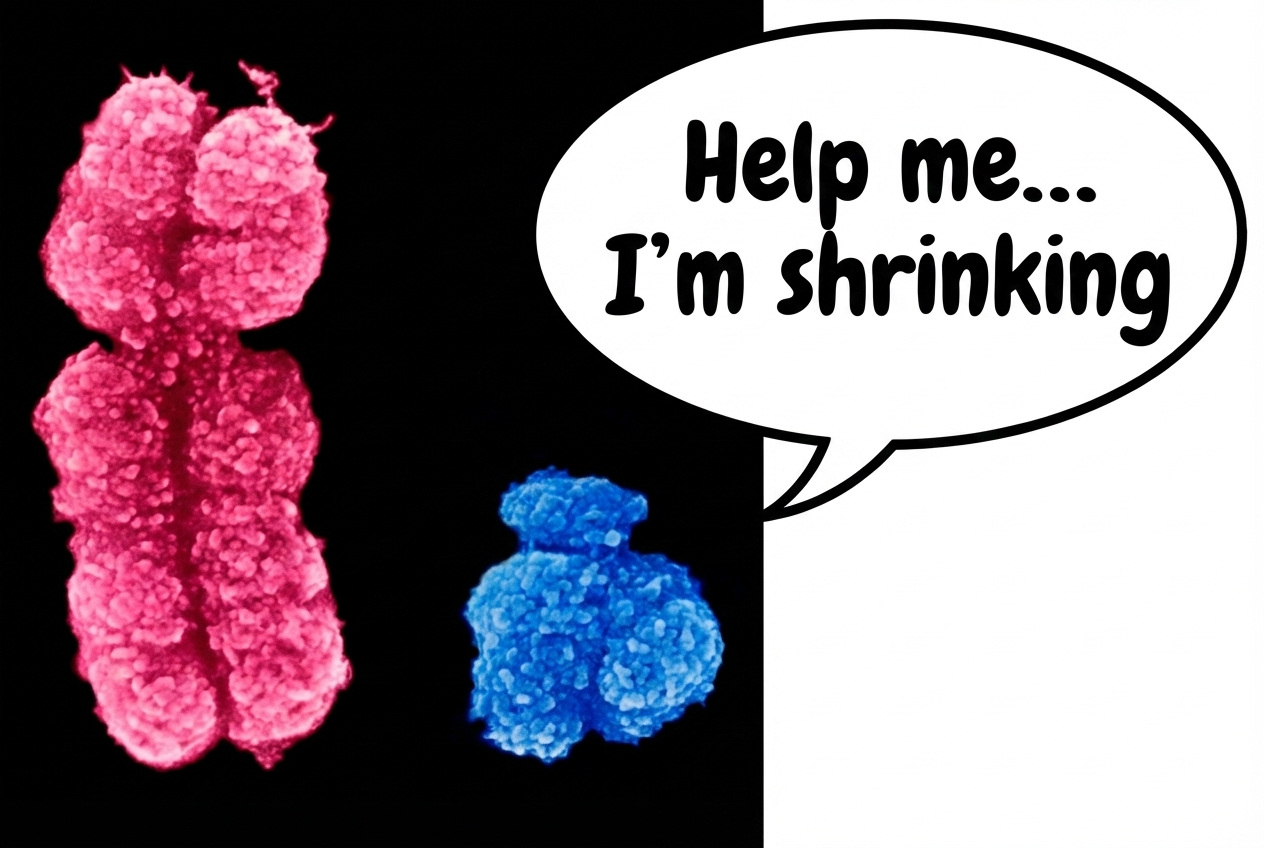
Somewhere between a headline and a punchline lives the claim that humans are slowly losing the Y chromosome and may need an alternative sex‑determination mechanism. I first heard it the way many people do, over drip coffee and Wi‑Fi, delivered with the tone reserved for half‑remembered apocalypse facts. Men are going extinct. Biology is broken. Stand by for Phase Two. The confidence is impressive. The evidence, less so.
The actual science is quieter and more interesting. The human Y chromosome really has shrunk over evolutionary time. Compared to its ancestral partner, it has lost genes, streamlined itself, and specialized hard into testis determination and sperm production. This much is well established. Comparative genomics shows that the Y has shed most of its original gene content since diverging from the X around 180 million years ago (Graves, “Sex Chromosome Specialization,” 2006). But shrinkage is not disappearance, and extrapolating a straight line from past loss to future extinction is narrative math, not evolutionary biology.
The modern Y is not passively eroding. It has evolved mechanisms to preserve itself, including palindromic repeats that allow internal gene repair through gene conversion. Hughes and colleagues showed that human and chimp Y chromosomes have conserved core structures for millions of years, undermining claims of imminent collapse (Hughes et al., “Chimpanzee and Human Y Chromosomes,” 2012). Bachtrog’s broader work on sex chromosome evolution points in the same direction. Degeneration happens early, stabilization follows, and the outcome is persistence, not vanishing (Bachtrog, “Evolution of Sex Chromosomes,” 2013).
The rhetorical trick comes from treating evolution like a leaky faucet. If something has been shrinking, it must keep shrinking, until one day it disappears in a sad drip. That is unfalsifiable storytelling dressed up as trend analysis. Evolution does not owe anyone linearity. It certainly does not read op‑eds.
What follows is usually framed as apocalypse, but apocalypse is just a failure of imagination with better branding. Science fiction learned this a long time ago. Tiptree loved to ask what happens when an assumed necessity quietly exits stage left and leaves everyone blinking in the new light. Le Guin went further and treated difference not as loss but as a change in grammar. Remove one clause, adjust the syntax, and the sentence still parses. Pamela Sargent’s worlds did not collapse without men; they reorganized, redistributed intimacy, and discovered that social complexity is not a monopoly franchise. Charnas, sharper still, treated lineage and memory as technologies, not chromosomes, and asked who gets to hold the switch.
In those stories, reproduction becomes less a biological reflex and more a civic project, like water systems or libraries. Sex determination is solved the way humans solve most problems: awkwardly, locally, with committees, rituals, and arguments that last generations. Some societies vote. Some assign by lottery. Some abandon the binary entirely and treat sex as a developmental phase rather than a destiny. None of this is prophecy. It’s rehearsal. And rehearsal is what science fiction does best: not predicting the future, but testing whether our panic survives contact with a world that simply keeps going.
Still, once the idea escaped the lab, it mutated quickly. If the Y ever did go, the argument runs, humans would need another way to decide sex. This is where the science pauses and the imagination warms up its engines. Since we are already here, I am willing to help future humanity prepare, preferably with peer‑reviewed nonsense.
Below are several abstracts from the rapidly expanding field of Emergency Sex Determination Studies, followed by a provisional timeline of increasingly desperate evolutionary workarounds. Please disregards any negative comments about the effectiveness and plausibility for any of these abstracts.
Abstract 1: Quantum Observer‑Dependent Differentiation
We report evidence that sex differentiation collapses into a stable developmental pathway at the moment of first observation. Prior to this, embryos exist in a superposition of regulatory states. Empirical support is pending replication, funding, and a better grasp of quantum mechanics. Preliminary models suggest outcomes depend strongly on observer expectation. This effect disappears when parents insist they “just want a healthy baby,” producing null results (Schrödinger, “What Is Life?”, 1944, misread badly).
Abstract 2: Midichlorian Threshold Activation
Cellular surveys reveal a previously ignored bioenergetic variable whose concentration spikes unpredictably during early development. When a threshold is crossed, downstream endocrine cascades lock in one of two stable morphologies. Attempts to measure the variable fail unless done by a hooded elder in a stone chamber. Reviewers remain unconvinced but intrigued (Lucas et al., “Unpublished Notes from a Galaxy Far Away,” 1977).
Abstract 3: Electromagnetic Tool‑Affinity Coupling
Developmental pathways correlate with early affinity for interacting with mechanisms of unknown function. Subjects displaying spontaneous confidence toward sealed compartments, unknown switches, or legacy hardware enter Pathway A. Subjects who wait for instructions do not. The causal mechanism is unclear; authors suspect arrogance as an epigenetic factor (Gibson, “Neuromancer,” 1984, applied irresponsibly).
Abstract 4: AI‑Assisted Classification with Persistent Error
A prenatal diagnostic AI assigns sex based on probabilistic modeling trained on obsolete datasets. Once assigned, the label feeds back into development through self‑fulfilling administrative cascades. System logs classify this as user error. Appeals process unavailable (Asimov, “The Evitable Conflict,” 1950, footnotes ignored).
Abstract 5: Thermal Denial Response
Embryos exposed postnatally to suboptimal temperatures trigger a hormonal pathway contingent on sustained insistence that conditions are acceptable. Those who vocalize comfort despite empirical thermostat data activate one suite of gene regulators. Those who request adjustments activate another. This mechanism appears uniquely human (Darwin, “The Expression of the Emotions,” 1872, taken personally).
Abstract 6: Teleportation Buffer Sex Drift
Repeated matter‑stream dematerialization during gestation introduces a consistent one‑bit error in chromosomal reassembly. The buffer resolves ambiguity by selecting the configuration most compatible with transport protocols. Side effects include déjà vu and an unexplained fondness for orange jumpsuits (Roddenberry, Star Trek Technical Manual, 1968, cited with a straight face).
Abstract 7: Narrative Necessity Field Activation
Population‑level modeling indicates that once demographic imbalance threatens narrative plausibility, a background field resolves sex determination in service of story continuity. The mechanism cannot be isolated because it only activates during franchise extensions. Attempts at falsification resulted in a reboot (Campbell, The Hero with a Thousand Faces, 1949, weaponized).
Abstract 8: Vacuum Energy Imprinting Model
Sex determination results from local fluctuations in vacuum energy during a critical developmental window. Measurements remain inconclusive, largely because the vacuum refuses to hold still. Authors suggest the universe may simply be improvising (Weinberg, Dreams of a Final Theory, 1992, misapplied).
Abstract 9: Ancient Alien Failsafe Protocol
A dormant regulatory system embedded in human DNA activates once native sex chromosomes approach functional decay. The protocol selects outcomes based on parameters no longer documented. Archaeological evidence remains circumstantial but deeply confident (Clarke, 2001: A Space Odyssey, 1968, treated as field notes).
Abstract 10: Artificial Gravity Orientation Response
Gestation in rotating habitats induces asymmetric morphogen gradients aligned with centrifugal force vectors. Sex differentiation follows the direction of perceived “down.” Earthborn controls remain confused by the results (O’Neill, The High Frontier, 1976, extrapolated recklessly).
Abstract 11: Chronologically Inverted Determination
Sex is assigned retrocausally by the organism’s future self reaching back through spacetime to resolve uncertainty. Longitudinal studies are impossible for obvious reasons. Funding agency described the proposal as “ambitious” and “deeply unsettling” (Kip Thorne, Black Holes and Time Warps, 1994, nodded at cautiously).
Abstract 12: Self‑Updating Evolutionary Patch
A species‑wide firmware update deploys once legacy hardware becomes unsustainable. The patch installs silently during sleep and cannot be rolled back. Release notes unavailable (Stephenson, Snow Crash, 1992, treated as predictive literature).
None of this, obviously, is science. It is what happens when a speculative claim outruns its evidence and invites myth to do the rest of the work. The Y chromosome story survives because it flatters a certain appetite for tidy doom. It fails because it depends on extrapolation without mechanism and prediction without testability.
If we insist on a timeline, though, it looks like this. First comes misunderstanding, dressed as urgency. Then comes imaginative replacement, borrowed from science fiction without apology. Finally comes cultural codification, where speculation hardens into lore and resists correction. Evolutionary biology is not involved in any of these stages, aside from being waved at occasionally.
I live in a region where glaciers retreat and forests burn, so I understand why shrinkage stories resonate. But biology is not climate change, and chromosomes are not ice sheets. The Y is still here, stubbornly redundant, annoyingly specialized, and deeply uninterested in our metaphors.
The better question is not what replaces it, but why we keep needing it to vanish in our stories. Maybe uncertainty is harder to tolerate than complexity. Maybe absurdity is easier than admitting that evolution does not narrate itself for us. Either way, if humanity ever does need a backup plan, I hope it is peer reviewed, reproducible, and does not depend on midichlorians.
References
Bachtrog, Doris. “Evolution of Sex Chromosomes.” Annual Review of Genetics, 2013.
Darwin, Charles. The Expression of the Emotions in Man and Animals. John Murray, 1872.
Graves, Jennifer A. Marshall. “Sex Chromosome Specialization and Degeneration in Mammals.” Cell, 2006.
Hughes, Jennifer F. et al. “Chimpanzee and Human Y Chromosomes Are Remarkably Divergent in Structure and Gene Content.” Nature, 2012.
Schrödinger, Erwin. What Is Life? Cambridge University Press, 1944.
Asimov, Isaac. “The Evitable Conflict.” Astounding Science Fiction, 1950.
Gibson, William. Neuromancer. Ace, 1984.
Lucas, George et al. Star Wars. 1977.

Leave a Reply